


Work that needs to happen across time zones requires solutions other than desk-side visits. People log in from airports, kitchen tables, and clean rooms, and the work just has to keep moving. For these workers, IT teams are the lifeline that keeps digital tools working and hardware running. But it’s information technology services management, the operating system for support at scale, that aligns teams, tools, and policies so that tickets become outcomes and downtime stays rare.
At the heart of IT service management is remote access software. RealVNC Connect delivers secure, integrated remote access that fits regulated and offline environments. RealVNC HelpDesk handles ad hoc sessions on unmanaged devices. Code Connect provides short-lived, zero-trust style access. The On-Premise Management Console centralizes control for offline estates and keeps data inside your network.
In this guide, we’ll define core concepts, map workflows, and explain how IT services relate to outcomes your business can actually measure. You’ll see practical use cases and best practices for governance, security, and day-to-day operations that support modern business goals.
What Is IT Support Management?

A modern support operation does a lot more than just close tickets. Successful programs manage people, processes, and technology so that distributed users stay productive and data stays protected. The core building blocks of enterprise service management consist of:
- Remote access
- Help desk intake
- Session control
- Identity policy
- Audit logging
- Reporting
- Knowledge management
Teams also need structure, clear roles, and repeatable workflows that work both in the head office and across regions and time zones.
Defining IT Service Management for Enterprise Scale
Enterprises run on service management. In IT, this service management acts as the central point for intake, routing, and communication. There are three paths any given request raised with the IT service desk can take:
- Service Requests (SRs): These are standardized requests for services like installing software, creating an account, resetting a password, and so on. Basically, an SR is any request for something to be done for a user.
- Incident Requests (IRs): These are raised when something breaks or doesn’t work as intended. Incidents are typically assigned a priority, with timers, SLAs, and frameworks in place to make sure they’re resolved within a certain timeframe.
- Change Requests(CRs): Change requests are raised to resolve an IR or SR when a substantial modification of the IT infrastructure is required to facilitate it. CRs are methodically written up and presented to the Change Advisory Board (CAB) or Change Control Board (CCB), where representatives of major IT departments approve or reject the requests.
How VNC and Remote Access Fit the Model
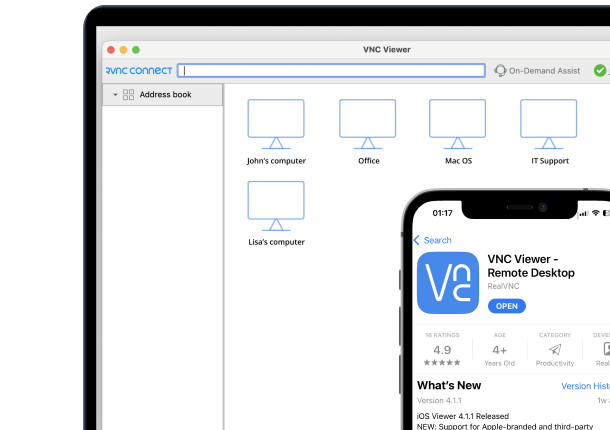
Within service management teams, remote access connects distributed workforces to the same level of support as in-house teams experience. Graphical remote control turns tickets into fixes for team members in the field, remote offices, or halfway across the world.
VNC, or Virtual Network Computing, is what gives technicians live access to troubleshoot incidents quickly and fulfill service requests without users needing to bring devices back to the office. RealVNC, a contributing founder of VNC technology, has improved on the original concept with enterprise-grade features.
RealVNC Connect now anchors remote work for IT service management teams at scale and has become a major facilitator of secure access for more than 60,000 businesses worldwide. The appeal is simple and comes down to consistent control, clear audit trails, and fast resolution for users who want secure connections from everywhere.
ITIL and the Information Technology Infrastructure Library
Scaling works best with clear, teachable rules you can audit. The Information Technology Infrastructure Library (ITIL) remains the most widely adopted framework for repeatable service management processes across modern ITSM frameworks. Core disciplines translate daily work into measurable business objectives. Many leaders reference the ITIL 4 overview to set a shared operating model. ITIL is broken down into the following frameworks:
- Service level management: Define and agree on targets, map SLAs and OLAs, track availability, MTTR, and report outcomes against experience goals that tie directly to business objectives.
- Change management: Manage changes with clear paths for standard, normal, and emergency updates. Include approvals, scheduling, a visible calendar, and clear risk assessment. Pre-approved models reduce delay while protecting stability.
- Problem management: Identify patterns behind the incidents, run root cause analysis, maintain a known error database, and publish workarounds that prevent repeat outages.
- Knowledge management: Capture solutions and record them as articles and runbooks. Review them regularly for accuracy and surface content in the service desk and self-service, so fixes are applied faster across IT teams.
Governance, Control Objectives, and Measurable Business Value
Support organizations have to answer to speed just as much as risk. An IT governance framework defines decision rights, metrics, and control objectives for identity, access, data, and continuity.
A mature and well-established service management system links those policies to daily execution and generates evidence that can be trusted—largely without extensive overviews. Leaders then connect those outcomes to business value and fund work by business priorities. Many IT service management leaders align their departments with the ISACA COBIT framework to keep risk and performance as visible as possible as platforms evolve.
Key Benefits and Use Cases of Remote Access in the IT Operations and Support

Remote access can only pay off when it improves how teams work. The right platform shortens time to resolution, integrates with existing infrastructure and workflows, and keeps support predictable and standardized. RealVNC Connect does exactly that, all while staying friendly to governance, offline setups, and mixed device fleets.
In this section, we’ll be looking at how an enterprise-ready remote access solution benefits IT service management and users alike.
Reduce Downtime and Elevate User Satisfaction
With stakeholders, business objectives, and SLAs all at stake, IT service managers know that speed matters. Remote sessions start quickly, issues get verified immediately on screen, and fixes land fast.
Additionally, when users know their issue can be fixed easily and immediately with good service quality, they’re more likely to call the service desk rather than try to find workarounds known as “shadow IT”.
Fewer service disruptions mean fewer escalations, customer satisfaction, and ultimately a lighter queue.
Regulated and Offline Environments
Some highly regulated and sensitive environments cannot touch the public internet. The RealVNC On-Prem Management Console runs as a local management system with identity-bound access, audit logs, and endpoint visibility so activity stays on your network.
Admins provision individual sign-ins, define the internal gateway address, and view licensed devices in a single list rather than hunting down IPs and trawling through DHCP records. The dashboard tracks license usage, device activeness, and session counts, while audit entries expand details that can be exported to CSV for evidence.
Role-based access keeps support aligned to change windows and the least privilege, following the principles of zero-trust. Programs minimize risk and raise service quality across air-gapped plants, labs, and secure offices.
Businesses that adopt this on-premises remote model over ad hoc find that service delivery improves and becomes consistent in places where connectivity is limited or the use of previous remote access tools is prohibited.
Real-World Patterns
Many business applications suffer from the same field challenges as the users do. The patterns below show how teams can keep moving while staying auditable and safe with remote access solutions.
Break-fix for third parties: External engineers need fast access, not a permanent tunnel like a VPN. With RealVNC’s Code Connect, a user’s device running RealVNC Connect can generate a short-lived, one-time code that a technician inputs into their RealVNC Connect application. The code then pairs the two together for a temporary, encrypted remote access session. Once the session times out or ends, the code cannot be reused, aligning with the security needs of enterprises.
BYOD and unmanaged devices: RealVNC’s HelpDesk covers users who aren’t domain-joined. A quick invite starts an ad hoc session on personal laptops and mobile devices, which keeps incident management flowing even when the hardware isn’t corporate-owned. These sessions are still recorded and auditable, with authentication tied to a named account on the service desk.
Audit evidence for compliance reviews: With RealVNC Connect, all sessions record who connected, for how long, and to which device. Exports in CSV align with ticket numbers and service requests so reviewers can easily follow the trail. That linkage helps leaders show due care, protect access, and keep the program focused on measurable business goals.
Industry Snapshots
Different sectors share similar goals while facing some very different rules. The industry sectors below show how remote access solutions can be adapted to suit difficult operating environments.
- Healthcare: Identity-bound sessions and recording in combination with strong security features protect Protected Health Information (PHI). On-prem auditing supports HIPAA oversight and improves service quality in busy wards.
- Financial services: SSO authentication and MFA protect access to trading and back-office systems. Tight change windows support PCI-DSS checks and reduce service disruptions.
- Manufacturing: RealVNC’s OEM solutions support OT workstations and HMIs inside air-gapped networks. Local logging keeps proof on site and reduces the likelihood of production line stoppage due to technical break-fix processes.
- Education: Students use a wide variety of operating systems, and triage and remote access solutions need to keep up. RealVNC’s On-Demand Assist standardizes the experience across Windows, Linux, and macOS devices and supports remote sessions on iOS and Android.
- Retail: Terminals across stores get a dedicated remote access solution for vendor fixes and infrastructure supporting point-of-sales (POS) systems.
How This Improves Your Operating Model
The benefits of remote access become evident once it links to the service provider workflow and clean service integration with ticketing and identity. That connection helps teams improve service delivery against clear business goals.
Programs that reference an explicit service management architecture place remote access beside asset management records and well-documented ITSM processes. Catalog entries quickly expose employee self-service capabilities, so simple requests reach the queue far less often.
Best Practices for Managed Support at Scale

IT service managers know that good management turns into a repeatable service. Policies guide choices, tools remove manual workflows, and people are free to focus on the work that matters. The expert tips below translate that into daily habits leaders can see and measure.
ITSM Frameworks that Improve Service Delivery
A steady operating model can shift with demand, keeping teams aligned throughout the process. The points below map structure to everyday work, so outcomes stay predictable regardless of work volume.
- Map ITSM processes to real queues with clear categories, departments, priorities, and ownership that staff can quickly reference under pressure.
- Treat the playbook as your standard management system. Version it, review it, and retire steps that no longer add value.
- Build service request management patterns for the most common tasks. That way, installs, access grants, and resets move quickly while capturing the right details at first contact.
- Grow self-service with short and accurate articles that pair with the matching request type to reduce agent touch.
- Align with recognized service management frameworks like ITIL so that training, audits, and upgrades stay consistent regardless of where teams operate.
Security Controls and Audit Depth
Strong controls are needed for a reason, as they support speed rather than fight it. A few disciplined practices make investigations faster and reviews less intrusive on daily operations.
- Enforces SSO and MFA for every admin path. RealVNC Connect supports enterprise identity, including Entra ID and Okta, under its authentication options.
- Record sessions where policy requires it, and retain logs long enough for trend analysis. Evidence should be directly tied back to tickets for factual incident management reviews—especially high-priority IRs.
- Maintain accurate asset management and IT asset management inventories so that access follows ownership and approvals.
- Write measurable control objectives for access, recording, and retention. Test them after real incidents and tailor thresholds to minimize risk.
- Aim to raise service quality while minimizing service disruptions during change windows and maintenance cycles.
Tooling and Automation: ITSM Software and Remote Access
Toolchains should reduce toil and improve data quality. The practices below help unify workflows and give teams a shared view of work.
- Enrich tickets automatically with device identity, user context, and recent changes so staff start with context.
- Keep a current configuration management database that maps services, dependencies, and risk tiers, so impact is visible before anyone connects.
- Expose a self-service portal with short forms and embedded knowledge. Simple requests shouldn’t require an agent.
- Automate approvals and deployments for standard changes from the same record that tracked the issue. Close the loop with a linked review.
- Connect remote access to the queue so sessions, files, and notes land in the record without copy and paste.
- Favor efficient processes that cut handoffs across IT operations, which improves data quality and helps decisions land faster.
Where Your Service Management Goes Next
Modern support works best when you use modern solutions that make service management disciplined, visible, and human. RealVNC Connect brings together that balance to remote work with secure sessions, ad-hoc HelpDesk access, and on-premises governance that fits regulated sites.
With RealVNC Connect, teams deliver reliable IT services across time zones and prove control with clear audit trails. Leaders see where work moves faster and how those gains support the core business goals.
If you’re exploring options for your service desk and want a practical path forward, contact us to talk through your environment and see how RealVNC Connect can help you modernize your IT service management.
FAQs
What makes IT support management essential for remote and hybrid workforces?
IT support management coordinates people, processes, and tooling so issues move from intake to resolution predictably. Standard workflows, SLAs, and remote access reduce downtime, keep data protected, and give leaders audit-ready evidence across locations and time zones.
How does RealVNC Connect ensure secure, compliant remote access?
Sessions are identity-bound with SSO and MFA support, encrypted in transit, and limited by least privilege. Logging and optional recording create audit trails. An on-premise management console keeps activity inside restricted networks and enables exportable evidence for reviews.
What are the key differences between legacy VNC solutions and modern IT support platforms?
Legacy tools focus on point-to-point access with minimal governance. Modern platforms add identity integration, policy controls, auditable logging, short-lived guest access, and options for cloud-brokered or fully on-prem operation, which fit compliance and large-scale operations.
What proactive measures can IT teams take to prevent common remote support issues?
Publish accurate knowledge, expose a self-service portal, and keep CMDB relationships current. Standardize request forms, preapprove routine changes, and monitor endpoint health. Review incident trends, then tune access policies and maintenance windows before problems repeat.