


An IT team of only three people trying to keep 150 users online and productive across eight different time zones knows that “remote” is not a perk, but the default.
Laptops move between factory floors, home offices, and field sites. Tickets always arrive when the expert is asleep. While your network paths shift around, end-user expectations, unfortunately, don’t. You still need clear communication channels, reliable access to devices, and security that doesn’t falter when someone joins guest WiFi at an airport.
The traditional walk-up desk-side support and ad hoc VPN sessions were never built for remote teams that live inside chat, tickets, and constant communication and collaboration. RealVNC has spent more than 25 years evolving VNC technology so IT can reach systems wherever they are without compromising control.
This guide focuses on exactly that: IT support for remote teams from the infrastructure perspective. We’re covering deployment models, team structures, security, and implementation so you can handle the common challenges of a truly distributed workforce with tooling built for purpose, not improvisation.
What IT support for remote teams actually means

Image: Unsplash| Person in black sweater using MacBook Pro on a Zoom call
For IT teams supporting real remote work, IT support means staying on top of systems you don’t physically have access to. The job is to keep people productive on hotel WiFi networks, campus networks, and home routers. Teams need to do this all while keeping the organization’s risk posture solid.
That requires a support model that’s built for remote teams from the ground up and not just an add-on to an office network.
VPN clients on desktops work when a few users are logging in from home on Fridays. It falls apart when every new employee, contractor, and vendor depends on that tunnel. You have to think about cross-platform access, policy enforcement across multiple jurisdictions, and managing remote staff and devices with no option for a walk-up.
That kind of support model needs device-level control, communication, and collaboration tools that tie into existing support workflows, and clear ownership for who can reach which systems.
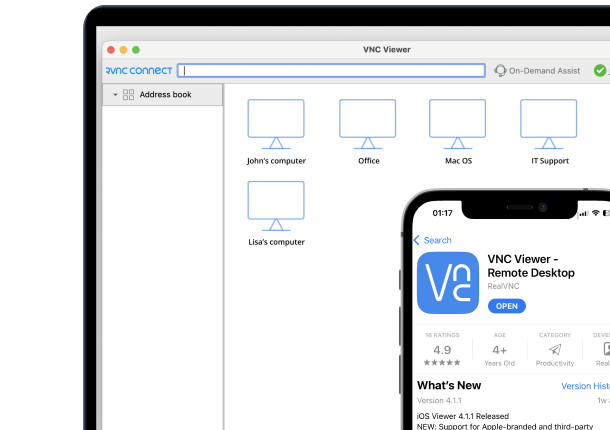
RealVNC Connect treats IT support as a team-based service. A subscription creates a team that links remote computers with the people allowed to control them, with roles that govern what each person can do. Discovery permissions, computer groups, and user groups provide structure so an IT team can segment access by site, business unit, or client.
Infrastructure decision: Cloud vs. on-premise connectivity

Image: Unsplash | Network switching and routing racks
Your choice between cloud brokering and direct connectivity decides how your remote access behaves under real-life conditions. Think of it as choosing whether RealVNC’s cloud helps you bridge networks for remote teams, or whether every session stays entirely inside your own perimeter.
Cloud connectivity model
In the cloud brokering model, RealVNC Connect Server and Viewer both make outbound connections through RealVNC’s secure cloud service, which negotiates a peer-to-peer route between two systems. If a direct route isn’t possible due to proxies, firewalls, or CGNAT, the session falls back to a relay through the cloud service, still with end-to-end encryption, maintaining the secure work environment.
Direct (On-Premise) connectivity model
Direct connectivity keeps every remote access packet inside your own network. The unified RealVNC Connect Server and Viewer listen on your internal addresses, the RealVNC Connect Viewer connects directly, and your firewall decides who gets in.
That gives your security team full visibility and keeps traffic within your existing monitoring. It’s especially useful for situations where protection of sensitive information resources is critical, or in air-gapped environments.
Making the Decision
A practical best practice is to start with cloud brokering for general users and branch offices, then reverse direct connectivity for highly regulated networks and endpoints. Many organizations end up adopting this approach, with cloud for remote workers who move between networks and direct connectivity for core sites that must keep traffic and end user devices local.
Subscription plans and scalability architecture
For RealVNC Connect, subscription choice really comes down to how your IT team wants to scale remote support. Here are a few key points to help frame it:
- Concurrent sessions define how many remote connections your support teams can run at the same time. Devices and users can be high, so the session limit becomes the real throttle. Plus and Premium allow unlimited users to share that pool.
- Essentials suits a single technician with a few systems to support. Plus and Premium fit growing teams that need shared access, security controls, and features like On-Demand Assist.
- Enterprise exists for estates that keep expanding and need options like an on-premise management console. The best approach is to look at your busiest hour of the week and size concurrent sessions based on that pattern.
Team management and role-based access control
RealVNC Connect’s team model gives IT teams a clear structure instead of a shared password and hope. You map people and devices once, then let policy take care of the rest when managing remote teams.
Roles and hierarchy:
- The owner has control of a single team.
- Admins manage users, roles, and global settings.
- The manager looks after devices and day-to-day configuration.
- User connects to systems but doesn’t have the ability to alter team settings.
Discovery and grouping:
- For small teams, default discovery lets everyone see every device.
- Larger teams use discovery rules, person groups, and computer groups, so that every technician only sees the systems they need to support.
- MSPs can separate tenants cleanly.
Directory and SSO integration:
- With EntraID or Otka, roles and groups are contained within identity systems. Life cycle joiners and leavers become a part of normal account management.
With RealVNC Connect, access control and authentication fit around your collaboration tools and ticketing stack, not the other way around.
On-Demand Assist: Instant support without pre-deployment
When you need a secure remote work environment for remote employees and contractors on machines outside your build pipeline, RealVNC Connect’s On-Demand Assist can provide it. With this feature, you support them in real-time without requiring them to install anything permanent on their end.
A typical session looks like this:
- The technician opens HelpDesk in RealVNC Connect and generates a time-limited nine-digit session code.
- The code expires after a short window, so even if an email is forwarded later, it can never be reused.
- The end user is asked to download a disposable app from www.realvnc.help and run it.
- The end user enters the code and provides explicit consent to establish the remote session. After this, the technician can see and control the device.
- When the session is completed, the app closes and leaves no footprint on the system.
That flow works for remote workers on BYOD laptops, field engineers on tablets, and third-party vendors on locked-down desktops. The team provides timely support when issues arise on Windows, macOS, Linux, and mobile operating systems like iOS and Android.
Security and compliance architecture for distributed teams
Supporting a distributed workforce forces security teams to protect systems in different countries, networks, and regulatory boundaries. RealVNC Connect handles all this variation through encryption, strong authentication, and detailed audit records that work the same way, no matter where in the world your users are.
Encryption and data protection
All RealVNC Connect sessions are encrypted by default using AES 256 encryption. Data is encrypted on the Viewer, decrypted on the Server, and the RealVNC infrastructure cannot read any session content in transit.
Administrators can mandate the AlwaysMaximum setting so every device endorses the highest encryption level. RealVNC operates ISO 27001-compliant data centers in the United States and the United Kingdom, which support strict security measures for brokering connections while keeping session data off the platform.
Access controls and authentication
RealVNC Connect layers two-factor and multi-factor authentication options on top of strong encryption. Teams can use email codes, TOTP applications, or SSO through EntraID and Otka, and Enterprise customers can mandate multi-factor authentication across the entire environment.
Session policies extend further through digital certificate issuance, smartcard support, and RADIUS integration for providers like Deo and RSA SecurID. Connection approval prompts, physical screen blanking, and time-limited access codes for the Code Connect feature add practical security measures that actually matter for shared spaces.
Audit trails and compliance
Every connection generates detailed audit logs that cover session start and end times, file transfers, privilege elevation requests, and reboot attempts. Chat transcripts are encrypted at rest, and optional session recording supports quality checks and break-fix processes for knowledge base entries.
Logs can be filtered by date, user, or device, so that security teams can quickly extract valuable insights. With ISO IEC 27001 2022 certification and support for GDPR, CCPA, HIPAA, and PCI DSS requirements, these audit capabilities form an essential part of any toolkit for compliance-focused operations.
Deploying IT support, communication, and collaboration tools
Implementation is where your design, users, networks, and the occasional mystery laptop finally meet. The steps below keep that rollout repeatable, audible, and friendly to the tools you already use.
Step 1: Subscription setup and team creation
Start by choosing a plan and concurrent session limit that realistically matches your helpdesk demand. Then, let RealVNC Connect automatically create your team. Configure the team name, contacts, and SSO settings before adding users. This way, identities flow from your directory from day one. Decide at this stage what devices can use the RealVNC Cloud broker, and which require direct access.
Step 2: Mass deployment of the RealVNC Server
Deploy RealVNC Server using your preferred deployment solution. Each operating system has its own ideal method of client and server deployment:
- Windows: MSI via SCCM or Intune
- macOS: Signed packages
- Linux: Local or external repositories
- Tablet/Smartphone: MDM pushes the RealVNC Connect app
Apply a shared configuration that’s drawn from your internal knowledge base so encryption level, authentication method, and team association are consistent for every deployment.
Step 3: Team member provisioning and role assignment
Begin by inviting team members via corporate email or let SSO assign them automatically, then set User, Manager, and Admin roles to match the duty levels. Apply discovery rules so that the named account sees only the systems they support. This will become the backbone for managing and supporting remote teams.
Step 4: Security hardening
Make MFA mandated, set encryption to AlwaysMaximum, and enable connection approval for all sensitive hosts. Configure idle timeouts, screen blanking, and routine audit log reviews so that remote work environments meet all security baselines rather than personal preference.
Step 5: Testing and validation
Finally, run end-to-end tests from accounts in your dev and test environments before rolling out the configuration to production. Validate role behavior, exercise On-Demand Assist, and confirm that logs and alerts appear where auditers and engineers expect them to get teams aligned.
Session monitoring and managing remote teams

Image: Pexels | Person in blue and white checkered dress shirt using silver MacBook
RealVNC Connect gives managers the visibility they need to manage remote teams simply across shifting time zones and constant ticket flow. The sessions page shows every active connection, who opened it, which device they’re on, and how long it has been running.
You can drill down into a technician’s session list, spot the concurrency limits before they start causing backlogs, and end sessions cleanly if someone forgot to close a window before logging off for the night.
None of this crosses into employee monitoring. You see the connection activity, not private behavior. This distinction is incredibly important, as you want oversight without staff feeling as though they’re being spied on. The logs and performance metrics are there to coach service agents, diagnose workflow slowdowns, and maintain employee satisfaction rather than to micromanage.
Cost efficiency and business impact
Travel budgets are typically the first place where businesses will see a visible saving. Once you stop flying technicians out for every outage and lean on remote support infrastructure instead, a small team can cover more sites without spending half its life in transit. Some organizations, such as OptivITy, found that using RealVNC infrastructure meant that 90% of incidents could be resolved remotely.
RealVNC Connect customers see this in practice. Wienerberger removed the need to ship PCs back and forward between headquarters and 20 remote sites. Instead, instant remote access let them cut down on courier spending and gain back hours of downtime.
The expected outcomes for teams that deploy dedicated remote access infrastructure and secure communication tools include:
- Elimination of travel costs for routine fixes.
- Allowing smaller teams to support much larger device fleets.
- Cutting support spending by 60 – 70%.
- Reducing the financial impact of downtime, which can reach into $25,000/hour for some SMBs.
Conclusion
Effective remote team management depends on infrastructure that’s built for purpose, rather than patched-together tools. You need remote support software and remote access tools that treat remote users and working remotely as the norm. RealVNC Connect fulfills this role for businesses that demand both cloud and on-premises connectivity and enterprise-grade security to safeguard sensitive information and critical company resources.
RealVNC has spent more than 25 years evolving VNC and backs RealVNC Connect with ISO 27001 certified operations, so security and reliability stay central, not optional extras. Concurrent session licensing, hybrid connectivity, and strong audit features give you room to grow without redesigning everything each time the team scales.
You can try RealVNC Connect to validate cloud and direct connectivity in your own environment, then review the pricing options once you know which model fits your infrastructure and support workflow.
Frequently Asked Questions
What is the difference between RealVNC Connect and VPN based remote access for a remote workforce?
A VPN exposes networks. RealVNC Connect adds remote support software with device-level control, role-based access, logging, and robust security measures across multiple platforms and mobile devices. Many teams pair VPN for network entry with RealVNC Connect for secure remote access tools that actually resolve issues.
Can I use both cloud and on-premises connectivity for different parts of my team?
Yes. Hybrid deployments handle unique challenges. Field offices and remote staff use cloud brokering, while plants or data centers stay direct for tighter control of company data. You choose per device at deployment.
How many concurrent sessions does my IT team need?
Start with how many support agents work live tickets. A five-person desk often needs three to five sessions to keep queues moving and boosting productivity. You can raise the limit as employee productivity and ticket volume grow.
Does RealVNC Connect replace our helpdesk or collaboration platforms?
No. It sits beside your service management and collaboration platforms as one of the essential tools. Technicians pick up tickets, connect with RealVNC Connect, then log outcomes and attach session details in the main system.
What happens if RealVNC cloud services are unavailable?
RealVNC first attempts peer-to-peer connections, then uses relays, so you usually maintain productivity even on difficult networks. For higher assurance, you can run direct connectivity so sessions stay inside your network and protect company data.
How does On-Demand Assist handle remote employees’ personal devices?
The technician generates a short-lived code. The end user downloads a disposable app on their laptop or mobile device, enters the code, and gets help. When the session ends, the app disappears, so BYOD remote workers stay compliant.