


It’s always the printer. Or the perimeter firewall. Or that one legacy finance server that only one person from the team knows how to reboot. And naturally, it crashes at 2:07 a.m.
This is where all tech support teams earn their stripes. The kind of moment where someone on the night shift opens up a secure remote access session, connects to a machine humming away halfway across the city, and quietly saves the day.
Modern technical support no longer relies on travel time or call scripts. It solves problems instantly, often before anyone in the organization even knows there was an issue. Whether it’s a bad Windows patch or a network WAN link threatening uptime, speed matters. Being able to fix things remotely is the new “turn it off and on again.”
So, what does tech support in today’s environment look like? It’s the engine that keeps modern operations moving. It spans global teams, late-night incidents, and systems that can’t afford any unscheduled downtime.
Much of this capability is enabled by remote support platforms built with security and reliability in mind. RealVNC Connect, one of the original developers of VNC technology, has spent decades helping teams respond faster without compromising control.
What Is Technical Support?

What is tech support? It’s the safety net behind nearly every digital interaction end-users have with the tools they use for digital productivity. Technical support itself refers to the processes, systems, and people that keep devices, networks, and software running when something breaks or looks like it might. These systems are in place for emergency outages, and they’re essential for daily operations, system optimization, and long-term planning.
Organizations offer technical support to help users solve problems, prevent downtime, and stay as productive as possible. Likely, you’ve already seen tech support in action if you’ve ever needed a password reset. Still, there’s a whole world that most users never see—server backups, security patching, network engineering, and cybersecurity.
The technical support specialists behind it all combine patience, logic, and specialized training to deliver fast, accurate technical assistance when it matters most.
Common Tech Support Tiers and Responsibilities
Modern support follows a tiered structure, with responsibilities increasing at each level:
- Tier 1 (Help Desk): These are the frontline responders who handle common issues like password resets, minor software problems, and connectivity checks. When structured correctly, it’s the first point of contact with the service desk.
- Tier II (Technical Support): These technicians dig a little deeper. They’re the escalation point for cases that need more technical knowledge, like software misconfiguration, hardware diagnostics, and desk-side support.
- Tier III (Infrastructure Engineers): These support teams are made up of high-level experts, product specialists, and engineers. They’re typically the highest point of escalation and step in when the issue moves beyond everyday fixes that need privileged access to domain environments, servers, and networking infrastructure.
Support Delivery Methods
The modernization of remote access has changed the way support is delivered, especially in hybrid and remote work settings. Traditional on-site support plays a big role, but most organizations now adopt a mix of these methods:
- Remote support: Allows teams to access devices from anywhere using tools like RealVNC Connect. This is often the fastest way to assist users and solve urgent issues quickly.
- Phone or email: Believe it or not, this is still common in industries where direct access is restricted or for supporting non-technical users who aren’t confident using remote tools.
- Tech support call centers: These are centralized hubs that route issues to the right resources and queues. Many use automation and routing logic based on an initial assessment of severity.
- Self-service portals: FAQs, walkthroughs, or chatbots that allow users to resolve issues on their own.
The most efficient setups give customers multiple channels to request help, and most successful teams combine those methods with strong backend systems that track and document every step.
How Tech Support Works in the Remote Era

With distributed teams, field workers, and always-on operations, tech support needs to keep pace. Remote access tools help technicians resolve issues across organizations without needing to be physically in front of desktops and servers.
Here’s how a typical tech support workflow looks for a remote worker who uses a BYOD (Bring Your Own Device) laptop.
- Issue reporting through the help desk: A user runs into trouble logging into their organization’s CRM from home. They call their help desk at the number clearly provided on the organization’s home page for team members.
- Initial assessment: The help desk service officer who takes the call will first try some basic troubleshooting. They will first determine whether there are access issues over the phone and perform basic connectivity tests.
- Troubleshooting: After resetting the password to rule out typos, the technician understands they will need to see the issue from the user’s perspective. To provide assistance, a remote connection and screen-sharing session are required.
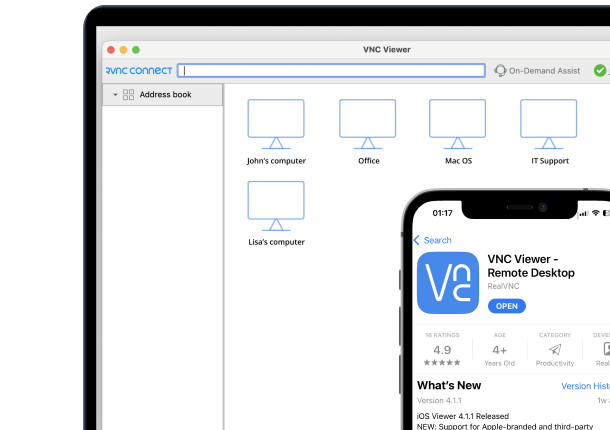
- Remote connection: For a hands-on issue such as this, a remote session is launched using RealVNC Connect. As the user has a BYOD device, there’s no local installation of the RealVNC Connect server on the device.
Choose one path based on who initiates access:
On-Demand Assist for BYOD, technician-led support: The support technician generates a short-lived code. The user downloads a disposable app and runs it without a permanent install, then enters the code. A secure remote support session starts with scoped permissions.
Code Connect for guest-initiated and pre-installed agent: The user creates a time-limited connection code for a specific device. The external specialist enters that code to begin a controlled remote access session, ideal when inviting third parties or handling temporary access.
- Remote fault-finding: The technician enters the user’s login credentials correctly and finds that the user is now able to log in. Understanding what the issue could be, the technician asks the user to briefly type out some numbers using their keyboard. The issue immediately becomes apparent.
- Diagnosis and fix: So, what was the problem? The user’s keyboard did not have the num lock on. It’s an innocent mistake that would have cost hours of productivity if remote access weren’t available as a tool. What would have otherwise been a frustrating trip back into the office turned into a five-minute first-time resolution.
- Escalation and collaboration: If the issue couldn’t be fixed at the point of contact, the technician would have escalated it to a higher-tier team to investigate the account issue in the back end. Either way, the result would be the same. A support team member from tier II would investigate and make contact with the user to further investigate the issue.
- Documentation in the knowledge base: New help desk technicians may not have had the intuition or technical skills of the experienced team member in our example. So, after the ticket is closed, the technician adds a note to the existing CRM troubleshooting workflows to check for basic password issues before moving on to more complex fault-finding.
This modern approach to tech support drastically improves efficiency. Remote support sessions and tools not only reduce the likelihood of frustrated users but also reduce operational costs, maintain customer satisfaction, and protect business continuity.
The RealVNC Perspective on Remote Access Tech Support
In the early days of remote support, the technology meant clunky VPNs and laggy screen control. Today, it’s a lot more seamless. RealVNC was one of the first to bring Virtual Network Computing (VNC) into mainstream IT workflows. Over 25 years later, that same tech is now at the core of many remote support tools businesses use every day.
RealVNC Connect builds on that foundation with secure, lightweight deployment options designed with tech support needs in mind. The essentials of remote support are there: screen control, file transfer, and a way for support teams to reach machines in remote locations and control them as if physically there.
RealVNC Connect is built not only for tech support but for enterprise demands with unattended access and instant support sessions through On-Demand Assist. The latest version of RealVNC Connect features a unified app that combines server and viewer functionality into one install that works with your existing deployment infrastructure.
Getting your organization ready for RealVNC Connect is simple, too. The RealVNC Cloud connection broker supports remote sessions behind firewalls and endpoints behind NAT and GNAT, so your network and security teams won’t need to create extra perimeter rules or forward ports for individual hosts.
Sessions are secured out of the box with end-to-end encryption as a default, and authentication can be handled by SSO and Windows Active Directory on-site.
Auditing connections, too, is seamless. Each session is tied to a named account, and information about who connected to what and for how long, is exportable to CSV, ready for audit.
Key Benefits and Use Cases
Modern tech support is measured in minutes, not hours or days. With remote access, issues can be identified and fixed before anyone needs to even set foot onto a factory floor or walk across a campus. Faster response times directly resolve issues and allow people to get on with their day.
Remote support also brings real cost efficiency. There is no travel, fewer physical overheads, and smaller businesses can cover more ground.
Industry Use Cases
Modern remote tech support is flexible enough to adapt to different sectors, devices, and risk levels. Here are just a few examples of sectors that can benefit:
- Healthcare: Secure support for imaging systems and hospital IT infrastructure while meeting HIPAA requirements.
- Manufacturing: Monitor and repair equipment without having to stop operations.
- Finance: Maintain control over high-security environments with compliance-ready support from tools like RealVNC Connect for finance.
- Education: Deliver service desk help to staff and students across a diverse range of BYOD devices.
- Managed Service Providers: Scale outsourced tech support across multiple clients efficiently.
- Media and Entertainment: Provide fast remote help desk access to production tools across locations with high-speed screen streaming.
Support That Meets Compliance Requirements
Many industries are in sectors where data security just isn’t optional. Remote support has to be airtight. Tools like RealVNC Connect deliver secure sessions with 256-bit AES encryption and detailed audit logs. Couple these features with RealVNC Connect’s compliance with GDPR, HIPAA, and PCI-DSS standards, and tech support teams have an all-in-one remote access solution for effective support.
Best Practices for Effective Tech Support
Delivering modern and high-quality tech support requires structure, security, and the right tools. These four pillars can help support teams run efficiently, securely, and at scale.
- Secure every connection: Always secure your remote sessions with enterprise-grade encryption and MFA, and use software that provides thorough audit logs.
- Build clear escalation workflows: Define your SLAs clearly and have the entire service management team agree on them. Document repeat issues and routine software installations. Frontline helpdesk team members should have enough specialized knowledge to know which queue to send any given issue.
- Equip teams with the right tools: If your organization has a mixed fleet, make sure your remote access tools work across all of them. RealVNC Connect works seamlessly with Windows, macOS, Linux, and even iOS and Android.
- Keep the customer experience central: Good tech support always keeps the user experience front and center. Yes, it’s about complex problem solving, but it’s also about building trust between end users and the IT department.
The Future of Technical Support is Remote

The future of technical support is remote by default. As businesses expand globally and rely on distributed computer systems, support has to scale with them without being tied to location. Secure remote tools now handle the bulk of service requests, and the industry itself will be worth $5.7 billion by 2032. These tools increasingly allow skilled technicians to resolve technical problems without even having to leave their chairs.
Still, there’s a place for desk support, because no connection means no remote access. That’s why hybrid models will always persist, blending on-site fixes with centralized triage.
Solutions like RealVNC Connect are driving this shift. With multi-device support, security built in by default, and unified workflows, every support agent has the tools they need to deliver high-quality service. With RealVNC Connect, your business gets greater coverage, lower overhead, and stronger business operations.
Ready to see how RealVNC Connect fits into your remote support strategy? Download the unified installer and run a limited test in real-world conditions. Like what you see? Get in contact with our experts and request an enterprise trial today.
FAQs
How does remote tech support work?
Remote tech support connects a technician’s system to the user’s device and allows them to control it as if physically in front of it. With tools like On-Demand Assist from RealVNC, support teams can step in instantly with no setup required.
Is remote tech support secure?
Remote tech support is secure when you use a secure remote tool. Tools like RealVNC Connect are made for enterprise and protect both hardware and software using encryption, MFA, and audit logging. They’re trusted by teams that demand strong back-end support and data privacy.
What is On-Demand Assist?
On-demand Assist is a fast support method for resolving technical issues without the user having any remote software installed on their device. The user enters a code, generated by the technician, and launches a disposable app. It’s best suited for customer support across organizations that allow BYOD devices.
What is Code Connect?
RealVNC’s Code Connect feature enables temporary, secure remote access using a short-lived session code. The end user generates a code on their device, and the support technician enters it to start a scoped session with permissions, audit logging, and explicit user consent. The benefit of using these codes is that access doesn’t have to be given forever, and once it’s revoked, it can never be used again.
How does remote support maximize productivity?
Remote support eliminates delays that would otherwise be caused by either traveling to the affected device or having a user bring the device to the help desk. Faster response means users get back to work sooner, helping teams maximize productivity across locations.