



What is end-to-end encryption (E2EE)?
Let’s dig into what end-to-end encryption is and, also, what it can do to keep you and your sensitive data secure.
E2EE is a data security method that makes sure only the sender, the intended recipient, and the communicating users can access the encrypted message data sent between them. It prevents third parties from accessing sensitive information during data transmission. This includes not only malicious actors and cybercriminals, but also internet service providers and platforms that facilitate transmission. When we say networks, they can be of any kind, e.g., the internet, local networks, or Wi-Fi networks.
The major advantage of E2EE is that even if someone gains access to the data, it’s virtually impossible to read it without the required encryption keys.
How does end-to-end encryption work?
Now that we’ve covered the end-to-end encryption meaning, let’s see how it works and explore the additional security measures involved.
On a very basic level, the E2EE process starts when a message/data gets sent from the user’s device. The data gets encrypted at the sender’s end, with only the receiver able to decrypt it. Encryption turns the data into ciphertext, essentially an unreadable format.
To decrypt the data, the recipient’s device needs a private decryption key. That secret cryptographic key is only stored on that device.
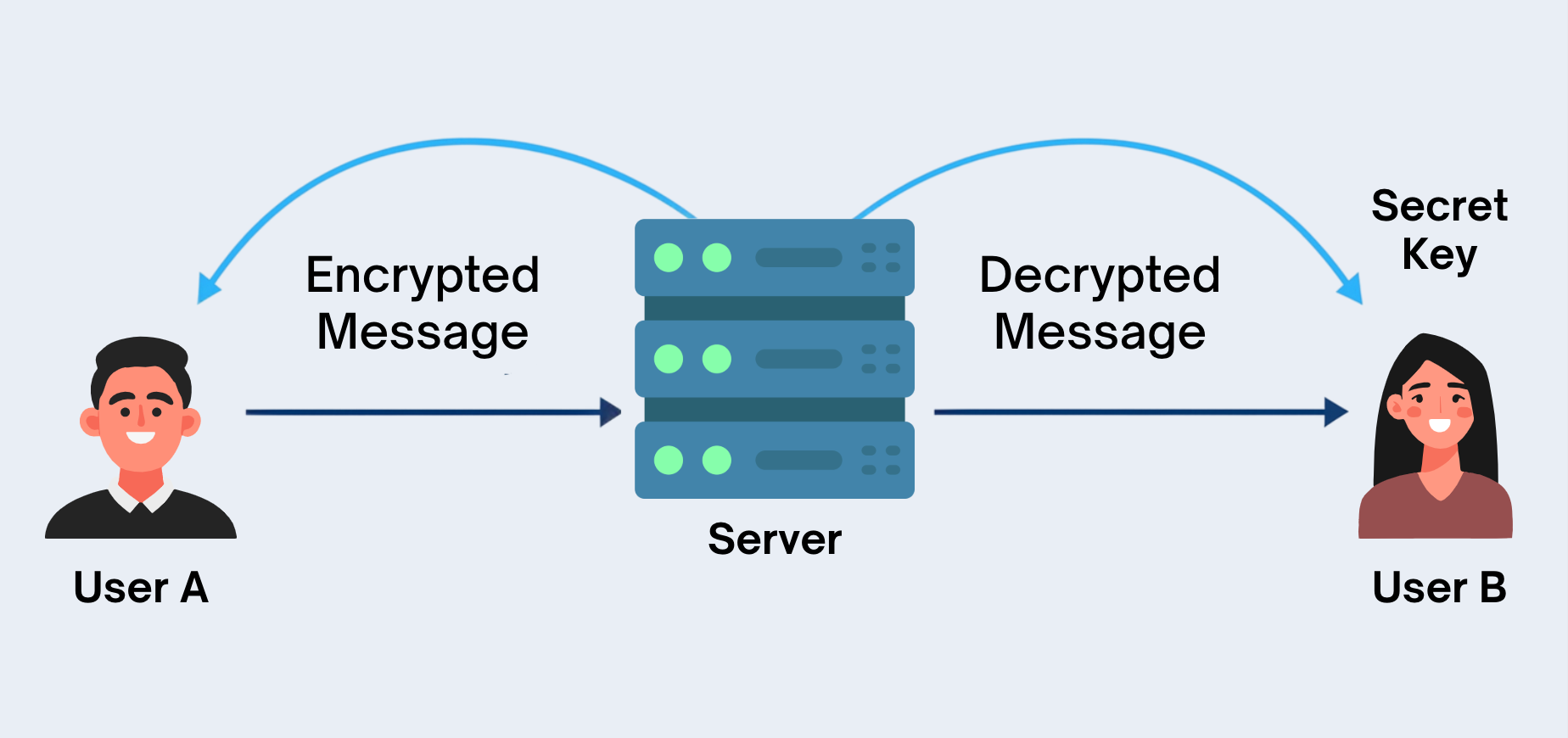
This process, called asymmetric cryptography, uses a public-private key pair. The sender uses the recipient’s public key (which is available to everyone) to send the message. However, the receiver has both a private and a public key, which are mathematically related. Only the receiver’s private key can decrypt the ciphertext. This is the secret key we discussed above.
As a result, data can travel over multiple connections and servers, and even be intercepted. Without both keys, decryption is virtually impossible.
Also, the keys won’t ever coincide, as the system will create unique ones every time someone joins.
An E2EE example
If this feels like an abstract concept, you’re not the only one to feel that way. This is why we’ll look at an end-to-end encryption example.
An example of how to use end-to-end encryption would involve a tech support agent for a hospital trust. They’re accessing a computer using secure remote access. As you’d expect, the computer they’re getting into contains users’ data as well as sensitive patient data. The last thing they’d want is for this data to fall into the wrong hands.
Also important to note is that the agent is working from home today and is connected to their home Wi-Fi. Because their remote access software uses 256-bit AES encryption, the data is end-to-end encrypted. Therefore, they can rest assured that, thanks to E2EE, no one—not even their internet service provider—can access it. Even though their home Wi-Fi password is known by their neighbour, this makes no difference. The neighbour might be able to intercept it, but not decrypt it.
Why end-to-end encryption is important
As cybercriminals become more sophisticated, protecting data becomes increasingly critical. Even basic information, especially those related to file storage, can be used in data breaches that result in stolen identities or compromised accounts.
Peace of mind is essential, and that’s exactly what E2EE helps with. Most users don’t realize it, but many identity theft cases start with very small pieces of information. An attacker might get access to one password and then use that to get into an email account. From there, they might get to a mobile device account, then a bank account, and so on.
With E2EE and strong encryption methods in place, you make that attack chain much more difficult to start. And when you combine it with other security measures, like multi-factor authentication and access management, your data becomes far more secure.
What are the benefits of end-to-end encryption?
Some of the key advantages of end-to-end encryption are:
Data privacy
Using E2EE ensures that data remains private to authorized users, such as the sender and receiver.
Data Security
E2EE helps keep your data more secure by significantly reducing the risk of theft while it’s being transmitted.
Protection against man-in-the-middle (MITM) attacks
Data remains encrypted from the moment it leaves the sender’s device to the moment it arrives at the recipient’s device. Even if an attacker hijacks the communication channel (e.g., a Wi-Fi connection), the data itself is safe. Without the public and private keys, the intercepted data wouldn’t be of much use to an attacker.
RealVNC and end-to-end encryption
RealVNC builds its product by putting security first, so end-to-end encryption and endpoint security are essential to our company.
When using RealVNC Connect, you can rest assured that your data is protected by encryption. All connections are encrypted end-to-end using up to 256-bit AES, 2048-bit RSA keys, and perfect forward secrecy. This means that sessions are entirely private to you, now and in the future.
Data can’t be decrypted, not even by us at RealVNC. Our use of E2EE is one of the reasons you don’t need to trust RealVNC to trust and use our product. You can find out more about the security of our product here.
But RealVNC Connect is not just about security; it’s also about ease of use. And you don’t just have to take our word for it. Click the button below and get a free trial!
Frequently Asked Questions
Is end-to-end encryption the same as standard encryption?
No. Standard encryption may secure data during transmission or storage, but it can still be accessed or decrypted by the service provider. End-to-end encryption ensures that only the sender and intended recipient can access the data.
Can service providers access my encrypted data?
Not with true end-to-end encryption. Even the service provider cannot decrypt or read your data, since they do not hold the private keys.
What happens if someone intercepts an encrypted message?
If someone intercepts an end-to-end encrypted message during data transmission, they will only see unreadable ciphertext. Without the recipient’s private key, they cannot decrypt or access the original content.
What types of apps or services use end-to-end encryption?
E2EE is used in popular messaging apps (like Signal and WhatsApp), ensuring robust security. remote desktop tools, secure email services, and file-sharing platforms where data privacy is a top priority.
How do public and private encryption keys work?
The sender encrypts the message using the recipient’s public key. Only the matching private key on the recipient’s device can decrypt it. These mathematically linked keys ensure secure communication.
Is symmetric encryption used in E2EE?
Most E2EE implementations use asymmetric encryption (public-private key pairs), though some systems may use symmetric encryption once a secure channel is established. Both methods aim to protect the message from unauthorized access.
What’s the difference between encryption in transit and end-to-end encryption?
Encryption in transit protects data only as it moves between endpoints, but it may be decrypted on intermediate servers. End-to-end encryption keeps data encrypted the entire way, from the sender’s device to the recipient’s device.