


Most people picture remote support as logging into one laptop, fixing the problem, logging out. For a managed service provider, that picture falls apart fast. A technician might touch a dozen client environments in one shift, each with its own policies and idea of an acceptable fix. Remote support for MSP teams has to hold all of that at once, and that’s what separates it from the remote access most people imagine.
What is remote support for MSP?
Remote support for MSP environments is the combination of tools, technician permissions, and documented workflows that let a provider access, troubleshoot, and maintain devices across many client accounts without sending anyone onsite. That’s a different problem than an internal helpdesk model, since a technician works across multiple client networks at once, each with its own security policies and SLA obligations.
A typical session follows the same basic flow: authenticate session, get permitted access, resolve the issue, let the session log itself. That log becomes the evidence an MSP points to later.
Support like this covers more than a screen-sharing call. It includes unattended access, attended support, file transfer, command-line help, and session records documenting the work. Done well, it means faster response, fewer onsite visits, better technician capacity, and stronger customer trust. MSP buyers weigh that against risk, including how a provider handles client data and what audit evidence it can produce. If you’re a small business deciding whether to outsource, see our guide to remote IT support for small businesses.
What features make MSP remote support work?
MSP remote support works best when access control, client separation, technician workflows, and documentation get designed together instead of bolted on afterward.
PSA and ticketing integrations also matter since they link a session to the request that triggered it, the client asset involved, the time entry billed against it, and the SLA it’s measured against. Without that link, a resolved session can leave no trace connecting the work to the ticket, which surfaces later as a billing dispute or a missed SLA nobody can explain.
| Feature | Why it matters for MSPs |
|---|---|
| Multi-tenant management | Keeps client environments and policies separated in one workspace |
| Unattended access | Supports maintenance and after-hours work with no user present |
| Attended support | Handles live, user-facing troubleshooting with consent |
| Session logging | Creates a record for billing, quality review, and compliance |
| PSA/ticketing alignment | Connects sessions to tickets, assets, and time records |
Multi-tenant client management
Multi-tenant management separates customer environments, devices, roles, and policies within a single technician workspace. For MSPs, those boundaries reduce the risk of connecting to the wrong endpoint or applying the wrong access policy across different client environments.
Effective remote support software organizes each customer through customer groups, device tags, policy templates, and named technician roles.
Device tags help technicians quickly identify the correct endpoint, while role-based permissions limit access according to service responsibilities instead of broad default privileges. A first-line technician may only access user workstations, while infrastructure engineers manage servers or approved unattended systems.
Using one secure remote support platform across multiple customers can also simplify administration and reduce the security risks associated with managing multiple remote access tools. Per RealVNC research on emerging threats, organizations using multiple tools reported a 67% incident rates, while those using only one remote access tool had 28% incident rates.
At the same time, remote support software complements existing identity and access management (IAM), privileged access management (PAM), and RMM platforms rather than replacing them.
Unattended and on-demand access
Attended and unattended support solve different problems. Attended access fits live, user-facing troubleshooting, usually through consent or a one-time code the user shares. Unattended access covers approved maintenance, servers, kiosks, and after-hours work with no one around to grant permission. Common MSP tasks include patch checks, configuration fixes, server maintenance, and reboot verification.
Because it runs without anyone present to catch a mistake, unattended access needs its own controls, such as session timeouts, customer-specific permission rules, and clear approval steps. These controls reduce standing-access risk while allowing technicians to complete scheduled maintenance efficiently.
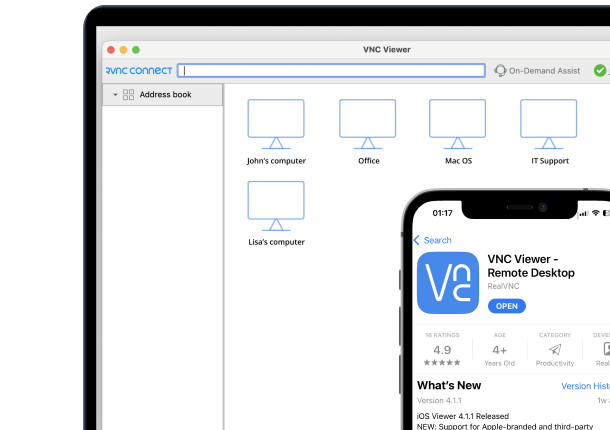
Unattended remote access platforms are also designed to improve transparency and support compliance requirements through robust auditing capabilities. RealVNC Connect, for instance, has a session recording feature you can use for your audit trail. It’s also compliant with regulatory frameworks such as ISO 27001 and HIPAA.
How does MSP remote support compare to RMM?
Remote support and RMM often work together, but they’re not the same. Remote support is technician interaction with a device in real time. RMM covers monitoring, alerts, patching, inventory, and policy automation running in the background. Remote support may be standalone, come bundled inside an RMM suite, or run alongside PSA, backup, and documentation tools. Suites cut console switching, while specialized tools often trade that convenience for deeper session controls or a simpler rollout.
| Capability | Remote support | RMM |
|---|---|---|
| Live control of a device | Yes | Yes |
| Unattended access | Yes | Limited |
| Continuous monitoring | Yes | Yes |
| Patching and automation | Varies depending on tool | Yes |
| Scripting | Sometimes | Yes |
| Ticket context | Depends on integration | Depends on integration |
Core differences for MSP technicians
Imagine an RMM platform detects unusually high disk usage on a client’s application server. The monitoring platform raises an alert and, if integrated with a PSA system, may automatically create a service ticket. If the issue isn’t resolved through automation, the assigned technician launches a remote support session to investigate the cause, apply the appropriate fix, verify that business applications are operating normally, and document the work before closing the ticket.
RMM reduces repetitive operational work by continuously monitoring endpoint health and automating routine maintenance, but it doesn’t replace judgment on complex troubleshooting or direct user interaction for cases like unexpected issues or necessary fixes when automation alone cannot resolve the problem.
Where remote support and RMM overlap
The overlap shows up in ticket workflows, device inventory, access permissions, and reporting more than in the remote-control experience itself, and PSA alignment matters just as much as the session tool. The question worth asking is whether a session can be tied to a ticket, an asset, technician, client, and time record.
Session notes then feed client reporting, technician training, billing accuracy, and quality control. Tool overlap causes confusion when nobody agrees on the source of record, so a workable model keeps roles distinct. For example, RMM watches and automates, while remote support provides controlled human intervention.
How do MSPs use remote support in practice?
The value of remote support becomes easier to understand when viewed through everyday service operations. Rather than replacing existing workflows, remote support helps technicians complete those workflows more efficiently while maintaining clear documentation.
| Scenario | Typical workflow | Business benefit |
|---|---|---|
| Hybrid employee support | Technician joins a live session, diagnoses the issue, resolves it, and updates the service ticket. | Faster response with minimal disruption for the employee. |
| After-hours maintenance | Technician connects through approved unattended access, performs maintenance, verifies services, and documents the session. | Reduces downtime during business hours. |
| Remote onboarding | Technician configures a new device, installs required applications, verifies security settings, and guides the user through initial setup. | Consistent onboarding across distributed teams. |
| Audit or billing review | Managers review session logs, recordings, and notes to verify completed work. | Improves transparency for customers and supports compliance. |
Session recording and audit logs support technician coaching, quality review, billing inquiries, and compliance reviews.
RealVNC Connect is one example of a platform MSPs use for secure remote access across distributed customer environments. While open-source tools may be a viable option for remote support, as Information Week reported, they’re more vulnerable to exploitation, accounting for 95% of security risks.
Aside from security and compliance issues, open-source tools come with other hidden costs, which account for a significant chunk, between 70% and 85%, of a tool’s total cost of ownership. IT teams need to manually manage, setup, and troubleshoot these tools, adding to time and resource expenses. Because these tools are mainly community-driven, finding dedicated customer support or support for updates and patches can be challenging. If you want to learn more about the true cost of ownership of open-source software, check out the RealVNC Access Redefined podcast.
Where does remote support help MSP clients most?
Remote support delivers the greatest value when travel delays, distributed workforces, or diverse device estates make onsite service impractical.
Cross-platform coverage matters here too. A provider supporting clients across Windows, macOS, Linux, and even Raspberry Pi devices needs a tool built for that mix, which is where a platform like RealVNC Connect fits as a practical example. Note that some organizations may still need occasional onsite assistance, particularly for hardware replacement, cabling, or physical infrastructure work.
SMB and hybrid workforce support
Smaller organizations get access to skilled IT help they couldn’t otherwise justify hiring full time, without waiting days for a visit. Email configuration, VPN troubleshooting, printer setup, software updates, and user training are the everyday work that fits into a remote session. Hybrid work raises the stakes on secure access to devices outside the office network, and clear communication matters more when a user can’t see the technician.
Industrial and distributed device support
Branch offices, retail terminals, digital signage, Raspberry Pi devices, and plant-floor workstations bring a different set of constraints. Downtime is costly, onsite access can be hard to arrange, and these systems often carry safety requirements office laptops don’t. Operational technology (OT) access also needs tighter change control, customer approval before changes happen, and thorough logging, fitting the client’s segmentation and safety rules rather than working around them.
What trends are changing MSP remote support?
The shift underway is away from reactive break-fix sessions and toward proactive maintenance, tighter security expectations, clearer client reporting, and closer integration with the rest of the service stack.
Automation and early AI-assisted tools are starting to take over repetitive technician work, routine checks and patch validation among them, though high-risk decisions still need a person reviewing them. The commercial shift matters as much as the technical one, as clients increasingly want measurable outcomes, not a count of closed tickets.
Secure-by-design expectations are part of this shift too. A credit union company implemented RealVNC Connect, which gave it a scalable solution that provides safe and secure remote sessions. By deploying RealVNC connect, the company was able to securely deploy the software across all branches, allowing them to efficiently resolve technical issues.
Buying criteria are also shifting toward open reporting, real policy control, session evidence, cross-platform access, and a clean fit with PSA and RMM tools.
What security risks come with MSP remote support?
MSP remote support concentrates risk in a way single-company IT doesn’t, since one provider’s credentials can open a path into dozens of client networks. The risks pair cleanly with controls, such as stolen credentials call for MFA, excessive technician rights call for role-based access, unclear activity calls for logging, unattended access calls for approval rules, and vendor risk calls for reporting a client can actually inspect.
Credential theft remains among the most common ways attackers get into a network, a pattern that shows up year after year in Verizon’s 2024 data breach report. With MSPs and IT services, however, misconfiguration is the biggest incident risk, accounting for 54% of incidents, the highest of any sector, per RealVNC’s 2026 research report.
CISA, alongside the NSA and MS-ISAC, issued joint 2023 guidance treating remote monitoring and access accounts as privileged access deserving the same scrutiny as any other admin credential.
RealVNC Connect is one example of a platform built around session-level controls, including MFA enforcement, role-based permissions, encryption, session recording, and audit logging.
Compliance frameworks also give clients a shorthand for judging whether those controls are real. SOC 2 Type II, ISO/IEC 27001:2022, and NIST CSF 2.0 come up most often, with NIS2 or DORA relevant depending on the client’s region.
What are best practices for remote support for MSP?
Use this checklist before deploying remote support software.
1. Map client environments.
Identify customers, devices, platforms, access needs, and where policies differ before assigning any permissions.
2. Define technician roles.
Match access to actual service responsibilities instead of granting broad default permissions.
3. Require MFA.
Treat every MSP account with access to a client environment as a privileged account, because that’s what it is.
4. Separate attended from unattended workflows.
Use consent-based access for user support and stricter approval steps for anything unattended.
5. Connect sessions to tickets.
Link remote activity to the ticket, the asset, and the time record.
6. Review logs and recordings.
Use the audit trail for quality review, billing questions, compliance evidence, and ordinary security monitoring.
RealVNC Connect can support this kind of process, offering secure, cross-platform remote access alongside session logs, recording, MFA, and role-based permissions. Whatever tool a provider chooses, it’s worth evaluating vendors on security documentation, compliance posture, support for customer-specific policies, and how easily evidence exports when a client asks.
Conclusion
The right platform helps technicians work across multiple customer environments while maintaining strong security, clear documentation, and efficient operational workflows.
When comparing remote support solutions, focus on how well each platform supports your client volume and compliance needs, technician workflows, and long-term growth plans. Those capabilities will have a lasting impact on service quality as your client base continues to grow.
Frequently asked questions
What is remote support for MSPs?
Remote support for MSPs allows technicians to securely access, troubleshoot, maintain, and manage client devices without being onsite. Compared with basic remote access, MSP remote support includes customer separation, technician permissions, audit logging, unattended access, and integration with service management workflows.
What features should MSP remote support software have?
Look for multi-tenant management, unattended access, cross-platform compatibility, session recording, audit logs, role-based permissions, and PSA or ticketing integration. The right combination depends on customer environments, compliance requirements, and technician workflows.
Is remote support secure for MSPs?
It can be when organizations apply security controls such as MFA, role-based access, encrypted sessions, session logging, and strong credential controls. Security should remain a primary evaluation criterion throughout the procurement process.
How do MSPs choose remote support tools?
Most run through a practical checklist covering client count, endpoint volume, supported operating systems, integration needs, compliance requirements, and pricing model. Testing real support scenarios beats reading a feature list.
How much does MSP remote support software cost?
Pricing varies by vendor. Some products license by technician, endpoint, concurrent session, or feature tier. MSPs should evaluate total cost of ownership, including onboarding, integrations, security capabilities, and scalability as the business grows.