An engineer on a personal laptop loses access to the payroll system while on a business trip just before the cutoff. They’re miles away from the head office, and it’s already late evening. Luckily, ad hoc remote support has them covered.
Ad hoc support means instant, secure assistance to any device, even when the company’s remote access software isn’t installed. In an ad hoc support scenario, RealVNC Connect makes access fast, simple, and structured for remote users. These ad hoc sessions use time-limited codes and a single-use helper to deliver on-demand support to meet real demand.
Across businesses, RealVNC sets the standard for scalable, user-friendly ad hoc support, backed by controls that professionals expect.
What Is Ad Hoc Remote Support?

Ad hoc support delivers immediate, secure assistance to any device without preinstalled agents. In an enterprise, ad hoc support refers to short, attended support sessions that start with single-use codes for a specific purpose and a particular problem.
RealVNC Connect provides a unified application that launches code-based entry through its Code Connect feature, applies account controls, and records connection activity for audits. Ad hoc models are ideal for moments when speed matters, and as a bonus, non-tech-savvy users can install the remote access server with ease.
Teams start support fast, guide users through consent, and end sessions cleanly. Once a session is completed, codes cannot be reused, and client-side applications can be discarded or retained safely for future instant remote support calls.
Where Ad Hoc Support Fits Best
RealVNC’s solution supports BYOD, hybrid users, contractors, and third parties across Windows, Linux, and macOS operating systems. Ad hoc access uses the VNC Cloud broker to establish high-quality temporary support paths across networks you don’t manage.
That model helps service desks manage sudden demand spikes, seasonal peaks, and incident response securely and safely—even across high-risk networks.
Enterprise teams gain policy control, MFA, detailed logging, and exportable records for audit, which suits regulated operations and offline sites. The same approach trims costs by avoiding agent rollout for rare support needs. Many businesses adopt ad hoc support for vendor break-fix, pilot rollouts, and whenever quick triage is needed.
If deeper remediation is ever required, a device can easily move from ad hoc support to managed deployment when ongoing and unattended access is required. RealVNC Connect adds Code Connect and On-Demand Assist for verified guest access and helpdesk in V8, supporting consistent workflows and faster priority support sessions.
Use Cases for Ad Hoc Support Work
Ad hoc support fits best when you need expert support right now, and the users’ devices lack organization-deployed agents, yet temporary access is safe and justified. Use cases include:
- BYOD and remote employees: BYOD devices cannot be joined to Windows Domain or LDAP networks, so ad hoc is an ideal way to deal with the challenge of secure remote access for unsupported devices.
- Contractors and third parties: Ad hoc can be used for quick vendor break-fix during demand spikes.
- Distributed operations and field teams: Field teams rely on roaming consumer mobile networks for connectivity. Ad hoc with a cloud connection broker means remote support can be provided, even behind CGNAT.
- Startups and pilots: For startups and outsourced software development, ad hoc support scales with demand without investing upfront in heavy tools.
- Project rollouts: Teams can begin with ad hoc support, then graduate to managed deployment for recurring support.
Governance, Training, and Audit

Ad hoc support should be treated like a gated workflow with clear steps and guardrails:
- Start with a short-term code-based initiation, explicit consent, and multi-factor authentication. This keeps security tight during support sessions.
- Manage all policies centrally and apply role-based account controls. Once in place, document the process for service desk playbooks.
- Record sessions where policy allows you to do so. Export logs for audit and reporting.
- Schedule frequent focused training on approvals, escalation, and data handling, making it second nature.
- For regulated sites or offline infrastructure, run RealVNC’s On-Premise solution inside your network to keep activity and data local.
- Team members with specialized skills and subject matter experts who have access to sensitive internal data should always choose ad hoc software like RealVNC Connect, which enforces encryption by default.
Architecture Choices
Choose the right approach for each ad hoc support request. A temporary code-based connection is a much faster way to launch than setting up a VPN that depends on routing tables, user accounts, and firewall rules. VPNs have their place for long-term commitments, such as managed monitoring or continuous maintenance, but they add far too much superfluous overhead for one-time fixes.
For break-fix or on-demand support, RealVNC’s ad hoc model gives attended desktop control with automatic session expiration. It allows technicians to reach devices safely without exposing the full network, which reduces security risk and keeps the scope limited to the current task.
Organizations operating in air-gapped environments can use RealVNC’s on-premises model to keep devices secure, self-hosted, and auditable. For organizations needing more reach and speed, RealVNC’s VNC Cloud delivers a scalable solution that requires minimal infrastructure changes.
To increase first-touch outcomes for the service desk, use logs to find blind spots and remove operational issues and bottlenecks by ironing out the process over time.
Always map policies to Zero Trust, using guidance from NIST SP 800-207 frameworks. Do it right, and you’re likely to see less scrambling when supporting your remote users and ad hoc workflows that become just as smooth as existing in-house playbooks.
Finally, keep ad hoc support strictly for cases that truly need it. When recurring support patterns and issues begin to emerge, deploy remote access agents to manage internal users or third-party endpoints.
Ad Hoc Support for Real-World Demand
Modern teams need speed, control, and thorough activity logging. Ad hoc support delivers these in a way that users can actually accept and easily implement. RealVNC standardizes ad hoc workflows with code-based entry, strong policy, and records that satisfy auditors.
The result is faster support that stays accountable across device types and sites. Ad hoc support meets urgent demand without agents and, most importantly, without delay.
Organization-supplied and domain-joined endpoints can shift from ad hoc support to managed deployment within the same console and the same rules. The solution fits hybrid fleets and regulated environments alike.
See how it works in practice with RealVNC Connect remote support. Want a quick trial for use in real-world conditions? Start with a clean, unified installer and download RealVNC Connect today.
FAQs
What is the difference between ad hoc and unattended remote support?
Ad hoc support is attended and time-bound. A technician helps users with a particular problem through temporary support sessions that start with a code. Unattended access is persistent and suited to fleet maintenance, monitoring, and after-hours operations.
Unattended access is typically handled by IT staff or full-time employees managing recurring maintenance and monitoring tasks. Many businesses use both to address different needs and solve tickets faster.
How does Code Connect secure temporary access?
RealVNC Connect’s Code Connect creates short-lived codes tied to a verified account. Sessions run over encrypted traffic with policy controls, so access is narrow and time-limited. Logs capture who connected, when the sessions started, and what happened.
The design shows RealVNC’s ability to balance convenience with enterprise-grade protection, maintaining security standards even in short-lived sessions.
What is On-Demand Assist in RealVNC Connect?
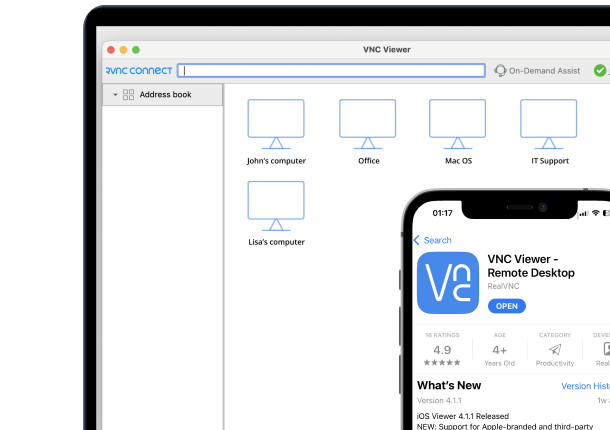
On-Demand Assist delivers ad hoc support to unmanaged or BYOD devices with no pre-install. A user runs a single-use download, enters a code, and an attended, time-limited session starts. Traffic is encrypted, and logs record the support sessions for audit. It is cross-platform, so technicians can help users on Windows, macOS, Linux, iOS, and Android.
For example, a contractor with a locked account can get help without VPN or agents. If you need to contact the team later, the audit trail ties events to a verified user. The service’s core function is fast on-demand support for break-fix, vendor access, and spikes in demand that many businesses face.
Can ad hoc support be used for mobile devices and BYOD scenarios?
Yes. Ad hoc support handles iOS, Android, Windows, macOS, and Linux. In many instances, organizations rely on specialized expertise to assist mobile users, even outside the company domain.
BYOD use reduces long-term commitments and avoids installing agents on personal hardware. Teams deliver technical support where internet reach exists, while keeping costs predictable.
What compliance and audit features are available?
Admins manage role-based access, apply MFA, and export audit trails. Logs record support sessions with user identity and timestamps. Regulated sites can keep data inside their own infrastructure using the on-prem Management Console.
That model suits MSP customers, providers, clients, and a company that values controlled network boundaries. IT teams can also conduct periodic reviews and share anonymized feedback with the internal community to refine procedures and resource allocation.