


Organizations now depend heavily on fleets of remote devices and workflows that can’t be brought back into the office every time there’s a support issue. Remote access has quickly moved from convenience to critical infrastructure for precisely this reason. Broadly, the benefits of remote access fall into four distinct areas: support speed, operational and infrastructure savings, workplace flexibility, and enhanced security.
Over the next few sections, we will look at these benefits in more detail and show how RealVNC not only provides these but can support them at scale.
Remote access refers to the ability to connect remotely to a computer, server, or system and then operate it as if you were sitting right in front of it. How remote access is delivered is as important as the environment it operates in. No two different organizations have the same requirements, which is why we will be comparing two types of remote access. One that brokers connections through the cloud, and direct connections for offline and sensitive work sites.
RealVNC has delivered and honed remote access technology for 25+ years. From ground-breaking development in the 90s to modern and enterprise-grade remote access solutions and remote access software today, RealVNC Connect provides organizations with distributed workforces and fleets with secure cloud, direct, and hybrid connectivity options.
Operational Benefits: Support and Troubleshooting Speed
When it comes to remote access technologies, operational benefits specifically refer to how quickly teams can respond, how rarely a system sits idle, and how few escalation steps occur from ticket to resolution.
The traditional method relied on an engineer being physically present with the device. That meant dispatching local technicians, scheduling, and a lot of people and equipment lined up in the same room. With remote access, support teams start remote sessions as soon as their users raise a hand and a technician opens the ticket.
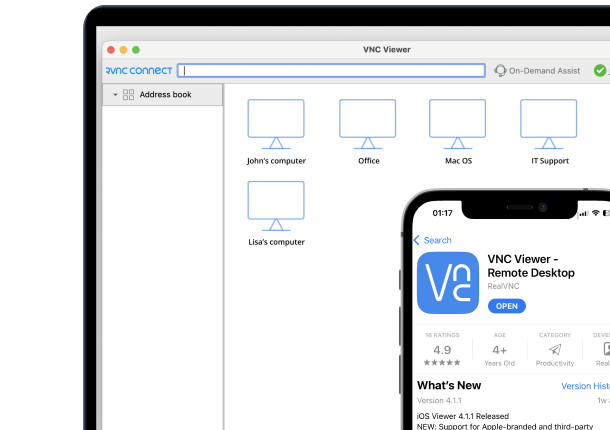
In RealVNC Connect, remote access for managed infrastructure is handled through Device Access. The server component of the unified app runs on each remote computer, so engineers can gain access whenever they need, whether someone is logged on or not. The same tool works across Windows, macOS, Linux, Raspberry Pi, and mobile devices running iOS and Android. This way, one approach covers the entire estate instead of four different playbooks.
If an issue is a one-off or a user’s device (BYOD), remote access services can shift to RealVNC Connect On-demand Assist. Users download and install a small app, enter a one-time, limited session code, and provide access and consent to a technician in a few clicks. No permanent access software stays on the device, and codes cannot be used more than once.
Each remote desktop session gives the technician the practical tools they expect and need. They can share screens, chat with the user live, and access files through file transfer, with an option to record sessions for later review.
With RealVNC Connect, businesses can expect operational benefits in the form of faster fixes, less friction during diagnostics, less downtime, and fewer small issues turning into big outages.
Cost Benefits: Infrastructure and Operational Savings
Remote access cost benefits show up in many ways. Some are obvious, like the removal of delay from support and operations. Others come in less obvious forms, such as a lack of infrastructural changes every time you need to provide access to a new remote user.
For organizations with widely distributed teams, remote access changes what support coverage looks like. One team can support multiple sites and time zones without having to duplicate the same roles across multiple offices. This increases flexibility but also saves cost as it reduces pressure to expand your physical office space as your headcount and endpoint count grow.
The effort that goes into deploying the solution also matters. The slow part of implementing a tool like remote access isn’t so much the installation time, but the sheer amount of network infrastructure changes needed to facilitate it. With RealVNC Connect Cloud-Brokered remote access, teams can avoid having to configure port forwarding, firewalls, routing, or subnet generation because the cloud brokers the connection.
Proxy or restrictive environments still typically need outbound allowances and can use a hybrid mix of cloud-brokered sessions and direct connections. That mix gives remote access solutions room to support remote systems where teams need access immediately, coming with the cost benefits of less travel time and allowing for more growth in the meantime.
Workforce Benefits: Flexibility and Productivity
Having a remote workforce comes with many benefits, especially for businesses and organizations that rely heavily on workers in the field, such as utility and critical infrastructure. But having a truly remote workforce stalls completely when you’re still relying on one physical location and a commute whenever tech breaks. Hybrid remote work needs the same kind of reliability, though minus the badge reader.
For day-to-day execution, remote access gives remote employees a more consistent way to reach the corporate tools and support they need. Remote access keeps IT support reachable, even when halfway up a radio tower, on a hospital ward, or across the other side of the planet. Well-implemented remote access reduces the use of risky workarounds like VPNs (Virtual Private Networks) or hosting local tools, so the sensitive data stays on managed endpoints instead of personal inboxes over suspicious WiFi.
The broader benefits of remote operations extend well beyond just the convenience factor. More benefits show up when teams can onboard global talent, support remote workers, and maintain business continuity during real-life problems like severe weather, travel delays, and building access restrictions. For extreme situations like disaster recovery, business continuity planning gets much easier when IT can rehearse recovery steps with remote access during BAU, then refine the runbook before a real incident strikes.
RealVNC reinforces that consistency with remote access in RealVNC Connect for enterprise desktop, server, and mobile devices. When your business remains flexible and remote work scales, remote access increases productivity and maintains support for remote workers wherever they happen to be.
Security Benefits: Access Control and Encryption
Your cybersecurity team likely wants secure remote access that reduces exposure, not expands existing attack vectors. Remote access can backfire when a Remote Desktop Protocol (RDP) service or an unencrypted VNC session is hosted on public-facing internet. Such solutions easily invite unauthorized users, increase security risks, and lead to data breaches of sensitive data.
A VPN can help, as VPNs create encrypted tunnels into the corporate network, but it can extend any remote access to an entire subnet (or beyond). A remote access solution with built-in robust security features like RealVNC Connect enhances existing security by removing less secure solutions and replacing them with a far more secure option.
RealVNC Connect supports remote access through cloud-brokering. After attempting a direct peer-to-peer connection, endpoints initiate outbound connections, so in most cases, there is no need for inbound port configuration. That design reduces any firewall change requests that open your organization up to additional and unnecessary security risks.
Session security features are also robust. RealVNC Connect uses end-to-end encryption with Perfect Forward Secrecy (PFS), API calls to TLS, and AES GCM 128- and 256-bit protection on both cloud-brokered and direct (offline) session connections. RealVNC itself cannot decrypt the content of any session, even when relayed through its data centers. This, plus full ISO27001 certification, independent audits, and CREST-certified penetration tests, supports secure remote access when teams need to protect sensitive data from the very first session.
Of course, sustainable remote access also depends on governance. RealVNC Connect allows granular access controls, defining user permissions, and enforcement of multi-factor authentication (MFA), paired with privileged access management as standard measures for remote access security.
RealVNC takes security seriously. To get a better idea of our security features and posture, download the RealVNC Connect Security Whitepaper.
Real-World Use Cases: Where Remote Access Delivers Value
Every industry sector has its own unique bottlenecks that slow business operations and result in downtime. Remote access solutions like RealVNC Connect remove these operational pinch points, providing real, measurable benefits that let teams focus on the fix, rather than logistics.
Below are a few industries that particularly benefit from well-implemented remote access solutions.
IT support teams and helpdesks
Whether in-house or a part of a managed services provider (MSP), remote access allows support teams to start sessions immediately, even when the end user is well outside the corporate network.
On-Demand Assist supports ad-hoc support without users needing to pre-configure software or wrangle a VPN on their own, keeping the first contact flow simple and easy. It also supports chat and file transfer, so technicians can guide, validate, and resolve without needing to ask someone to relay mouse clicks and error messages over the phone.
Remote and distributed workforce
For businesses with workers and freelancers across the country (or globe), remote access allows quick and easy access to internal familiar tools via jumpboxes, printers, and databases. Cross-platform coverage across multiple operating systems means one unified app can be installed and a standardized experience for both users and IT teams. If policy calls for it, teams can limit their footprint by avoiding persistent access software on unmanaged endpoints while still retaining a completely predictable support coverage.
Manufacturing and field operations
Manufacturing only remains profitable when equipment and output are running 24/7. These teams rely on remote access to keep their remote systems available and shorten any downtime from failures. RealVNC Connect gives immediate device accessibility and allows engineers to gain access to devices that are often locked behind factory doors or too dangerous to diagnose while running.
Cloud and infrastructure management
Cloud instances of Windows and Linux servers don’t necessarily come with strong security measures, especially when it comes to remote access and public-facing management. For VDIs and cloud-hosted systems, RealVNC Connect allows cloud and local firewalls to keep blocking incoming traffic, while allowing outbound HTTPS for remote control sessions via its cloud-brokering feature. Zero-knowledge and end-to-end encryption also mean that any session data remains out of the hands of cloud providers and firmly in your control.
Key Advantages of RealVNC Remote Access
Remote computer access solutions should be treated as a managed capability rather than a last-minute resort. IT decision-makers and architects should also consider their unique environments, then decide on the type of remote access to be implemented. RealVNC Connect is a flexible remote access tool that is scalable and flexible enough to meet most requirements. Other key advantages include:
Zero configuration cloud connectivity: As session brokering occurs via outbound HTTPS connections (like viewing a web page), it works behind restrictive corporate network firewalls and proxies without any significant changes to infrastructure.
Predictable behavior on real networks: Whether your endpoints are sitting at an overseas airport or just down the corridor, cloud-brokering means businesses get a consistent experience across a variety of real-life network conditions.
Zero-knowledge privacy posture: All remote session data is protected by AES GCM encryption and Perfect Forward Secrecy. No one, not even RealVNC employees, can ever intercept or decrypt remote session information.
Hybrid options without tool sprawl: Use cloud connectivity for scale, and direct remote access for private networks. Both options are supported within the same platform, reducing the need to separate tools for remote computer access.
One experience, regardless of platform: A unified app that works across Windows, macOS, Linux, Raspberry Pi, plus mobile devices. It makes every session feel the same and is the right remote access solution for businesses that need remote desktop access across mixed fleets.
Next Steps for Modern Remote Access
Remote access is now a foundational approach to modern IT support and remote worker support. Operational speed improves when support can act immediately, so the benefits of remote access show up as fewer changes and far less waiting.
Cost savings follow when fewer trips and less physical office space are needed to cover what would have been the same footprint. Benefits to the business don’t stop at IT teams and operations. Your employees benefit too. Team members are more productive and satisfied when they can access the same files, servers, and internal applications from almost anywhere.
Whether you need secure cloud brokered remote access or offline direct connections inside your own network, RealVNC Connect is straightforward to download, deploy, and pilot in real operating conditions. Run it on a small set of endpoints first, validate performance and governance, then expand enterprise-grade remote access with RealVNC Connect across the organization.
Frequently Asked Questions
Why choose remote access over on-site support?
Remote access from tools like RealVNC Connect helps IT teams assist remote locations, so remote access work starts quickly rather than having technicians travel on-site to perform diagnostics, fixes, or updates.
Is remote access less secure than on-site access?
A secure remote access solution like RealVNC Connect can massively reduce exposed services and deliver a more secure connection than traditional methods, such as a virtual private network or port forwarding the RDP/VNC. It supports the controlled, secure access and advanced security features that enterprises need.
How fast can we deploy remote access?
Since modern cloud-brokered remote access solutions like RealVNC Connect don’t require port forwarding or network infrastructure changes, remote access can be deployed much faster than traditional methods like VPN and RDP with port forwarding.
Do we still need a VPN?
VPNs (Virtual Private Networks) provide a broad network reach for endpoints. If remote access to specific machines is all your business requires, a VPN is no longer required when a remote access tool is in place. Many businesses, however, choose to keep their VPNs in place for specific internal needs, but with remote access delegated to remote access tools such as RealVNC Connect.
Can it handle unattended server management?
Yes. Install the RealVNC Connect unified app or standalone server for remote access to critical systems. Then, configure Device Access to enable the unattended access feature.
How do we support audits and compliance?
Businesses can configure RealVNC Connect via role-based permissions, session logging, and recording to document who is accessing what, and at what time. Pair this with multi-factor authentication to strengthen data security and data protection across support workflows.