



If you’re in the process of evaluating remote access solutions and need clear answers about protocol design, security validation, and management capabilities, you’re in the right place. This comparison helps you compare the technical foundations and enterprise readiness of NoMachine vs. RealVNC, so you can match the right tool to your requirements.
Understanding NoMachine and RealVNC Core Technologies
NoMachine builds its remote desktop software on the proprietary NX protocol. The Luxembourg-based company developed NX for X11 optimization on Linux and Unix systems, with compression and caching that performs well for multimedia workflows. NoMachine offers an intuitive interface with simple setup, a free version for personal use, and features such as file transfer, session recording, and multi-user collaboration.
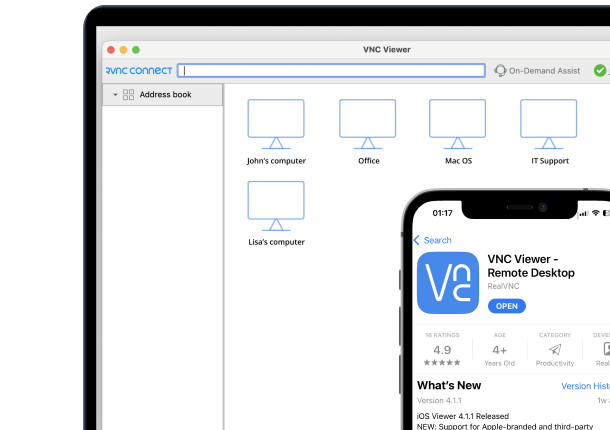
RealVNC builds on virtual network computing (VNC), an open standard documented in IETF RFC 6143. Founded in 2002 by the original creators of VNC technology at Cambridge, RealVNC developed both the protocol specification and commercial implementations around it. The platform delivers consistent behavior across Windows, Mac, Linux, iOS, and Android, backed by third-party security certifications. RealVNC Viewer also works with other VNC implementations like TightVNC. If you’re reviewing your options, see our list of NoMachine alternatives.
Aspect | NoMachine | RealVNC |
Protocol | NX (proprietary) | VNC (IETF RFC 6143) |
Design Focus | Performance optimization | Cross-platform consistency |
Commercial Model | Freemium with enterprise add-ons | Subscription tiers with support included |
Protocol Architecture and Performance
NoMachine’s NX protocol compresses X11 display data through client-side caching and SSH tunneling, with UDP support for audio and video. This delivers fast connections for video editing, CAD work, and scientific visualization on Linux systems. NX became closed-source with version 4 in 2013, which means both endpoints require NoMachine software.
RealVNC uses Tight, ZRLE, and H.264 adaptive compression. The VNC protocol transmits screen data and control events between devices, adjusting compression based on network conditions. RealVNC authored the RFC 6143 specification in 2011, so that platform-agnostic behavior is supported across all supported operating systems.
Users prefer NoMachine for high-performance Linux-to-Linux connections. RealVNC suits IT support teams that need stable, cross-platform access to remote computers with consistent functionality.
Enterprise Management and Security Certifications
NoMachine Enterprise Server includes admin tools for multi-node deployments with load balancing. Identity integration requires manual LDAP and Active Directory configuration. Administrators manage infrastructure and log remote sessions through NoMachine’s server admin tools.
RealVNC Connect provides a unified cloud or on-premise management console with browser-based administration. Pre-built Azure AD and Okta connectors simplify SSO and SAML integration. A RESTful API enables automation for large deployments, and session recording captures remote sessions for audit trails.
NoMachine implements AES-128 TLS encryption with 2FA support and SSH tunneling but publishes no third-party security certifications. In contrast, RealVNC holds ISO 27001:2022 certification and SOC 2 Type II attestation from independent auditors, and offers a 24/7 Security Operations Center that monitors threats.
HIPAA, PCI-DSS, and FedRAMP require vendor certifications, which is why RealVNC’s third-party validation demonstrates independent security assessment and helps you overcome the tedious process of self-reporting these capabilities and certifications.
Licensing Models and Total Cost of Ownership
NoMachine offers a free version for personal use with one connection limit. Commercial deployments require separate products: Enterprise Desktop from $44.50/year, Terminal Server from $3,494.50/year for Linux virtual desktops. Each requires separate licenses for Windows, Mac, and Linux.
RealVNC Connect uses concurrent sessions across unified tiers: Lite (free, non-commercial), Essentials ($8.25/month), Plus ($16.50/month), Premium ($29.75/month), and Enterprise (custom). A single subscription covers all platforms. Download a 7-day free trial to test key features.
PS: you can download a 7-day trial to test key features including transfer of files and clipboard sharing.
Platform Support and Deployment Flexibility
Both support Windows, macOS, Linux, iOS, Android, and Raspberry Pi.
- NoMachine requires both endpoints running NoMachine software. Enterprise Server enables multi-user environments and includes web client for browser access. Enterprise deployments require server provisioning.
- Cloud-brokered connections over the internet eliminate server infrastructure. HTML5 browser access requires no install. Cloud deployment has zero infrastructure overhead.
Version 8 combines Viewer and Server into one unified app, compatible across platforms. Install once, switch roles as needed via the user friendly interface.
NoMachine provides community forums for free users and Standard Support with Enterprise licenses. RealVNC includes professional support with SLAs in all paid subscriptions.
Use Case Analysis and Selection Criteria
- for high-performance multimedia – NoMachine NX compression for video editors, 3D rendering, and multimedia content creators who need speed on Linux systems. NoMachine helps keep minimal lag and delivers crisp visuals even on low-bandwidth connections.
- for enterprise production support – RealVNC offers certifications, professional SLAs, and unified management for IT helpdesk teams and regulated industries. RealVNC is best for teams needing secure, easy-to-manage unattended access.
- for Linux/Unix research – NoMachine X11 optimization is good for scientific computing and research labs where teams collaborate on Linux-to-Linux workflows.
- for compliance-driven organizations – RealVNC’s ISO 27001 and SOC 2 certifications are required for healthcare, finance, and government procurement.
For example, Arup, a global engineering firm, operates 17,000 RealVNC licenses across 40 countries. The IT team selected RealVNC Connect for reliability, performance, and the ability to enforce corporate security policies across critical engineering systems.
If the question of NoMachine vs. RealVNC is on the table, use these five criteria for selection:
- Security certifications. Are you looking for regulated compliance or feature-based security?
- Protocol standardization. Are you for IETF RFC vs proprietary evolution, vendor interoperability?
- Enterprise management. Do you need cloud-native or server-based architecture? Or both?
- Commercial support. Included SLAs or community/commercial split?
- Deployment complexity. Account for infrastructure requirements, time-to-deployment, operational overhead.
RealVNC Connect Advantages for Enterprise Environments
RealVNC’s founders created VNC technology in the late 1990s at Cambridge. The company has developed the protocol and commercial implementations for over two decades. Four features differentiate RealVNC Connect for enterprise use:
- Security certifications. ISO 27001, SOC 2 Type II + HIPAA attestation streamline vendor risk assessments. Procurement teams access documentation through the Trust Center.
- Unified platform. One product covers all use cases across all platforms. No separate Desktop, Terminal Server, and Cloud Server products to manage.
- Included support. Professional support with SLAs comes standard in paid subscriptions. Enterprise customers receive 24/7 availability.
- Protocol standardization. RFC 6143 ensures interoperability and long-term flexibility without vendor lock-in.
Download RealVNC for free today. The first 7 days are on us.
We’ve compared the top remote access solutions. There’s a clear winner.
In summary, NoMachine delivers high-performance remote desktop with multimedia capabilities and free tier for individuals. RealVNC Connect provides enterprise management, third-party certifications, unified platform, and commercial support for compliance obligations. We also compare RealVNC with another multi-protocol tool in Jump Desktop vs RealVNC.
Frequently Asked Questions
Which protocol performs better?
Performance varies by use case. NoMachine’s NX optimizes for speed and low latency on Linux systems, which suits multimedia and high-FPS tasks. VNC maintains stable visual quality across all platforms. For cross-platform IT support, RealVNC delivers consistent results without worrying about platform-specific behavior.
What security certifications matter?
RealVNC holds ISO 27001, SOC 2 Type II, HIPAA attestation, and UK Cyber Essentials from independent auditors, among others. NoMachine provides features without third-party certifications. Please remember that regulated industries require vendor certifications.
Can NoMachine free be used commercially?
No, as free covers personal use only. RealVNC offers tiers for small business and enterprise needs, and a Lite plan, for free, for personal needs.
Do both solutions work consistently across platforms?
Both support major platforms. VNC’s framebuffer design delivers identical functionality on Windows, Mac, Linux, iOS, and Android. NoMachine’s NX protocol was X11-optimized for Linux. Windows and Mac support came through extensions.
Which deploys faster at enterprise scale?
RealVNC Connect’s cloud deployment requires zero server infrastructure. Install the unified app, sign in, and connect to remote computers. NoMachine Enterprise needs server provisioning and multi-node configuration.