



Digital signage is a managed system of digital displays that shows scheduled, dynamic, or real-time content in physical spaces. A digital signage system combines screens, playback hardware, software, connectivity, content operations, and device support to deliver information reliably across a fleet.
Organizations use digital signage for promotions, menu boards, safety notices, KPI dashboards, wayfinding, room schedules, weather, RSS feeds, and emergency alerts. AVIXA defines digital signage as electronic visual communication that can operate independently or across a centrally managed network.
A content management system, or CMS, gives authorized users a place to upload, approve, schedule, and remotely update content. Commercial displays suit public-facing settings because they support longer operating hours, higher brightness, and flexible orientation.
Digital signage is also an operational system. IT teams may manage network access, software patching, bandwidth, uptime, and support when a player freezes, a screen goes offline, or a kiosk requires attention at another location.
Key Components of Digital Signage Systems
Digital signage works when its physical, software, and support layers work together. Displays show the message, but content, connectivity, playback logic, and device access controls determine what appears, when it appears, and how quickly a team can correct a problem.
Media players often download and cache approved content locally. This allows a screen to continue showing its assigned playlist through a temporary connectivity interruption.
| Component | Primary Role | Operational Consideration |
|---|---|---|
| Commercial display | Shows images, video, data, and messages | Brightness, duty cycle, orientation, warranty, and viewing distance |
| Media player or player app | Retrieves and renders content | Performance, operating system support, local caching, and remote access |
| CMS or management software | Publishes, schedules, and organizes content | User roles, approvals, screen grouping, reporting, and integrations |
| Content and templates | Deliver messages consistently | Brand governance, accessibility, local editing rights, and refresh cadence |
| Connectivity | Transfers content and status data | Ethernet, Wi-Fi, cellular fallback, bandwidth, and segmentation |
| Remote support | Helps teams diagnose endpoints | Secure access, auditability, permissions, and support procedures |
Display and Playback Hardware
Display and playback hardware form the physical layer of a digital signage network. Commercial-grade screens are commonly used in public environments because they can support longer operating schedules, higher brightness options, flexible mounting, and business-focused warranty coverage. LCD screens suit cost-effective indoor use.
External media players are dedicated devices that connect to screens, download content, and render playlists from the CMS. Player apps perform a similar function on compatible hardware.
System-on-chip, or SoC, displays include playback capability within the screen. They reduce external hardware and cabling but still require compatibility testing, lifecycle planning, and remote support if the endpoint stops responding. Video walls require additional planning because multiple screens may need specialized controllers, synchronized playback, and precise layout management.
When a player fails, IT or AV teams need a way to inspect device health, restart an application, check inputs, review logs, or confirm what appears on screen without sending someone onsite. A remote-access integration can support that workflow without replacing the CMS.
CMS, Content, and Scheduling Software
The content management system (CMS) is the publishing and control layer for digital signage. It determines what appears on each display, when it appears, and which users have permission to change it. Marketing teams may use the CMS to build layouts and playlists, while IT and operations teams use it to organize screens, manage access, and monitor device status.
Scheduling assigns content by time, date, location, audience, or business event. A restaurant may run breakfast content in the morning and lunch content later in the day. A workplace may schedule safety messaging before shift changes. Templates help protect brand consistency while allowing local teams to update approved fields.
Many platforms support dynamic feeds such as calendars, weather, dashboards, webpages, point-of-sale data, and social media feeds. These integrations need clear ownership because inaccurate feeds are as visible as incorrect static content. The WCAG 2.2 guidance is also useful when teams consider readable hierarchy, contrast, motion, and content that avoids known seizure or physical-reaction risks.
Digital Signage vs. Traditional Static Signs
Digital and static signs solve different communication problems. Traditional signage is often simpler and less expensive for messages that rarely change, including permanent labels, basic directional cues, and regulatory notices. Digital signage is stronger when information changes often, needs scheduling, or must stay consistent across several locations.
| Consideration | Digital Signage | Traditional Static Signs |
|---|---|---|
| Update speed | Remote changes can reach grouped screens quickly | Requires printing, delivery, and manual replacement |
| Content flexibility | Supports schedules, video, data feeds, and localization | Best for fixed messages |
| Upfront cost | Displays, players, installation, and software | Printing, mounting, and design |
| Ongoing maintenance | Requires connectivity, software, support, and patching | Requires replacement when content changes |
| Measurement | Playback records, QR codes, POS correlation, and traffic data where available | Usually relies on manual observation or campaign proxies |
Core Differences From Static Signage
The core difference is operational. Digital signage is managed as a content and device network. Static signage is managed through print production, placement, and replacement.
This makes digital signage suitable for menu boards, promotions, shift notices, room schedules, safety updates, internal communication, and other time-sensitive communications. Centralized CMS control also helps organizations maintain consistent messaging across offices, stores, campuses, and public facilities.
Static signs work well for permanent information, low-budget environments, and labels that do not require regular updates. Digital displays should not replace every printed sign, and excessive motion can distract viewers.
Where Digital and Static Signs Overlap
Most organizations use both formats. A building may rely on static signs for permanent directional cues while digital displays show changing room assignments, event schedules, service updates, or queue information.
Both formats need readable design, clear visual hierarchy, and thoughtful placement. Compliance notices require governance in either format. Digital systems add permissions, approval workflows, and audit considerations because a published change may appear across many public-facing screens at once.
Real-World Examples of Digital Signage
Digital signage becomes easier to understand when connected to familiar environments. A restaurant may use digital menu boards to update pricing, specials, allergens, and daypart menus without reprinting every panel. A retail store may use screens to present promotions, product information, or brand content at specific points in the customer journey.
Formats include digital posters, digital billboards, interactive digital signage, outdoor digital signage, digital menu boards, and video walls.
Corporate offices and manufacturing sites often use hallway or breakroom displays for safety reminders, KPI dashboards, shift information, and HR updates. Universities and hospitals can use wayfinding screens and directories to help visitors find rooms, clinics, departments, or events. Transportation hubs may show live schedules, service alerts, and location-specific advertising.
Video walls, unattended kiosks, and self-service systems need coordinated layout and playback planning.
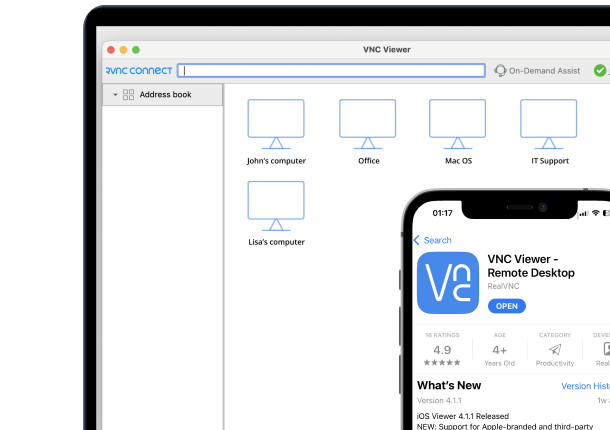
As devices spread, teams need defined support workflows for screens that stop displaying content or endpoints that need configuration checks. RealVNC Connect is one secure remote-access option that can help IT teams inspect signage endpoints, troubleshoot media players, and support unattended devices without dispatching a technician to every site.
Where Digital Signage Is Used
Digital signage fits best where information changes regularly, audience attention is location-based, or an organization needs consistent messaging across multiple sites. It is not automatically the right choice for every message or setting.
| Environment | Typical Screens and Content | Useful Measurement or Operational Check |
|---|---|---|
| Retail, restaurants, and hospitality | Menu boards, promotions, product information, and guest updates | Proof of play for delivery verification; offer redemption, QR scans, or carefully controlled sales correlation for outcomes |
| Corporate and manufacturing | Safety notices, shift updates, KPI dashboards, and training reminders | Timely updates, playback reliability, and message coverage |
| Healthcare and education | Wayfinding, directories, patient or student updates, and alerts | Accurate content, uptime, and navigation support |
| Transportation and public services | Schedules, service information, queue updates, and public notices | Content timeliness, availability, and operational response time |
Retail, Restaurants, and Hospitality Displays
Customer-facing environments use digital signage to keep offers current and display timely information. Digital menu boards can change by time of day, inventory status, location, or promotion schedule. Retail screens can highlight offers, support product education, or carry in-store advertising. Hospitality settings may use digital displays for event schedules, guest information, wayfinding, and service updates.
Integration with point of sale systems may help align displayed pricing or promotions with checkout systems, but implementation quality varies by vendor, data source, and internal process. Measurement also varies. Organizations may look at sales correlation, QR scans, offer redemption, traffic data, or playback records rather than direct click-style analytics.
Workplaces, Campuses, and Public Services
In operational environments, digital signage focuses less on advertising and more on clarity. Campuses and hospitals use wayfinding displays to help visitors reach the right destination. Workplaces use screens for shift updates, training reminders, room schedules, safety messages, and performance dashboards.
Public services may use digital signage for appointment queues, court dockets, transit schedules, service information, and emergency alerts. Governance matters in these settings because outdated healthcare, safety, or public-service information can create compliance or reputational risk.
A well-run deployment assigns ownership for every screen group, content type, and approval path. Organizations also need a process for reviewing stale content and responding when devices stop reporting.
Future Trends in Digital Display Networks
Future planning often focuses on hardware choices, fleet visibility, and data integrations.
Cloud-managed digital signage systems can support remote updates, proof-of-play reporting, and fleet visibility. Where privacy permits, teams may consider audience measurement alongside POS correlation, QR scans, sensors, dwell time, or campaign timing.
DOOH teams may use programmatic or location-aware advertising workflows. Measurement, governance, and brand-safety controls remain essential.
Secure remote access can support endpoint operations. A digital endpoint monitoring deployment illustrates that role without positioning remote access as a signage platform.
Security Risks in Digital Signage Systems
Digital signage security matters because public-facing screens often connect to CMS accounts, media players, dynamic feeds, and third-party integrations. An unauthorized content change can become a visible reputational, safety, or compliance issue within minutes.
| Risk Area | Practical Mitigation |
|---|---|
| Unauthorized publishing | Role-based access, MFA, approval workflows, and regular account reviews |
| Unpatched endpoints | Defined patch schedules for operating systems, browsers, player apps, and embedded software |
| Network exposure | Segmentation, firewall rules, restricted remote access, and secure configuration baselines |
| Untrusted feeds or webpages | Approved sources, content review, and change control |
| Bandwidth or uptime failures | Local caching, health monitoring, alerting, and scheduled update windows |
Role-based access limits who can publish, approve, schedule, or administer content. Patch management protects media players and SoC displays that may run operating systems, browsers, embedded software, or player applications. Network segmentation is especially important where signage shares infrastructure with corporate, retail, healthcare, or industrial systems.
The NIST Cybersecurity Framework 2.0 and ISO/IEC 27001:2022 offer useful risk-management references for governance and security planning. Where signage endpoints sit near industrial or operational technologies, teams should also assess relevant guidance such as NIST SP 800-82 Rev. 3.
For endpoint troubleshooting, RealVNC Connect security controls include end-to-end encryption, authentication options, and configurable access permissions. Secure remote access supports support teams, but it does not replace endpoint protection, identity management, a SIEM, or the CMS.
What Is Digital Signage Implementation Best Practice?
Digital signage implementation begins with the use case, not the screen. Define whether the system will support menus, wayfinding, internal communications, dashboards, alerts, advertising, visitor information, or another specific outcome. That decision informs content requirements, approval workflows, operating hours, measurement, and hardware selection.
Next, map the screen fleet. Document locations, viewing distance, brightness requirements, orientation, power, mounting, network access, and player requirements. Choose among professional displays, external media players, and SoC screens based on uptime needs, warranty, heat, operating hours, support lifecycle, and remote manageability. Use high-resolution displays when readability is critical.
CMS selection should cover scheduling, templates, approvals, user roles, remote updates, reporting, integrations, and governance. Build connectivity, local caching, content ownership, accessibility checks, account reviews, patching, uptime monitoring, and remote troubleshooting into the operating model before go-live.
A phased rollout reduces risk. Start with a pilot, validate workflows and playback reliability, refine support procedures, then expand in stages. When hands-on support is needed, a secure remote-access tool gives IT teams a controlled way to reach signage endpoints across locations.
Conclusion
Digital signage is a connected system of screens, playback hardware, software, content, and support processes used to deliver timely visual messages in physical spaces. It supports timely visual communication, but it depends on more than attractive screens.
A reliable deployment needs the right displays, media players or SoC hardware, CMS software, scheduling, connectivity, monitoring, and governance. Before comparing vendors, map the use case, locations, content needs, technical requirements, security controls, and support model. That preparation makes it easier to select a platform that fits the organization’s scale without overlooking the operational work required after launch.
Frequently Asked Questions
What is digital signage?
Digital signage is a network of electronic displays or digital screens used for visual communication, including ads, menus, announcements, dashboards, wayfinding, videos, and other visual content. It usually combines a display, media player or built-in system-on-chip, software, and a CMS.
How does digital signage software work?
Digital signage software lets authorized users upload content, build templates, schedule playlists, manage screens remotely, and monitor playback. Many platforms also support role-based access, integrations, analytics, and remote content updates.
What hardware is needed for digital signage?
Core hardware includes commercial displays, LED displays, media playback devices or SoC screens, mounts, network connections, and power. Some deployments add cameras or sensors for analytics, depending on the use case and privacy requirements.
Where is digital signage used?
Digital signage appears in retail stores, restaurants, workplaces, campuses, hospitals, transit hubs, public-service settings, kiosks, venues, and DOOH networks. Outdoor digital signage and digital billboards are also used in high-traffic areas. The right use case depends on information that changes regularly and needs visible, location-based delivery.
What are digital signage analytics?
Digital signage analytics may track screen uptime, content playback, campaign timing, engagement signals, and available traffic data. They can inform ROI analysis, but teams should account for attribution gaps, privacy obligations, and limitations in their data sources.