



Introduction
When employees have to carry USB drives from store to store just to update screens, digital signage stops feeling modern. Old promotions stay live too long, urgent messages take longer to publish, and every display becomes another manual task for local staff.
A digital signage network solves that problem by centralizing control across displays, media players, and software, allowing teams to publish and manage content across one screen or thousands.
This guide explains how a digital signage network works, its architecture and components, deployment models, operational workflows, and how to evaluate platforms. If you’re new to the topic, start with our guide to what digital signage is and how it works.
What a Digital Signage Network Is (and How It Works)
In a digital signage network, the server controls media distribution while each client screen or player presents the assigned content.
The signage CMS acts as the control layer where teams upload content, design layouts, schedule playback, and manage devices. Media players function as client endpoints that retrieve playlists and execute playback. Displays deliver the visual output.
The workflow follows a structured path: digital signage content enters the CMS, where it is organized into playlists and assigned schedules.
From there, the system distributes that content to media players, which often store files locally for resilience. Digital screens then render the content in real time according to schedule, and updates occur via polling or push, depending on the configuration.
Networked displays deliver several measurable operational gains:
- Centralized updates across multiple locations
- Consistent branding across regions
- Rapid deployment of urgent messages
- Reduced need for on-site maintenance
Standalone screens lack this coordination because each display requires manual updates, which increases errors and delays. A digital signage network replaces that fragmented approach with centralized control and the benefits of remote administration.
Core Components: Displays, Media Players, CMS, and Connectivity
A functioning digital signage network depends on four components: displays, media players, CMS software, and connectivity.
Display devices vary by environment, with commercial LCD panels, LED video walls, kiosks, and outdoor-rated screens each serving different use cases. Organizations use interactive and specialty display devices to support both customer engagement and behind-the-scenes processes.
Media players drive dynamic content execution on digital signage devices, which ranges from dedicated hardware and small-form PCs to embedded system-on-chip units within displays. Standalone players provide flexibility, while SoC displays reduce hardware footprint and simplify installation.
The signage CMS manages publishing, scheduling, grouping, and administration. IT teams use the CMS as an operational control layer to manage content distribution, permissions, and playback monitoring across networked displays.
The right connectivity options help a digital signage platform perform consistently:
- Ethernet: preferred for stable, high-reliability environments
- Wi-Fi or cellular: suitable where cabling is impractical
- Local caching: maintains playback during outages
- Firewall and network rules: shape secure deployment
Large deployments benefit from edge delivery strategies that reduce latency and bandwidth strain across distributed locations.
How to Deploy and Operate a Digital Signage Network
Deployment begins with clear requirements, in which teams define locations, screen types, audiences, uptime expectations, and governance needs. Hardware and operating system baselines follow, including approved display models, media player configurations, and kiosk settings.
Device enrollment requires structured naming and grouping conventions. Location tags and functional labels allow bulk management across sites. Teams configure network access and security policies before devices go live.
Daily operations center on real time content workflows. Playlists support dayparting, regional variations, and mixed formats, including video, HTML5, and static media.
Scheduling controls the timing of each piece of content, while targeting determines which display groups receive it. Approval processes add a layer of control before publication, while templates simplify the work required for campaigns that run often.
Governance separates enterprise deployments from smaller setups, while role-based permissions, approval chains, and audit visibility allow marketing, operations, and IT teams to collaborate without conflicts.
A phased rollout reduces risk and should include the following steps:
- Pilot a limited set of screens
- Validate playback, workflows, and support processes
- Expand in stages with monitoring in place
Consistent scaling becomes far easier when each location follows the same structure for devices, content workflows, permissions, and support.
Security, Remote Management, and Reliability
Security applies across both CMS platforms and endpoint devices. Strong deployments use MFA, SSO, TLS encryption, and role-based access control to separate administrative and editorial functions. Device lockdown in kiosk mode restricts unauthorized changes, while audit logging tracks activity across the system.
Reliability depends on active monitoring where teams track uptime, playback status, and content freshness using automated alerts and health checks. Offline caching allows players to continue displaying approved content during connectivity issues.
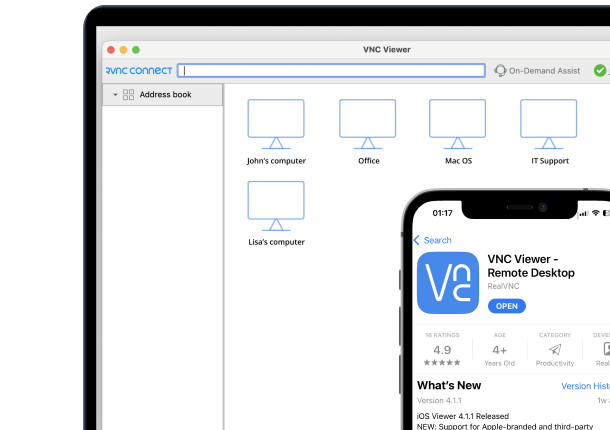
Remote device management gives teams a better way to monitor, update, troubleshoot, and control signage endpoints without visiting each location. Secure remote access tools such as RealVNC Connect allow IT teams to troubleshoot player issues, verify configurations, and apply updates without traveling to each location.
RealVNC Connect uses cloud-brokered connections, end-to-end encryption, and multi-factor authentication to maintain secure sessions across distributed endpoints.
Costs, ROI, and Vendor Evaluation
The total cost of a signage network extends beyond the initial hardware investment, as you must include operating expenses in the long-term budget.
Initial investments include displays, media players, mounts, and installation, while recurring expenses often include the content management system, network connectivity, creative production, technical assistance, and routine platform maintenance.
The ROI organizations can expect varies by use case:
- Internal networks measure reduced update time and fewer site visits
- Customer-facing deployments track engagement and campaign performance
- DOOH networks measure exposure, impressions, and revenue
Proof of play records helps confirm that campaigns, messages, or announcements actually ran according to the approved schedule.
Vendor reviews are more effective when teams use a defined checklist to compare:
Evaluation Area | What to Assess |
CMS usability | Scheduling depth and workflow control |
Hardware support | Compatibility with players and SoC displays |
Integrations | APIs, POS, and data feeds |
Remote access | Secure device control and troubleshooting |
Support Quality and SLAs | Availability, response times, escalation paths, and SLA commitments |
Scalability | Ability to expand across locations |
TCO | Long-term operational costs |
A structured vendor comparison helps organizations avoid restrictive choices and select solutions that can grow with their future needs.
Build a Digital Signage Network That Scales
A digital signage network turns individual screens into a coordinated environment where devices, content processes, and management controls work together.
Successful deployments depend on structured planning, standardized components, and secure management practices. Scale and governance shape infrastructure decisions, while reliability depends on monitoring, proof of play, and remote access.
RealVNC’s secure remote access helps IT teams support digital signage environments without treating remote management as an afterthought. With encrypted, cloud-brokered access, teams can troubleshoot distributed endpoints, reduce unnecessary site visits, and maintain stronger operational control.
Try RealVNC Connect for free today to simplify secure remote access across distributed signage devices.
Frequently Asked Questions
What is a digital signage network?
A connected system of screens, media players, CMS software, and network services used to publish and manage content remotely across one or many locations.
How do you manage content across multiple screens?
To manage a signage network across multiple screens, teams typically use a signage CMS to upload media, create playlists, schedule playback, target display groups, manage permissions, and monitor performance.
What connectivity is best for digital signage?
Ethernet works well for displays that need steady network access to receive content updates, report status, and maintain uptime. Wi-Fi, cellular, and local caching support flexible deployments where cabling or continuous internet is difficult.
How do you secure a signage network?
A secure signage network should use TLS encryption, MFA, SSO, RBAC permissions, device lockdown, audit logging, and regular software updates.
What features matter most in screen management software?
Device enrollment, uptime monitoring, proof of play, remote reboot, and secure remote access for troubleshooting and consistent operational support.