


When resolving IT support needs, businesses often refer to remote support vs help desk solutions interchangeably. The confusion stems from the way help desks often use remote access tools to fix issues. At the same time, remote support platforms often connect with ticketing systems.
But while both are necessary for full-scale technology assistance, they serve different purposes and user needs. Technicians use remote support tools to access users’ devices to fix technical issues. Meanwhile, IT support teams streamline the support process—from accepting service requests to resolving them—with help desk software.
This guide will examine where each solution fits within the IT support workflow and whether you need remote support, a help desk, or both working together.
Why compare remote support vs help desk?
Remote support is generally better for diagnosing and fixing a user’s device in real time, while a help desk is better for logging, prioritizing, assigning, and measuring support work. Choose remote support when a technician needs secure screen access; choose a help desk when the team needs consistent control over support requests.
The challenge grows as more people contact your IT hotline for assistance. HDI reported that an average support center processes up to 10,675 support tickets monthly. 34% of support staff observe rising ticket volumes.
IT teams work to minimize downtime and reduce ticket queues while assisting distributed users and maintaining secure remote access. But troubleshooting typically doesn’t start with a tech accessing one’s device. It begins with a customer reporting an issue. IT teams use different tools in each stage, from assessing the problem to resolving it. To reduce user downtime and resolve user issues quickly, organizations usually evaluate remote support and help desk platforms together.
The next sections compare how the approaches work, where they differ, and how they can operate together.
What are remote support and help desk systems?
What does each solution contribute to your IT support strategy? Understanding their primary responsibilities will make it easier to see how they deliver value and collaborate at different stages of the support process.
What is remote support?
Waiting for technicians to come in person to get users unstuck from a mobile app or PC software problem isn’t always possible. That can even be impractical for work and customer settings. Remote IT support can bridge the physical distance as long as the IT staff and the user have an active network connection. With live screen viewing, technicians can provide real- time remote assistance, investigating issues as the user experiences them.
Some cases require attended support, with the user interacting with the technician in real time so the latter can observe the problem. Once the remote connection is established, the technician can determine the root cause and apply a fix while the user views what happens. In other situations, such as software updates or system maintenance, the user’s participation isn’t required. The two parties can agree on an unattended session on authorized devices.
Remote support is ideal for giving immediate assistance when technical problems disrupt a user’s work. It helps desktop support teams resolve problems on end-user devices, such as account issues, software bugs, routine maintenance, and configuration (setup) errors. It doesn’t cover equipment installation, repair, and cabling work, which require tech support to be physically present.
What is a help desk system?
While remote support focuses on execution, help desks lean toward coordination. Resolving a user’s problem begins when a user places a service request via communication channels, such as phone calls, chat, email, or a company portal. Thus, the help desk serves as the single or primary point for reporting IT-related issues. Ticketing systems create a unique support ticket containing the date, time, and user details. After reviewing and prioritizing the request, the system routes the issue to the right agent or team.
The assigned agent or team investigates and tests solutions using knowledge bases and resolution histories. The ticket may also be escalated to a more skilled team or different specialist if needed. SLA commitments (response and resolution time, escalation path) are recorded at every step. Help desks coordinate and document user support but don’t provide direct access to the affected device, network, or software.
Remote Support vs Help Desk: Feature Comparison
The comparison below highlights the key differences between remote support and help desk solutions and shows where combining them can create a more efficient workflow.
| Feature / Dimension | Remote Support | Help Desk | Best Fit |
|---|---|---|---|
| Primary purpose | Diagnose and resolve device issues remotely | Organize, prioritize, and track support work | Combined support operations |
| Session initiation workflow | Technician launches an approved live or unattended session | User submits a request that is categorized and assigned | Help desk for intake; remote support for remediation |
| User/device access | Screen viewing, remote control, and device administration | No direct endpoint access by default | Remote support |
| Ticket triage and prioritization | May capture session details but does not manage queues | Categorizes requests by urgency, type, and impact | Help desk |
| Escalation routing | Transfers or refers technical issues as needed | Routes tickets across teams and support tiers | Help desk |
| Knowledge base integration | Can support technician guidance during sessions | Links known fixes to tickets and self-service workflows | Help desk |
| Audit trail and reporting | Session notes, recordings, and access logs | Ticket histories, SLA metrics, workload, and resolution reports | Both, ideally connected |
| Best-fit issue types | Live endpoint, software, account, and configuration issues | Multi-channel requests, queues, handoffs, and service measurement | Depends on the issue lifecycle stage |
The table shows where the capabilities of both tools intersect. Their unique functions become clearer when a user phones in or sends a message to request technical assistance.
How do remote support and help desk workflows differ?
These two solutions may complement each other, but their operational paths for resolving user issues differ.
Stage 1: Capturing and preparing the request
The help desk documents the issue and its urgency, then designates it to the appropriate technician with enough context to resolve it. The industry standard is for 80% of issues to be resolved at this primary point of support intake to help calm frustrated users before technical work starts. But only 5% of call centers achieve the world-class first-call resolution benchmark, according to data from SQM.
Stage 2: Investigating and resolving the issue
The assigned agent investigates the issue before starting a secure remote support session when they need endpoint access. The help desk continues tracking the case.
Stage 3: Recording the outcome and enabling future support
The help desk documents the resolution history, including handoffs, status changes, and the final resolution. These records help track service quality and customer satisfaction over time. Meanwhile, the notes and recordings from remote support capture technical evidence from the session, which the IT support team can review to improve efficiency in future cases.
Consider this scenario:
A company staff member calls the IT hotline after getting an “access denied” message when logging in to a business platform. After the help desk validates the user’s identity and confirms the issue’s priority, it then assigns a technician to investigate the affected device.
During the session, the tech discovers that the issue requires a specialist’s access to the backend system. He escalates the case to a specialist, who can refer to the support ticket to view the request history. Meanwhile, the first technician’s logs and notes give the specialist and wider support team the context required to continue troubleshooting where initial assistance left off.
What do remote support and help desks share?
Despite their distinct functions, remote support and help desks rely on four disciplines to deliver reliable and secure assistance:
Principle 1: Reliable service depends on structure.
Help desks and remote support empower businesses to resolve IT issues faster by defining the process and person responsible for each support request. The help desk establishes who should provide assistance and what access is appropriate. The remote support tool then gives the technician endpoint access needed to implement the fix.
Principle 2: Trust must be verified.
Verifying the identities of parties involved in a remote session protects systems and devices. Users can verify that the person accessing their device is authorized. For the IT team, the identity check confirms that the request is legitimate before the technician assists and views sensitive information.
Principle 3: Good support leaves evidence.
Tickets and session records show what happened during the session, whereas knowledge bases preserve troubleshooting guidance for future support. They help teams review support activity and identify recurring problems. They also provide insights to performance metrics, helping managers track user satisfaction and giving desk agents evidence from prior cases to maintain consistent service quality and personalized service.
Principle 4: Governance connects everything.
Governance sets the rules for your IT team in approving and monitoring remote access. This aligns remote support with wider IT services and the IT department’s standards. CISA and industry guidance emphasize using approved tools and approved access paths, along with regular auditing to protect users and systems from unauthorized use of remote access software. In practice, the help desk documents the necessity of remote access and who is authorized to use it. Meanwhile, the remote support tool controls how that access is granted and recorded, which also helps maintain system performance through approved access controls and auditing.
When should you choose remote support vs help desk?
The right choice depends on your team’s immediate challenges.
Choose remote support when device access is the bottleneck
Device access may be your bottleneck if technicians wait for users to describe problems they can’t view or need to travel to diagnose remotely accessible devices. Such access becomes particularly useful in managing devices across locations or in these situations:
- Observing an error as it occurs
- Reproducing an issue
- Changing settings
- Password resets/account issues
- Installing software updates
- Performing authorized maintenance
When users or devices are spread across multiple customer sites or offices, remote support helps manage distributed IT infrastructure without the time and costs of travel. Businesses can support hybrid or fully remote setups because remote tools allow IT staff to offer real-time assistance.
Remote support can solve software and configuration problems. But connectivity failures aren’t one of them because providing remote support requires a working connection with the target device. On-site assistance must come first when the problem involves damaged hardware/cabling, network outages, or power failures.
Choose a help desk when workflow control is the bottleneck
If users ask for assistance through various channels and managers can’t easily see who is handling the case or which SLAs are at risk, workflow control is likely the bottleneck. Help desks provide a unified multi-channel intake with structured escalation paths. Depending on your escalation criteria, high-priority incidents or complex IT issues can be routed from lower-tier agents to a support desk or IT support team with greater technical expertise. Lower-priority cases can be directed to self-service or lower-tier agents.
Managers can use analytics to view ticket volume, workload, response times, recurring issues, and SLA breaches. Such data helps managers pinpoint where support is slowing down.
Startups can begin with a single tool that meets their immediate needs when their teams are still small. But as your business expands, you’ll need a mix of structured ticket management and remote access to sustain consistently efficient support.
How RealVNC delivers secure remote support without the trade-offs
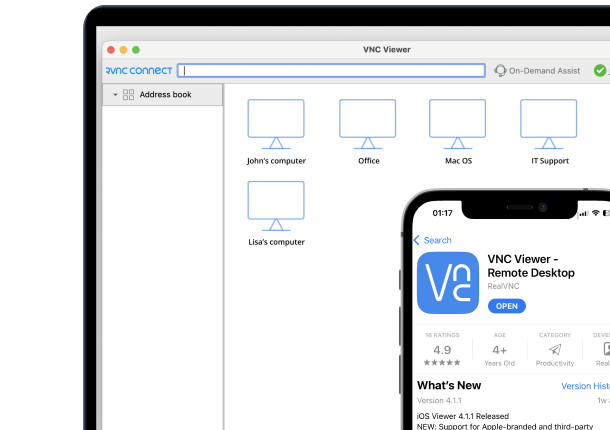
A help desk can establish why remote support operations are needed. Technicians still require remote troubleshooting tools to securely access and fix the affected device. RealVNC Connect provides a secure remote access layer for technical work that follows an approved support request.
Controlled connection
RealVNC Connect’s cloud-brokered architecture enables technicians to launch secure, authorized remote troubleshooting sessions without exposing remote-desktop services directly to the internet.
Verified identity and appropriate access
To manage user access, RealVNC Connect uses multi-factor authentication (MFA) and identity providers such as Microsoft Entra ID and Okta for single sign-on (SSO). MFA and SSO help verify who is signing in before remote-access capabilities become available. Meanwhile, role-based access control assigns permissions based on a technician’s role. Granular permissions determine the devices they can access and the actions they can take on them.
Documented interaction
RealVNC Connect allows teams to record supported RealVNC Connect sessions locally and use session logs to review remote-access activity.
Authorized third-party access
Your organization may need a third-party technician to help troubleshoot a system without giving them permanent access to the platform or device. The Code Connect feature in RealVNC Connect creates a 9-digit time-bound passcode granting third-party access when external assistance is needed.
Remote Support vs Help Desk Verdict
The deciding factor depends on where your support team needs to get unstuck and on the key benefits each option offers. Choose remote support if you lack remote access to devices, since it is the stronger fit for direct remediation of a live endpoint or changing configurations from far away. A help desk will suit your business more if workflow control is slowing the team down. When both problems exist, using both tools can improve and sustain efficiency as you scale.
Conclusion
Growing IT teams and MSPs often benefit from combining structured ticket management with secure remote access. Before finalizing your choice, check your ticket volume, endpoint environment, compliance requirements, and staffing capacity. From there, you can determine where an integrated workflow, including secure, auditable remote access, can provide the most value.
Start a free trial of RealVNC Connect to give your technicians secure, auditable remote access that fits your existing help desk workflow.
FAQs
What is the difference between remote support and a help desk?
Remote access software enables technicians to view and troubleshoot a user’s device through an attended session or approved unattended access. A help desk manages the request around that intervention with its ticketing system. It can also initiate a remote session, but ticketing and remote control remain separate functions.
Can remote support replace a help desk?
Remote support can resolve many device-level issues, but it doesn’t replace ticketing, escalation, service-level, and reporting functions as your operation grows. Small teams may manage low-ticket volumes with a basic help desk platform.
Is remote support cheaper than a help desk for SMBs?
Not necessarily. Your buying criteria should go beyond subscription rates. Consider your users, endpoints, cost of unresolved downtime, implementation, end-user training, and integrations. Remote support can shorten the time fixing IT issues. A help desk can reduce wasted effort through prioritization, self-service, workload visibility, and structured routing.
Which is more secure: remote support or a help desk?
One solution isn’t inherently more secure than the other. They both address different security risks. The help desk supports identity checks and documented authorization. Remote support software ensures that access itself is properly secured and recorded. Least-privilege roles and consent settings are among the control mechanisms teams can apply.
What is the difference between a service desk and a help desk?
Help desk tools primarily handle end-user support and incident resolution. Service desks typically cover a broader range of IT services, including service requests, IT asset management, and change management, which refers to coordinating and documenting planned changes to IT systems. Organizations and platforms use these terms differently, so examine capabilities and workflows when comparing your options.