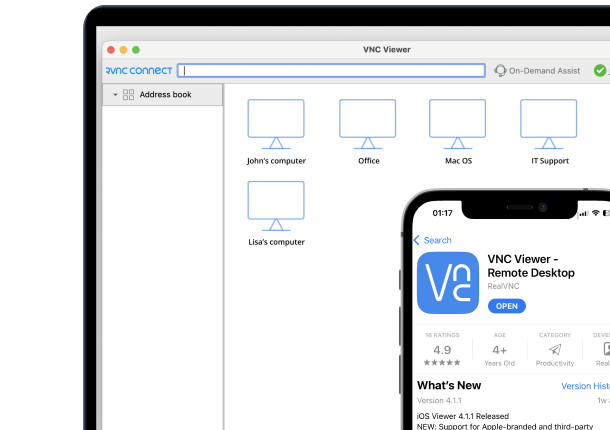




A Raspberry Pi set up as a small desktop or kiosk can still reach a Mac elsewhere on your network or the internet, once RealVNC Viewer is installed on it – useful if you’d rather leave a Mac running in the background and just view it from the Pi.
Why access a Mac from a Raspberry Pi
This suits setups where a Raspberry Pi is the everyday, low-power terminal but a Mac elsewhere still needs occasional attention – checking a file, running a Mac-only app, or helping someone troubleshoot their Mac. RealVNC Connect works the same way regardless of which platform is on each end.
What you’ll need
- A Mac running macOS, either on the same network as your Raspberry Pi or reachable over the internet
- A Raspberry Pi running Raspberry Pi OS to connect from
- A RealVNC Connect account and licence – a free trial is available
- About 10 minutes to complete setup on both devices
Step 1: Set up RealVNC Server on your Mac
On the Mac you want to control:
- Download the RealVNC Connect setup app from the RealVNC website.
- Click Download for macOS.
- Click Accept and Install, and follow the on-screen instructions.
- Once installation completes, choose Start my free trial if you’re new to RealVNC Connect, or Sign in to continue if you already have an account.
- Your browser will open automatically. Follow the on-screen prompts, then click Allow to return to the RealVNC Connect Setup app.
- Review the settings shown, then click Launch. If you keep the default VNC Password, make a note of it – you’ll need it when you connect from another device.
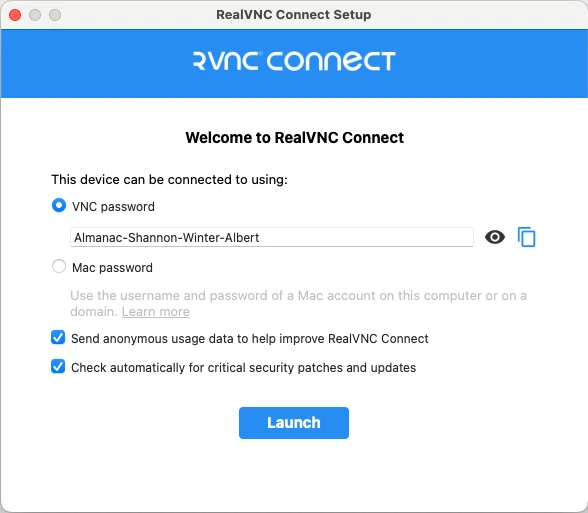
Granting the macOS permissions RealVNC Server needs
On macOS Mojave and later, RealVNC Server needs Screen Recording and Accessibility permission before it can show and control the Mac’s desktop. Skip this step and RealVNC Viewer will show a blank screen, or you’ll only get view-only access.
- When prompted, click Open System Settings, then click the padlock icon at the bottom left to make changes.
- Enter an administrator’s username and password when asked.
- Enable the option for vncagent under both Screen Recording and Accessibility, then click the padlock icon again to lock the changes.
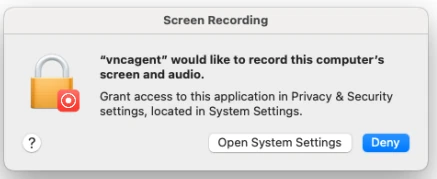
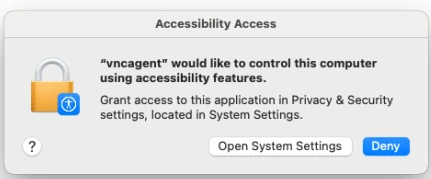
You’ll also see a monthly prompt asking to allow vncagent to capture your entire screen and audio – this is expected, and approving it keeps the connection working.
Step 2: Install RealVNC Viewer on your Raspberry Pi
- On the Raspberry Pi, install RealVNC Viewer using the Recommended Software tool, or open a terminal and run: sudo apt install realvnc-vnc-viewer
- Open RealVNC Viewer from the applications menu and sign in using the same RealVNC account you used on the other device.
Your Mac will now appear automatically as a connection in RealVNC Viewer, listed under your team.
Step 3: Connect to your Mac for the first time
In RealVNC Viewer, double-click the Mac you want to connect to.
Verifying the connection with Identity Check
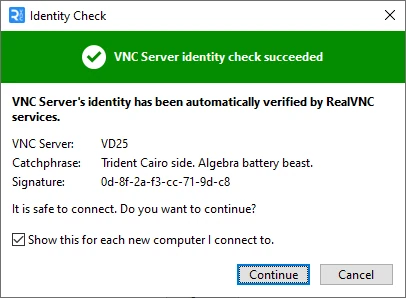
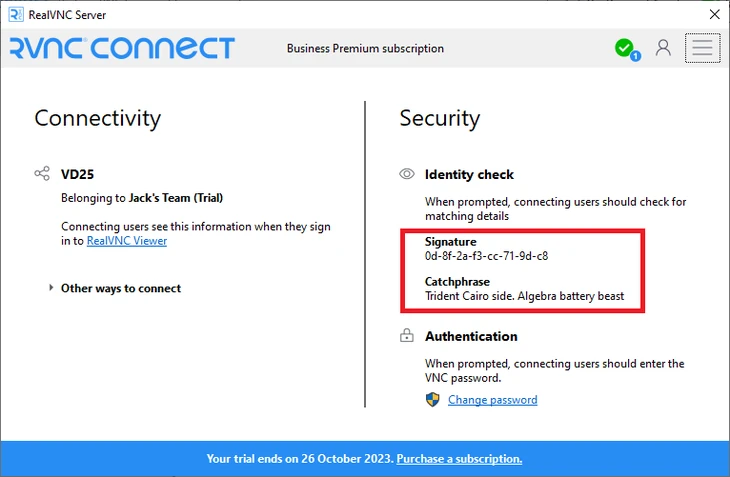
The first time you connect, RealVNC Viewer shows an Identity Check screen with a Catchphrase and Signature. Compare these against the values shown in RealVNC Server on the remote computer to confirm you’re connecting to the right machine. RealVNC Viewer remembers this identity and will warn you if it ever changes on future connections.
Authenticating
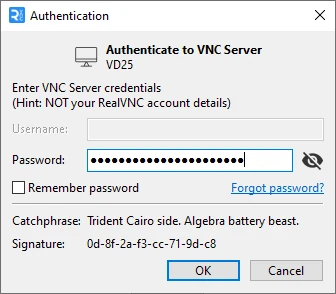
Enter the VNC Password you noted during setup. If you chose Mac Password authentication instead, use the username and password of a user account on the Mac.
Controlling who can connect to your Mac
If you set up authentication using Mac Password, only members of the Mac’s Administrators group can connect by default. To let other users in, add them via Managing users and session permissions for RealVNC Server on the Mac – otherwise they won’t be able to authenticate, even with valid macOS credentials.
Troubleshooting common issues
- Blank screen or view-only access: check that Screen Recording and Accessibility permissions are enabled for vncagent in System Settings > Privacy & Security on the Mac.
- Can’t authenticate: make sure you’re using the password noted at setup, or the correct macOS account credentials if you selected Mac Password authentication.
- Mac doesn’t appear in RealVNC Viewer: confirm both devices are signed in to the same RealVNC Connect account and team.
Keeping your connection secure
RealVNC Connect encrypts cloud connections end-to-end, and every new connection is verified using the Identity Check described above. For extra protection, turn on two-factor authentication on your RealVNC account and use session permissions to control exactly who can view or control the Mac.
Start controlling your Mac from Raspberry Pi with RealVNC Connect
RealVNC Connect offers a free trial with no credit card required, so you can test remote access between your Raspberry Pi and Mac before subscribing.
FAQs
Can I access a Mac from a Raspberry Pi?
Yes. Install RealVNC Server on the Mac and RealVNC Viewer on the Raspberry Pi, then connect using your RealVNC Connect account or a VNC Password.
Does my Mac need to be switched on and unlocked?
The Mac needs to be powered on with RealVNC Server running, but it doesn’t need to be sitting unlocked at the login screen.
Why do I see a blank screen when I connect?
This almost always means Screen Recording and/or Accessibility permission hasn’t been granted to vncagent on the Mac. Enable both in System Settings > Privacy & Security.
Can I use RealVNC Viewer directly on the Raspberry Pi desktop?
Yes. RealVNC Viewer runs as a normal graphical application on Raspberry Pi OS, alongside your other desktop software.