



When a critical machine leaves service without warning, the disruption does not stop at the maintenance desk. Production plans shift, deliveries move, and leaders must choose between waiting for a diagnosis or reallocating people and equipment.
Predictive maintenance technology uses condition signals, equipment history, and analytical methods to identify likely equipment issues early enough to plan an intervention. It bases maintenance decisions on an asset’s operating condition rather than a calendar alone, giving teams time to inspect, prepare parts, schedule work, and record the outcome.
That lead time only creates value when it changes a real decision. Fixed service intervals can remove healthy equipment from operation, while an issue can develop between inspections. A simple threshold may suit a clear temperature limit; more complex assets may require statistical analysis or machine-learning models that interpret changing patterns over time.
This article explains where predictive approaches fit alongside reactive, preventive, and condition-based maintenance. It sets out the decisions that make asset-health data useful, the components required for dependable forecasts, and the investment trade-offs leaders need to assess. It also examines common operational failure modes and the access controls needed when remote specialists investigate alerts on operational systems.
What Is Predictive Maintenance Technology?
Predictive maintenance technology combines condition signals, equipment history, and analytical methods to estimate failure risk early enough to plan a proportionate intervention. It gives leaders a way to decide when an asset needs attention from its actual operating condition, rather than from a calendar alone.
The category is attracting investment, but market growth does not prove a program will produce operational value. Grand View Research’s Predictive Maintenance Market Size & Share Report valued the market at $14.2 billion in 2025 and projects growth from $17.5 billion in 2026 to $98.1 billion in 2033. The investment question remains simpler: will the signal change a maintenance decision before production, service, or asset life is affected?
A threshold alert may be enough when a temperature reading has a clear operating limit. More complex equipment may need statistical process analysis or machine-learning models that assess several signals over time. The right method follows the failure mode and the available evidence.
- Reactive repair: Teams intervene after equipment stops working or shows a clear defect.
- Preventive maintenance: Teams service assets at fixed time or usage intervals.
- Condition-based action: A current reading triggers action when it crosses a defined limit.
- Predictive intervention: Analytics estimate likely future failure and the useful time to act.
| Maintenance approach | Decision trigger | Executive trade-off |
|---|---|---|
| Reactive repair | Failure or visible defect | Lower monitoring cost, but disruption dictates the schedule. |
| Preventive maintenance | Calendar or usage interval | Predictable planning, but healthy assets may leave service early. |
| Condition-based action | Threshold breach | Clear action rule, though gradual patterns may remain unseen. |
| Predictive intervention | Estimated failure risk | Better timing where data and workflow support the forecast. |
The distinction shapes capital allocation. Leaders need to fund the method that improves a real intervention, not the most elaborate model available.
Which Decisions Make Asset Health Data Valuable?
Asset-health data matters when it changes a decision about uptime, service continuity, lifecycle cost, or safe operation. A technically accurate forecast has little operational value if no one owns the maintenance window, spare-part decision, or work order that follows.
The adoption pattern supports that focus on operating design rather than analytics alone. IoT Analytics’ Predictive Maintenance Market: 5 Highlights for 2024 and Beyond reported in 2023 that 95% of adopters saw positive return on investment, while 27% reported payback in less than one year. Those results describe respondents, not a promise for any facility; they still point to the value of choosing assets where a changed decision has material consequences.
Use four dimensions before selecting sensors or an industrial IoT platform:
- Asset Criticality: Determine the consequence of lost service, repair delay, and lack of redundancy.
- Signal Readiness: Confirm that condition data has a reliable baseline and operating context.
- Prediction Usefulness: Set the lead time and confidence needed to alter the plan.
- Workflow Closure: Assign an owner who turns the forecast into completed work and recorded learning.
| Framework dimension | Leadership question | Evidence source | Decision supported | Common misread |
|---|---|---|---|---|
| Asset Criticality | What does loss of this asset interrupt? | Production dependency and repair lead time | Instrumentation priority | Every costly asset suits forecasting. |
| Signal Readiness | Is the signal complete and contextualized? | Sensor history and maintenance records | Data investment | More data automatically improves decisions. |
| Prediction Usefulness | Will lead time alter the intervention? | Forecast confidence and planning window | Model selection | Detection alone equals value. |
| Workflow Closure | Who acts and records the result? | CMMS records and decision rights | Operating-model design | Alerts close themselves. |
Adoption is also becoming more common. Yahoo Finance’s report on the Fluke survey stated in 2026 that adoption rose from 9% to 18% in one year, while reactive maintenance remained at 36%. That does not settle the investment case. It makes disciplined selection more necessary as more teams collect asset data.
How do asset criticality and signal readiness interact?
Asset criticality tells you where a missed failure carries the greatest consequence; signal readiness tells you whether a forecast deserves trust. Start with production dependency, repair lead time, redundancy, and the practical exposure created when the asset leaves service.
The cost range shows why each asset needs its own assessment. Facilities Dive’s reporting on MaintainX research found that one hour of unplanned downtime averaged about $25,000 in 2024 and could exceed $500,000 an hour for larger organizations. Dr. Tim Gudehus, Director, Deloitte Analytics Institute, wrote in Deloitte’s Predictive Maintenance – Position Paper: “Data is the fuel of any predictive maintenance engine. Its quality and quantity is the limiting factor for analyzing root causes and predicting failures well ahead of time.” A critical asset with weak baselines needs better evidence before it needs a more sophisticated model.
How do prediction usefulness and workflow closure work?
A forecast is useful when it provides enough lead time, confidence, and specificity to change the maintenance plan. Workflow closure means a named owner receives the alert, decides on intervention, creates the computerized maintenance management system (CMMS) work order, and records whether the work confirmed the forecast.
Consider a hypothetical CNC spindle with an unusual vibration pattern and a 48-hour intervention window. If the team has a planned stoppage, a spare part, and an accountable engineer, the forecast changes the schedule. If none exists, it remains an interesting signal. ThinkAI Corp’s General Motors case study documented an AI-driven model that predicted more than 70% of equipment failures at least 24 hours in advance in 2025; that is a documented case, not a transferable benchmark.
- Lead time: Define the minimum notice needed to schedule safe work.
- Confidence threshold: Set the evidence level that warrants intervention.
- Intervention owner: Name who approves, plans, and completes work.
- Closed-loop outcome: Record whether the finding proved accurate and improved the next decision.
IEC 63270-1:2025 calls for defined functional structure, procedures, interfaces, and data requirements. Those requirements turn an alerting project into a maintenance capability with accountable handoffs.
Which Components Enable Reliable Failure Prediction?
)
Dependable failure prediction rests on a chain of evidence: fit-for-purpose sensing, contextualized data, proportionate analytics, and an intervention workflow. Break one link, and the forecast becomes harder to trust.
Across analyzed cases, SSRN’s Optimizing Predictive Maintenance with Machine Learning and IoT reported 30–40% lower unexpected downtime and 20–30% lower maintenance costs in 2024. Those ranges are useful context, not an investment promise. They depend on data quality, equipment type, and the team’s ability to act on findings.
- Condition signals: Select vibration, thermal, acoustic, oil, pressure, or electrical data for known failure modes.
- Asset and operating context: Add load, duty cycle, maintenance history, and environmental conditions.
- Data pipeline: Govern edge-to-cloud synchronization, retention, normalization, and data lineage.
- Analytical method: Match thresholds, statistical process analysis, anomaly detection, or remaining-useful-life models to the decision.
- Action integration: Connect alert priority to CMMS ticketing, technician evidence, and outcome feedback.
| Component | Leadership signal | Decision enabled | Common failure mode |
|---|---|---|---|
| Condition signals | Sensor relates to a known defect path | Instrumentation scope | Monitoring convenient data rather than useful data |
| Operating context | History explains changing load and environment | Accurate interpretation | Treating every operating state as comparable |
| Data pipeline | Records remain traceable across systems | Trustworthy model inputs | Missing or irregular records |
| Analytical method | Method matches available evidence | Proportionate investment | Using complex models for simple thresholds |
| Action integration | Alert reaches an accountable owner | Timely intervention | Diagnosis stops before work begins |
Edge computing gateways deserve scrutiny when latency, bandwidth, resilience, or data-residency requirements justify local processing. They are not a default architecture choice. Dr. Romain Rouvoy, Professor at Université de Lille and INRIA, cautioned in AI4I-PMDI in 2025 that public datasets do not capture fleet context, missing data, and irregular data acquisition. Production validation must therefore reflect the conditions your operators actually manage.
How Should Leaders Build a PdM Investment Case?
A sound investment case starts with avoided consequence, not sensor count. Prioritize a limited group of assets where an earlier intervention changes throughput, quality, contractual performance, repair planning, or asset life.
Sector context changes the weighting. Regulated process industries may place greater weight on safe operation and audit evidence; discrete manufacturers often focus on throughput and maintenance-window coordination; fleets tend to prioritize vehicle availability and operating safety. Preventive maintenance remains the better economic choice when service is simple, failure patterns resist modeling, or the proposed architecture costs more than the exposure it reduces.
Plant Services’ account of Cosmo Oil’s refinery program reported in 2025 that centralized data and digital twins across three Japanese refineries reduced engineers’ data collection and analysis work from hours to minutes while supporting rotating-machinery monitoring. The example shows a workflow change, not a universal return figure.
- Rank consequences: Quantify safety, throughput, quality, contractual, and repair implications for each candidate asset.
- Define the intervention: State the action a forecast enables and the lead time it requires.
- Fund the full operating model: Include data engineering, integration, training, spare parts, and model review.
- Measure realized outcomes: Compare avoided events, maintenance timing, false positives, and lifecycle decisions with the baseline.
CSL’s Shell Case Study recorded more than 16,000 internet-connected control valves across Shell’s global refineries as of April 2023. Its condition-monitoring work illustrates why scale increases the need for clear prioritization and ownership. The business case earns approval when it funds a decision process, not a collection of connected devices.
The 4 Predictive Maintenance Failure Modes
A pilot can produce accurate outputs and still fail in day-to-day operations. The recurring problems are incomplete evidence, disconnected records, excessive alerts, and unclear authority when production and maintenance priorities conflict.
NASA’s analysis of barriers to model-based prognostics and health management identified prediction complexity, validation, safety and regulation, adoption cost, impact measurement, and data availability, quality, and ownership in 2023. These are connected design issues. A model review needs clear evidence thresholds, defined human override authority, feedback from technicians, and periodic reassessment of whether the forecast remains useful.
- Incomplete evidence: Missing, irregular, or uncontextualized sensor data distorts model outputs.
- Integration debt: Disconnected OT, CMMS, and enterprise records prevent workflow closure.
- Alert fatigue: Excessive or low-confidence alerts erode technician trust.
- Ambiguous decision rights: Teams lack clarity on who can pause production, approve work, or override a prediction.
Dr. Kalina Staykova, Associate Professor at Copenhagen Business School, wrote in Predictive Maintenance for Industry 5.0: “We identify four factors that facilitate PdM adoption: trust between decision-maker and model (maker), control in the decision-making process, availability of sufficient cognitive resources, and proper organisational allocation of decision-making.” Leaders need to treat those factors as operating requirements. A forecast earns trust when teams know who reviews it, what evidence supports it, and how the decision will be recorded.
RealVNC and the Predictive Maintenance Access Problem
)
Condition alerts often require a remote reliability engineer, original equipment manufacturer specialist, controls integrator, or IT team to inspect a human-machine interface, engineering workstation, historian, or CMMS-connected endpoint. The access problem is providing timely support without making standing third-party access, shared credentials, or unrecorded sessions routine parts of maintenance work. Asset criticality, workflow closure, and decision rights apply to this support activity as much as they apply to the model.
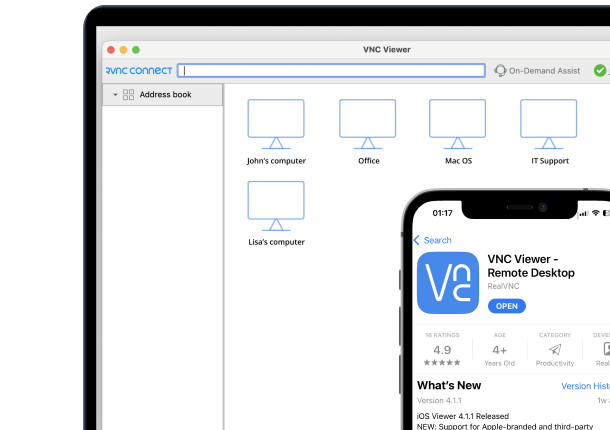
RealVNC Connect provides a controlled remote-access layer for support and remediation activity adjacent to a condition-monitoring program. Its controls map to practical workflow outcomes:
- Multi-factor authentication (MFA) and single sign-on (SSO): Microsoft Entra ID or Okta identity assurance supports attributable access.
- Role-based access controls (RBAC): Granular action-based permissions limit keyboard, mouse, and file-transfer activity by role.
- Session monitoring, recording, and detailed audit logs: Authorized administrators can review remote diagnostic activity and retain evidence.
- Code Connect: Single-use 9-digit session codes provide time-bound third-party access without persistent credentials.
The requirements in IEC 63270-1:2025 for defined interfaces, procedures, and data requirements extend to the remediation workflows around monitored assets. When remote specialists investigate an alert, teams need to document who reviewed operational systems, what activity occurred, and how the maintenance decision closed. RealVNC Connect does not replace maintenance engineering, sensor analytics, CMMS functions, or safety procedures; it governs the access surrounding distributed support. That gives IT and OT leaders clearer evidence of remote activity when they review operational decisions.
Final Words
Predictive maintenance technology earns its place when it changes a real maintenance decision before an asset leaves service. Start with the consequence of downtime, then test whether condition data is reliable enough to guide action, whether the forecast provides useful notice, and whether a named owner can turn it into a work order and recorded outcome. That approach keeps investment focused on assets where earlier intervention affects throughput, service continuity, repair planning, or operating safety. IEC 63270-1:2025 reinforces the need for defined procedures, interfaces, and data requirements across that operating model.
Remote investigation belongs inside that closed loop when reliability engineers, integrators, or original equipment manufacturer specialists need access to operational endpoints. RealVNC Connect brings multi-factor authentication (MFA), single sign-on (SSO), role-based access controls (RBAC), and detailed audit logs to those support sessions, so your teams can attribute access, limit permitted activity, and retain evidence of the work completed. Leaving this access unmanaged weakens the decision trail precisely when the maintenance program needs clear ownership. Arrange a meeting to discuss how RealVNC Connect provides controlled, auditable remote support for maintenance and OT workflows.
FAQs
What is the asset-health decision framework?
Predictive maintenance technology should be evaluated through asset criticality, signal readiness, prediction usefulness, and workflow closure. This framework tests whether a monitored asset deserves investment, whether its data supports a reliable forecast, whether the forecast provides useful planning time, and whether an accountable owner acts on the result. IEC 63270-1:2025 also identifies procedures, interfaces, functional structure, and data requirements as core program considerations.
How does condition-based maintenance differ from predictive maintenance?
Condition-based maintenance starts service when a measured condition crosses a defined threshold, while predictive maintenance estimates future failure risk and useful intervention timing. A vibration or temperature limit may suit a clear failure mode; analytics are more useful when gradual or combined signals require interpretation. Both approaches may sit within the same reliability program.
Can you give me an example of predictive maintenance?
A CNC spindle that develops an unusual vibration pattern is one example: the system estimates a likely failure and gives the maintenance team time to schedule inspection, parts, and a work order before production is interrupted. Other examples include thermal monitoring of electrical equipment, oil analysis for rotating machinery, and pressure monitoring in industrial systems. The method is valuable only when the forecast changes an operational decision.
Which governance controls sustain industrial prognostics?
Industrial prognostics require clear data ownership, validation thresholds, alert escalation, human override authority, technician feedback, and periodic review of model usefulness. NASA identifies data quality, ownership, validation, safety, cost, and impact measurement among the connected adoption barriers in model-based prognostics (NASA, 2023). Dr. Kalina Staykova and her co-authors also identify trust, decision control, cognitive capacity, and appropriate allocation of decision-making as adoption factors (Predictive Maintenance for Industry 5.0, 2023).
What tools are used in predictive maintenance?
Common tools include condition sensors, edge computing gateways, data pipelines, analytical models, asset-health dashboards, and computerized maintenance management system (CMMS) workflows. The correct combination depends on the failure mode, operating context, required lead time, and ability to connect an alert to planned work. A larger toolset does not compensate for missing maintenance history or unclear decision ownership.
How does RealVNC support predictive maintenance workflows?
RealVNC Connect governs remote support sessions adjacent to maintenance activity through multi-factor authentication (MFA), single sign-on (SSO), role-based access controls (RBAC), session monitoring, recording, detailed audit logs, and Code Connect time-bound session codes. These controls help organizations identify who accessed an engineering workstation or other operational endpoint, limit permitted actions, review session activity, and authorize temporary third-party assistance. RealVNC Connect does not provide sensor analytics or maintenance models; it controls the access surrounding investigation and remediation.