



IT campaigns carry risk; so ensuring an organized display has become a prerequisite for most organizations. Picture managing a large network of digital screens across multiple offices, campuses, or retail sites. One screen goes black, another freezes, and your team hears about it from someone walking by. That could waste months of work put into securing leads.
This is why teams operating at scale in a secured environment are pivoting towards digital signage remote management over manual screen management approach. But, what exactly does this concept entail? Well, digital signage remote management is the process of monitoring, controlling, and updating the display of content, which could be ads, info, or announcements through a centralized system.
Continue reading as we further explain digital signage remote management, including its features, implementation, security, and platform compatibility.
What Digital Signage Remote Management Is and How It Works
Digital signage remote management entails the centralized oversight of display and media players from a single administrative interface covering content, device status, remote reboot, and fleet management. Now, the key narrative here is its unique signage network monitoring abilities, which makes it distinct from content publishing that is often limited to scheduling and distributing media to multiple screens.
Before going further, we must state that this term is also used to refer to the following:
- Remote Device Management (RDM).
- Remote Monitoring and Management (RMM).
- Cloud-Brokered Screen Management.
The entire process entails setting up a central management console to coordinate remote device control. This console acts as an on-device agent for each device component gathering system data and executing commands, and encrypting outbound connectivity with multiple monitors (commonly on ports 443 and 3478).
Key Features and Monitoring Capabilities
A digital signage software should offer vital proof of play reporting features from player health monitoring, and remote screenshots to remote commands and real time alerts. Let’s break down each of these features.
Player Health Monitoring
Under this function, signage network management systems monitor the operations of its players through the central console. It can detect CPU loads, storage thresholds, and if a device loses network connectivity or powers off. The system can also prevent hardware failure by spotting overheating or power irregularities. It does this by integrating device polling protocols or cloud-agent software that regularly report these statistics.
This feature ensures that issues like frozen screens, overloaded devices, and connectivity failures are prevented. As in the case of this Fortune 100 client of Canopy, where downtime was dropped by more than 40% and teams gained full visibility into device performance, it ensures uptime and consistent campaign delivery.
Remote Screenshots and Playback Verification
Through remote signage management platforms, visual confirmation of what displays show at any moment, helping to verify that content is running as planned. Users can use this feature for audit or troubleshooting, detection of playback errors, frozen screens, or blank displays, and validation that playlists and scheduled content correspond with location-specific programming. It allows teams to effectively reduce their physical visits to their display screens.
Remote Commands (reboot, restart, configuration updates)
Digital signage softwares can execute commands such as, rebooting frozen players, restarting applications, and pushing configuration updates. The interesting part is that this feature can be automated to reduce downtime and manual troubleshooting. As seen in the case of this DOOH (Digital Out-of-Home) operator managing 1,000 screens, whose problems included frozen players, unreliable connectivity, and expensive “truck rolls”, it can help organizations achieve 95% reduction in on-site visits and 99.9% uptime.
Alerting and Notifications
Through a remote digital signage software, IT personnels can receive instant notifications, enabling troubleshooting teams to respond immediately. It could be any form of notification including:
- Alerts triggered on device offline status, playback failure, or hardware errors.
- Escalation chains through mediums such as SMS, email, push notifications.
- Alerts based on thresholds (e.g., temperature exceeding safe limits).
Scaling Across Multi-Site and Multi-Tenant Deployments
Even if the connected devices are up to a thousand, it is the goal of digital signage networks to ensure a single, structured, and manageable ecosystem. This allows for seamless management functions like grouping and tagging by unique differentiators whether it is geography, site type, or department. It plays a crucial role in creating an enjoyable environment across several deployments and sites.
Take for instance; in the UK, global real estate group, Lendlease transformed its employee communications, using a cloud-brokered digital signage system. According to the Lendlease team, this centralised system enabled them to roll out a uniform, easy-to-manage network, and create a “true office of the future” across all its sites in Europe.
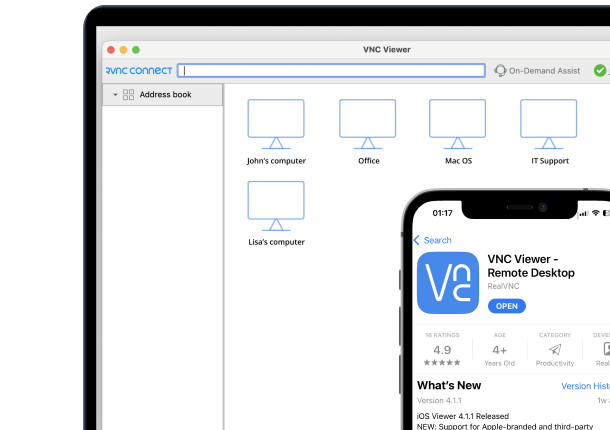
Meanwhile, in multi-tenant environments like malls, airports, hospitals, or franchise chains, remote screen monitoring gives each tenant a dedicated workspace, user only access, and admin’s overarching control across deployments. Adding RealVNC Connect to your infrastructure ensures that you maintain this control, especially since it lets you restrict what a user can do mid-session rather than just handing over an open-ended connection.
Security, Network Requirements, and Platform Compatibility
These are the features that make a digital signage remote management software stand out from the competition.
Security Components
- SSO or SAML Support: These are features that allow users to get an easy and verified login.
- MFA for Administrator Authentication: This feature gives your signage network an extra layer of protection against unauthorized access. With it, admins verify their identity using two or more authentication factors before access.
- TLS or HTTPS Protection for all Communications: These features are the backbone of secure connections. It performs the function of encrypting and decrypting messages when they move from a sender to its receiver.
- Vendor Patching and Vulnerability Response Processes: These highlight a proactive approach to fixing bugs, closing security gaps, and improving system performance. Platforms can execute these plans through their regular updates.
- RBAC and Least-Privilege Administration: These systems maintain the balance between control and user expression. Their main goal is to avoid human errors in the signage networking process.
- ISO 27001 or SOC 2 Alignment: A ISO 27001 or SOC 2 certification certifies a platform’s security, availability, processing integrity, confidentiality, and privacy controls based on the Trust Service Criteria (TSC) established by these Institutes.
Network Requirements
- Bandwidth Requirements: The bandwidth needed for a remote management system depends on the content resolution, frame rate, and the number of displays connected to the network.
- Wireless vs Wired Connection: Whenever possible, use a wired Ethernet connection for your digital signage players. That’s because this type of connection provides greater stability and bandwidth compared to wireless connections, which can be prone to interference and signal degradation.
- Offline Functionality and Caching: Pick a remote signage network that has local caching functionality. This allows digital signage content to play even when you have a downtime or when internet connectivity cuts off.
Platform Compatibility
- Operating Systems: It is always recommended to choose digital signage systems that support various operating systems even though it is Windows, macOS, or Linux.
- AI Integration: The best remote signage platforms are now integrating AI and automation techniques to ensure seamless content changes and scheduling. Stay ahead of the curve and take advantage of these solutions.
After setting up the right infrastructures, you need RealVNC Connect to maintain control and stability, to ensure that even if something goes wrong, you have the logs to prove exactly what happened.
Content Control and Offline Resilience
Reliability is the backbone of any remote device management signage. You don’t want small downtime to erode the trust your system and team has struggled to build. However, what is reliability without control? The simple logic to ensuring reliability is to maintain control of your network one way or another.
To achieve control and efficiency, top remote management platforms typically cover areas, such as:
- Playlist orchestration
- Scheduling by time or daypart
- Group-based publishing
- Content approval workflows
- Version control
- Location-based targeting
- Live data feeds
- Emergency messaging override for urgent communications.
Besides control, offline resilience is another crucial factor that determines which remote signage network you should choose. You have to ask questions like; what happens during off-hours when there is no Internet connection? Do failover rules apply when scheduled content cannot load? Does differential sync reduce bandwidth use for updates?
Seeking answers to these questions gives you a clear prospect for your digital signage remote network. But, it doesn’t end there; even with the right signage remote network in place you need RealVNC’s RealONE solution to manage, troubleshoot, and update digital screens from a single, centralized dashboard without needing a VPN.
Implementation and Vendor Evaluation
Setting up an effective remote signage network requires strategy instead of listening to every marketing claim online.
- Assess Current Hardware and Connectivity
If you already have existing hardware components for your remote management system, then you first evaluate what is working and what you need to improve on.
- Define Ownership Across IT, AV, Content, and Support Teams
This phase involves creating a structured model to execute tasks. For instance, IT personnel handle secure technology infrastructure, while AV teams are in charge of hardware. Content strategies are driven by the marketing/communications department, while support teams ensure a complaint-free day to day operation.
- Establish Maintenance Windows and Escalation Paths
This phase entails investing in a proactive approach to managing system health, while setting up systems that can effectively resolve issues. The goal here is to ensure uptime by reducing technical emergencies.
Your remote signage network becomes effective with these tips but it may not fully address every project interface issues. Hence, RealVNC Connect is the ideal solution to complement your signage system for deeper troubleshooting: OS-level issues, kiosk-mode recovery, cross-platform support, and audited administrator access that signage-specific tools may not cover.
Beyond risk aversion the RealVNC Connect allows for seamless management since they can access each player interface as if they were physically present. Then there’s the layer of enhanced security and accountability where this tool ensures that every action taken on a player is logged and traceable.
Conclusion
The days of regular site visits and physical player health monitoring of display screens are now gone, thanks to the new age of digital signage remote management. Users get centralized visibility, remote control, and scalable content operations in IT delivery. However, teams must invest in signage systems that meet certain criteria like SSO or SAML Support, TLS or HTTPS Protection, ISO 27001 or SOC 2 compliant, and our network standards.
Also, setting up an effective signage management platform may not solve all your monitoring issues. Hence, complementing it with RealVNC Connect, a platform that offers 256-bit AES encryption, granular RBAC, and total session recording, is the most optimized solution for an interface.
Try RealVNC Connect free and upgrade your signage remote management system above the competition.
Frequently Asked Questions
What Is Digital Signage Remote Management?
Digital Signage Remote Management is the process that involves centralized monitoring, control, updates, and troubleshooting of screens and media players from one platform, covering content, device status, remote reboot, and fleet management.
How Does Cloud-Hosted Screen Control Work?
In cloud-hosted screen control, distributed players connect to a central dashboard over secure internet-based communication, enabling remote device control, easier scaling, and less on-site maintenance.
What Features Matter Most for Managing a Signage Network?
Several features are vital to managing a signage network. These include:
- Player health monitoring
- Uptime alerts
- Proof of play
- Content distribution at scale
- Governance features like MFA, SSO, and audit logging.
Can You Manage Digital Signage Without a VPN?
Yes. Many platforms use firewall-friendly outbound connectivity with TLS encryption end to end and proxy support, no VPN required.
How Do You Scale Remote Management Across Hundreds of Screens?
To scale remote management, you can use tags, grouping, mass deployment templates, zero-touch provisioning, policy-based management, and staged rollouts. Multi-tenant architecture helps service providers and larger environments.