


If your organization’s IT infrastructure is still mostly sitting on a Windows domain with a single help desk, DameWare can be a practical fit. However, there are not very many environments that truly operate as a 100% Windows shop in 2026. Business mergers, SaaS adoption, devs running Linux boxes, and executives who live on mobile devices have turned IT support into a cross-platform exercise.
IT leaders who understand this and are looking for DameWare alternatives usually do so because of the diversification of operating systems, but also because they are trying to avoid the trap of getting stuck in vendor workflows. They also think of their security posture because remote access makes up a significant part of the control plane. Aspects like encryption, logging, and identity control are just as important as compatibility with operating systems in use.
This guide is for forward-thinking IT decision makers who are looking to compare enterprise remote access and remote support options for their mixed fleets without having to rely solely on Windows.
Understanding DameWare remote and when to consider alternatives
SolarWinds DameWare remote support is targeted at IT teams that predominantly support Windows domains, where an all-in-one suite for on-call help desk suffices. Alongside remote control, DareWare remote sessions can cover Windows, Linux, and macOS endpoints, but the tool itself is designed to center around Windows and Active Directory workflows.
Teams will usually start looking for alternatives when DameWare is no longer fit for service. Common drivers are typically:
- The SolarWinds stack dependence limits vendor flexibility.
- The deployment model requires extensive server, agent, and network planning.
- Licensing is based on support technician seats, which can significantly impact budgets when teams scale.
- A patchwork approach to remote access protocols (VNC/RDP) across Linux, macOS, and Windows machines.
Dameware remote support is an effective remote access tool in smaller environments running classic Windows operations. Modern organizations require more vendor independence, earning alternatives a second look.
Comprehensive evaluation framework for remote support alternatives
Selecting a remote support solution can result in teams deciding on a tool that doesn’t fit how your teams operate. A structured framework that guides each alternative keeps evaluation grounded and unbiased when vendors bring on the sales pitch and feature lists.
Below is a six-point framework you can use to approach the search for a remote access solution that details business operations, outcomes, compatibility, and vendor-specific details.
1. Deployment model and infrastructure
There are two main deployment models when it comes to remote access, but businesses should start with how the product will actually be run in production.
Many teams prefer a cloud-based service that centralizes configuration while speeding up rollouts at the same time. Others in sensitive industries that demand offline setups will need an on-premises and direct connection setup for policy and connectivity constraints.
Ask questions like what must be installed, what needs inbound network exposure, and how upgrades will work inside of tight windows.
2. Cross-Platform Consistency
With mixed operating system environments now being the norm, it is important to evaluate whether technicians are going to get a standardized experience across Windows, macOS, Linux, and mobile endpoints. Consistent tools reduce the time to train technicians and end users, plus prevent awkward situations where what works on one laptop does not work on another.
3. Security and compliance readiness
Security should be treated as a design property rather than a checkbox. Review the encryption, authentication options, audit logging, and access controls for zero-trust and least privilege. Confirm how security evidence can be produced for auditing and how long and where logs are retained.
4. Management and Automation
Management and automation are what reduce operational overhead for teams. Look for centralized policy, role-based controls, and a solution that can be deployed at scale. Verify all management capabilities and API support for reporting, integrations, and audit processes.
5. Vednor independence
The only true way to avoid vendor independence completely is to use open-source solutions, but these come with unacceptable risks for enterprises. In saying this, the vendor you do choose for remote access shouldn’t keep you locked into its ecosystem for authentication, ITSM tooling, and other software designed to work alongside the remote access component itself.
6. Licensing and TCO
Compare licensing models and how costs scale when your business needs to grow. Align pricing with real usage patterns like device counts, concurrent sessions, or technician seats.
Evaluate support teams and the practical feature sets that are actually included in the tier you would buy, rather than add on later.
| Evaluation criterion | DameWare-leaning pattern | Modern requirement |
|---|---|---|
| Deployment model | Often on-premises oriented | Remote access that can run cloud or self-managed |
| Platform consistency | Varies by OS and protocol | Remote support sessions need parity across endpoints |
| Security posture | Strong controls, validate scope | Documented security controls and audit trails |
| Management approach | Tooling plus add-ons | Unified management with automation hooks |
| Vendor dependency | SolarWinds-aligned | Vendor-agnostic integration options |
| Licensing structure | Commonly technician-based | Predictable scaling for remote support teams |
Cloud-native architecture and simplified deployment
A cloud-native deployment changes the cost profiles of remote support in a way that businesses can immediately feel. Cloud-brokered connections mean fewer handoffs, considerably less network configuration, and far fewer dependencies.
Infrastructure requirements, endpoint management, and deployment complexity
A DameWare remote access solution assumes that you will stand up servers, have new subnets and firewall rules already in place, and will have created dedicated OUs, GPOs, user and computer objects before rollout can even take place.
In a cloud-based model, teams can create teams, users, and groups on the browser-based management console itself, or use SSO to authenticate existing users. Then it is just a matter of deploying all-in-one lightweight software to devices, which can be done at scale.
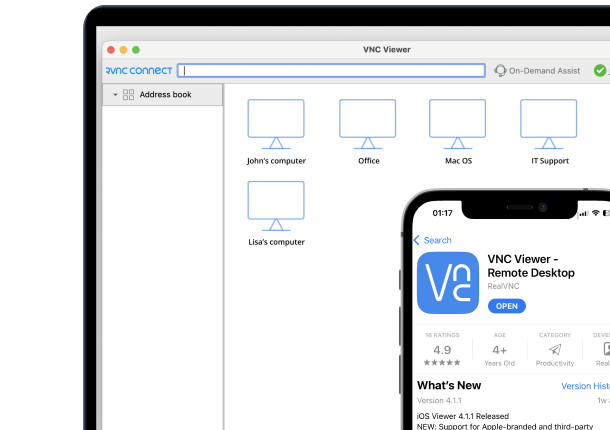
RealVNC Connect, for example, supports mass deployments and rollouts using your existing packaging tools like Microsoft InTune. It turns deployment into a repeatable policy task instead of a one-off sprint across endpoints.
Operational advantages of cloud-native IT management architecture
Cloud delivery reduces server upkeep, shortens already crowded change windows, and keeps features current without needing to extend downtime windows for critical infrastructure. A cloud-brokered remote connect also means a remote machine behind an internet service provider CGNAT or proxy servers can be reached without modification to perimeter firewall rules.
RealVNC Connect onboarding supports fast setup for distributed teams. And if policy requires a self-hosted option, the enterprise management console can still offer the same path while keeping deployment and administration inside your network.
Cross-platform consistency and unified user experience
Consistency across both the remote viewer and server applications and operating systems means that both support teams run the same playbook.
Protocol architecture and feature parity
DameWare remote support can reach macOS and Linux as well as Windows, and its SaaS product DameWare Remote Anyway can remotely access Android and iOS mobile devices. However, it uses a mix of remote access protocols to achieve this, meaning that the experience is uneven and performance changes from one desktop to the next.
A consistent remote support software tool becomes harder to document in the knowledge base and playbooks when the protocol beneath changes the workflow. For network security systems relying on Deep Packet Inspection, multiple allowances and duplicated rules based on protocol also need to be created to facilitate it.
RealVNC Connect’s approach uses a single Remote Framebuffer (RFB) across all operating systems, and the RealVNC Connect client is a unified application with both server and viewer functionality. That means that screen sharing controls stay consistent across OS types and devices.
Operational impact of consistent user experience
Standardization of experience is important where it matters most: during escalations and high-priority incident requests. With technicians and support teams familiarized with the one menu layout and settings, customer support can be delivered more efficiently when every second counts.
Multi-monitor support also helps support teams keep context while in the same screen-sharing flow. And remote control from a mobile device should ideally be similar regardless of whether you’re supporting an iPad in the office, or an Android tablet out in the field.
Vendor independence and ecosystem flexibility
Plenty of teams like how SolarWind’s tools align and work together, but if a remote tool ends up holding an organization hostage to its tech stack, you can lose risk control.
Ecosystem dependencies and integration limitations
Organizations running ServiceNow, Zendesk, or Jira Service Management typically want a clean integration without having to reengineer data connectors. A vendor-agnostic approach leans on standard identity, predictable exports, and APIs that support automation and data sharing.
RealVNC Connect’s API Access supports that model and fits into broad IT management workflows without awkward workarounds and brittle custom scripting.
Strategic benefits of vendor independence
The freedom to choose not only best-in-class tools, but the best fit for your organization is important for endpoint management, audit control, and long-term cost control. Keep ownership of your data, keep options open, and keep customer support conversations focused on outcomes rather than vendor politics.
Industry use cases beyond Windows-centric environments
It’s quite rare to see an organization running a Windows-only fleet in modern environments. Two scenarios come up repeatedly in enterprise evaluations.
First is where ITSM has to deal with mixed endpoints. A global firm can easily have a Windows-only finance department, but devs and designers using macOS. They could have engineers using Linux servers and desktops that are not even domain-joined. A technician can’t be expected to provide remote assistance to all platforms if the remote access tool simply doesn’t support it or behave the same way.
Lightweight remote monitoring can also be of benefit in industries like manufacturing, where downtime and proactive maintenance can save time and money.
Second is cloud and hybrid operations. DevOps teams often need controlled, secure remote access sessions into bastions, jump boxes, or managed servers. This needs to be done with full auditing, especially for incident post-review on secure infrastructure.
Addressing complexity and deployment challenges
Depending on your remote access tool, the complexity usually shows up first at the help desk, then later in any post-incident reviews. Some quick challenges and responses unique to your business can help guide decision-makers toward a more informed decision. For example:
- Challenge: Deployment overhead across sites and the network.
Response: Standardize the rollout with policy-driven installs with centralized control.
- Challenge: Protocol and tool sprawl mean multiple workflows for essentially the same work.
Response: Lean more toward consistent session tooling, so playbooks only need one entry for one task.
- Challenge: Licensing costs rise as teams and coverage expand.
Response: Choose a subscription plan with a starting price that is cost-effective for operation, but leave room for expansion based on realistic forecasts.
- Challenge: Update cadence and patch management that creates risk and weekend work.
Response: Use predictable release controls and use a centralized management platform and automated patching cycles rather than manual per-device patching.
Best practices for evaluating remote support alternatives
An evaluation can yield better-than-expected results because you’re looking at a polished demo and not your operational reality. Keep the process strict, then let the tool prove itself under normal pressure.
Requirements and stakeholder alignment
- Understand, then document what “good” looks like for remote support sessions across the networks and OSs your business uses, or is likely to use in the future.
- Define the security and audit requirements up front and make sure the owners of these business facets are involved from the start.
- Map out your integration needs, including identity and your ticketing system workflow.
- Set metrics for what success looks like for deployment time, admin effort, and technician efficiency.
- Include both the helpdesk management and a few power users that represent the departments in your business, so that you’re building from a foundation of real business operations.
Proof of concept validation
Run at a minimum, two weeks of support sessions with endpoints representative of your daily business operations. Test onboarding controls and audit log retrieval, plus the information contained within. Include escalations that require session transfer between support tiers to make sure handoffs are clean.
Test the stated feature sets under real-world conditions. File transfer, session recording, multi-monitor support, unattended access, authentication, multifactor authentication, and security features are a good start.
RealVNC Connect as a streamlined enterprise solution
RealVNC Connect is a remote access software that fits teams that don’t want to be tied to a vendor tech stack and demand secure, efficient, tooling that’s enterprise-grade out of the box.
Here is how RealVNC Connect’s robust features sit alongside your evaluation criteria:
- Enterprise robust security includes ISO 27001 and SOC 2 compliance claims, plus annual third-party penetration testing and FIPS-aligned cryptography statements in RealVNC’s security and compliance controls.
- Unified protocol architecture supports consistent remote control across Windows, macOS, Linux, and Raspberry Pi, which keeps feature sets and training tighter.
- Deployment flexibility supports cloud plus on-premises operation, including offline licensing for direct connectivity in restricted networks.
- Real-time chat that lets technicians coordinate with users mid-session.
- Consistent remote control across platforms, including a mobile device option for iOS and Android devices, plus multi-monitor handling.
Operationally, session recording stays local to the viewer device, and built-in file transfer supports sharing of logs and tools without having to escalate permissions for or map file shares.
Conclusion: Selecting vendor-independent remote access solutions
DameWare serves Windows and Active Directory environments well when they align with workflows that SolarWinds dictates via its tech stack. Modern teams with mixed platforms and that prioritize vendor independence often need a more streamlined remote access path with more flexible deployment.
Evaluate alternatives on deployment simplicity, protocol consistency, security features, and licensing transparency. RealVNC Connect aligns with all of these and is a suitable candidate as a DameWare alternative with its unified architecture and flexible deployment.
RealVNC Connect is:
- Consistent across Windows, Linux, macOS, and mobile operating systems.
- Flexible for both cloud and on-site deployment.
- Completely vendor-agnostic and preserves integration choice and procurement leverage.
Try RealVNC Connect alongside other candidates for evaluation. You can download and install it with a free trial, then pilot it inside your real-world business operations.
Frequently asked questions about DameWare alternatives
What is the main difference between DameWare and modern tools like RealVNC?
DameWare is closely aligned with SolarWinds, and its workflows rely on different session methods across platforms. Modern options like RealVNC Connect focus on a consistent remote access delivery across different OS types and a much simpler deployment.
Can remote access work without Active Directory?
Yes. Many enterprises with users that aren’t defined in ADDS can authenticate through cloud identity providers and still maintain strong access control.
What should enterprises prioritize in a DameWare alternative?
Start with operational fit above all else. Look for consistent cross-platform control, predictable deployment, and a tool that doesn’t lock you into a vendor’s tech stack just to use one feature.
How does deployment time differ between server-based and cloud-first approaches?
Server-based models typically take longer due to the infrastructure changes required, packaging, and network configuration. Cloud-first rollouts move much faster, allowing users to start support as quickly as initial policies and access are defined.
Will technicians get the same experience across all platforms?
With a tool like RealVNC Connect that is designed for consistency, yes. Other remote access tools may use different protocols for different operating systems, resulting in a differing experience in both user experience and performance.
What should teams plan for during migration?
Run a short pilot first with real tickets under real conditions. Managed services providers should also validate multi-tenant controls, auditing, and escalation paths before finally cutting over.