


If you have spent years wiring up remote access for production systems, you probably remember the old routine. Set up a VPN, request static IPs, persuade someone to open ports on a firewall, then put forward a case for the new rule in the change review.
It worked, but it rarely felt elegant or safe.
RealVNC has lived in that world for more than twenty-five years, building VNC technology that large enterprises and smaller teams have used as their primary remote access software. The lessons from those deployments are baked into RealVNC Connect and its private brokering service for cloud-based remote access.
Instead of fighting with inbound rules, RealVNC Connect uses outbound connections and an intelligent broker to create secure remote access paths. The same platform supports internet-facing connectivity and on-premises remote access solutions, so IT can choose what fits each environment.
In the next sections, you will see how the architecture works, how the security features behave in practice, and how to decide when a cloud-based model or an on-prem deployment makes more sense for your own network.
What is cloud-based remote access?
When people talk about modern remote access, they often mean some variation of a server running on the remote computer, a viewer running on the admin side, and a broker in the middle that introduces the two. Cloud-based remote access simply formalises that idea and removes the manual network work that used to consume so much time.
With RealVNC Connect, both VNC Server and Viewer create outbound TLS connections to RealVNC’s own infrastructure. The broker authenticates each endpoint, checks team membership, and then sets up a remote connection that feels local. Firewalls treat those sessions like ordinary web traffic, so you are not asking your network team to open ports in the perimeter firewalls just to reach a machine that needs help.
From there, the service automatically chooses the most efficient path. Cloud-based remote access sessions try direct, peer-to-peer routing first, and relay traffic only when network hardware blocks that option. You get the convenience of cloud-based brokering with performance that feels very close to, if not the same as, a local session.
Plenty of remote access products work on a similar principle. TeamViewer, AnyDesk, Splashtop, and LogMeIn Rescue all use some form of cloud broker. The difference is that RealVNC Connect runs on RealVNC-owned infrastructure and gives you one platform that supports both cloud connections and direct connections.
RealVNC Connect is enterprise-grade remote access software and gives you the flexibility to choose the connectivity model that suits each environment, rather than forcing everything through a single deployment model.
How cloud connection brokering works
In RealVNC Connect, remote access starts with an outbound handshake rather than an inbound hole in a firewall. RealVNC Server on the remote computer and RealVNC Viewer or the RealVNC Connect App each connect out to the cloud-based remote access broker over TLS.
Edge teams typically prefer this model since it resembles normal web traffic. Teams do not need to configure port forwarding, and restrictive infrastructure, such as CGNAT and proxy servers, is bypassed.
Cloud-based remote access handshake process
A remote access request begins when both endpoints establish outbound TLS connections to the broker. The service authenticates the account and verifies that both devices sit in the same team, then it brokers a remote session between them.
RealVNC Connect then attempts a peer-to-peer path first, so session data can flow directly between endpoints for performance. If NAT or network hardware blocks direct connectivity, the broker keeps the remote connection alive by switching to a relayed path through RealVNC’s infrastructure.
End-to-end encryption stays in place across both routes, so the broker can facilitate secure access without gaining visibility into session content.
Peer-to-peer vs cloud relay routing
Peer to peer means the broker introduces the endpoints, then the remote session data travels directly between the two systems. RealVNC servers handle brokering and control traffic rather than carrying the session stream.
Relay means RealVNC’s private infrastructure carries the session traffic when direct routing fails, while end-to-end encryption remains unchanged, so RealVNC cannot decrypt session data. Administrators can disable relay for stricter policies, which causes remote access to fail if peer-to-peer cannot be established.
RealVNC runs brokering in its own data centers in San Jose, Sterling, London, and Dagenham, which do not use or rely on AWS or Azure for brokering. Those cloud-based design choices give consistent security features and central monitoring without forcing one fixed network path for every connection.
Security and data protection considerations
IT teams usually ask one blunt question once a remote session touches a broker: Can the vendor see the screen? RealVNC answers that with a security model built around end-to-end encryption and a “zero knowledge” approach, even when traffic routes through its cloud infrastructure.
Zero-knowledge encryption and data protection
RealVNC Connect encrypts each remote session end-to-end using AES GCM with 128-bit or 256-bit keys. Perfect Forward Secrecy prevents someone from decrypting old traffic later, even if keys are compromised in the future. RealVNC also states that web calls use at least TLS 1.2.
Session recording does not change that model. When recording is enabled, recordings save locally on the device doing the controlling. That combination of security controls supports work involving sensitive data and reduces exposure to common cyber threats.
Central administration, access control, file transfer, and easy integration
The RealVNC Connect Portal acts as the central place to manage teams, user roles, and device groups. Roles such as User, Manager, and Admin control who can see and administer shared resources.
RealVNC separates account authentication from device authentication, so one credential does not automatically grant full access to every endpoint. RealVNC supports multi-factor authentication with email verification by default, with TOTP and SSO options available for stronger control.
Granular permissions like file transfer, printing, and view-only mode are configured in settings on the remote desktop, not in the Portal. That approach fits existing systems where endpoint policy already ties in with assets for secure access.
Cloud-based vs on-prem deployment choices
Most IT teams do not want a new tool for every network segment. RealVNC Connect keeps it simpler. One platform supports both cloud connections and direct connections, so you choose a deployment approach that matches policy and topology rather than swapping products.
Cloud-based remote access usually wins for speed. Sign in on each endpoint, let the device join the team automatically, and start working without firewall changes. RealVNC Connect handles brokering through outbound connections, which fits distributed teams and MSP workflows.
Some environments still require a different answer. Enterprise subscriptions include On-Prem Licensing. This model supports deployments with no internet connectivity, and admin is provided by a local management console.
Administrators apply an offline license, then use direct connections that rely on IP addresses or hostnames rather than cloud brokering. That approach fits isolated networks and stricter controls in large enterprises, even if it increases setup effort.
| Feature | Cloud-Based Connectivity | On-Prem Connectivity |
|---|---|---|
| Setup | Sign in to the RealVNC Connect App, device auto-joins the team | Manual license key distribution, IP, or hostname configuration |
| Firewall config | None required outbound only | Required ports and routing |
| Device discovery | Automatic appears in Portal | Manual requires IP or hostname |
| Internet required | Yes for brokering service | No with On-Prem Licensing |
| Best for | Distributed teams, MSPs | Air gapped, high security networks |
Defaulting to cloud-based connectivity for coverage and cost savings is a practical rule to follow. The reserve direct connectivity for networks that are air-gapped, isolated, or host sensitive data. Both options, even in isolation, remain valid remote access solutions that fall under the RealVNC Connect Enterprise platform capabilities.
Key remote access solutions and use cases for it teams
IT teams adopt new tooling because the current process wastes hours and creates risk. As some teams that have adopted proprietary remote access products like LogMeIn Rescue, or used open-source remote desktop software, have found out the hard way, not all of these tools are created equal.
The strongest remote access solutions remove friction without weakening control, and RealVNC Connect tends to show its value in three common scenarios.
MSP and IT support teams
MSP and support teams often face the same reality across every customer. Nobody wants to change firewall rules so a technician can remotely access a PC for a one-off fix. Cloud-based remote access paired with On-Demand Assist supports remote support without pre-installation. It supports allowing technicians to start temporary access using a time-limited code generated by the user, then resolve issues for non-technical users.
HelpDesk in RealVNC Connect adds workflows that matter in the field, including session recording, permission escalation, and resume on reboot. It is the difference between finishing the ticket and reopening it after an update restarts the box.
Remote and hybrid workforce
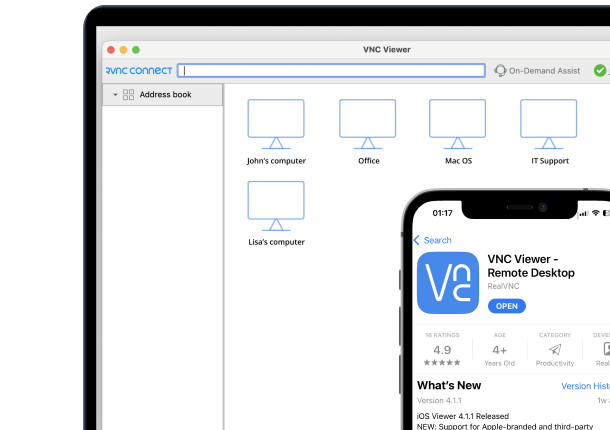
Remote and hybrid work creates its own bottlenecks. Users want remote desktop access to office PCs without turning the VPN into a shared choke point. The unified RealVNC Connect App supports remote session access across Windows, macOS, and Linux machines, plus mobile operating systems, including iOS and Android devices.
Controls such as the ability to print documents, transfer files, and help staff stay productive while admins keep policies consistent.
Cloud infrastructure management
Cloud infrastructure introduces a different risk. Exposing RDP or SSH to the public internet invites trouble. RealVNC Connect supports secure remote access to Microsoft Azure workloads like Azure Virtual Desktop through brokered connections that avoid opening management ports, while still fitting alongside existing cloud tooling and VDI solutions like Citrix DaaS.
Getting started with cloud-based remote access
Rolling out cloud-based remote access with RealVNC Connect is usually measured in minutes rather than change requests. The steps below reflect how most IT admins get running in production.
- Create a RealVNC account and start a free trial at RealVNC Connect. No card is required, which makes early testing easier with security and operations teams.
- Download the RealVNC Connect App on every remote computer and on any devices that need to be accessed. Install the Viewer or unified app on admin machines used for support and operations.
- Sign in to the RealVNC Connect App on each endpoint. The remote access software automatically adds those devices to your team in Portal for easy access, without manual discovery.
- In the Portal, configure roles for users, group devices, and apply high-level security controls that govern who can see and connect.
- Connect using RealVNC Viewer or the unified app to begin remote access sessions.
For enterprise rollout, use cloud connectivity tokens to join endpoints to your team from the command line or during installation, which avoids manual sign-in on every device. RealVNC documents Windows MSI options such as JOINCLOUD, plus group assignment, so you can standardise deployment and keep device discovery controlled.
Conclusion
For many teams, cloud-based remote access removes the long-standing friction that came with configuring and managing device connectivity through VPNs, static IPs, and firewall exceptions. RealVNC Connect was built to address that reality directly.
It operates as one intelligent system that automatically selects peer-to-peer connectivity when possible and securely falls back to encrypted relay when networks demand it, with the option to support internet-free deployment where policy requires it.
Security remains central. End-to-end encryption and a zero-knowledge design mean even RealVNC cannot view session data, all while running on privately owned infrastructure rather than public hyperscalers. The result is secure remote access that scales without adding operational drag.
These actionable insights position RealVNC Connect as an essential tool for teams that want to stay ahead. Start a free trial to experience cloud-based remote access built for real enterprise environments.
Frequently Asked Questions
Does cloud-based remote access mean my screen data goes through RealVNC servers?
RealVNC Connect attempts a peer-to-peer remote session first. If that fails, it can relay through private infrastructure. End-to-end encryption supports data protection, so RealVNC cannot decrypt session content, so secure remote access always stays intact.
Do I need to open firewall ports for cloud-based remote access?
No. Cloud-based remote access uses outbound connections, similar to standard web traffic. That keeps remote access deployment simpler and improves connectivity. Most teams gain easy access without requesting inbound firewall changes.
Can I use RealVNC Connect without any internet access?
Yes. Enterprise On-Prem offline licensing supports remote access without the internet. You deploy licenses offline and use direct connections with IP addresses or hostnames, which can suit a fixed physical location. It has cross-platform support for Windows, Linux machines, macOS, and mobile devices.
How does cloud-based remote access compare to VPN for remote work?
Cloud-based remote access supports remote desktop access without routing all traffic through a corporate VPN. That can reduce bottlenecks, improve secure access, and enhance efficiency for IT teams. It can also support cost savings in VPN capacity planning.
Can I disable the cloud relay feature for compliance reasons?
Yes. Administrators can configure RealVNC Connect so that secure remote connectivity fails if peer-to-peer cannot be established. That supports stricter policy controls and reduces exposure to cyber threats while keeping consistent security features and session monitoring.
Can I provide ad-hoc support without installing software on the user’s device?
Yes. On-Demand Assist is a remote support software that enables temporary access through a time-limited code. It supports allowing technicians to securely access and help non-technical individual users quickly, including mobile support on mobile devices across major operating systems.