



A line slows because a machine status signal reaches maintenance too late. Output plans move, quality teams lose context, and customers experience the delay long after the first missed condition on the factory floor.
Smart factory connectivity solutions provide the governed links between industrial equipment, local edge services, networks, and enterprise systems. They keep production data available where decisions occur, preserve local operation when central services are unavailable, and give authorized people defined routes to use and support connected assets.
The challenge grows when older controllers, Industrial Internet of Things (IIoT) sensors, cloud services, and external specialists must work across the same production environment. A connection that works for a pilot can become a weak dependency when nobody owns the data, fallback behavior, or access route. Think of the architecture as a rail junction: each route needs a clear purpose, a signal owner, and a safe response when traffic changes.
This article examines the decisions behind device integration, edge control, network transport, and enterprise data exchange. It compares the trade-offs around response time, resilience, interoperability, lifecycle overhead, and security segmentation, then explains how leaders can govern OT/IT integration and remote access as part of one factory operating model.
Why Smart Factory Connectivity Is Now a CTO Issue
Factories are adding connected assets faster than they are standardizing who owns the data paths between them. That gap shows up when plant engineering needs a local workaround, enterprise IT needs a common policy, and neither team can explain which route carries production-critical information.
The scale is moving quickly. Kearney’s 2024 State of Industry 4.0 forecasts more than 4 billion installed connected-manufacturing devices by 2030. Each new sensor, controller, robot, or gateway adds an identity, a data source, and a lifecycle decision that needs an accountable owner.
Smart factory connectivity solutions work when manufacturers treat device integration, edge processing, network performance, and access control as one governed operating model. The right architecture preserves local production resilience while making trusted data available to enterprise systems and approved external partners.
What Do Smart Factory Connectivity Solutions Solve?
Smart factory connectivity solutions solve the gap between collecting industrial data and using it safely where decisions happen. They coordinate device interfaces, edge services, network paths, data exchange, and access controls so production information reaches authorized systems without making every workload dependent on a central service.
Point-to-point connections often work for an initial machine or pilot. They become difficult to govern when each site adds its own gateway, naming convention, and support route. Think of several uncoordinated data routes as a shift handover with incomplete records: people may act quickly, but nobody has a dependable shared view of current conditions.
Private cellular illustrates why network selection must follow workload needs. IoT Analytics’ State of Private 5G in 2024 reported 1.28 million private-5G Internet of Things connections globally in 2023, or 5% of 25.6 million 5G IoT connections. It is an emerging option for specific coverage and mobility requirements, rather than a default answer for every plant.
| Legacy approach | Layered connectivity approach | Executive consequence |
|---|---|---|
| One-off machine links | Defined device-to-edge interfaces | Lower integration rework |
| Flat traffic routing | Workload-specific network paths | Clearer service criticality |
| Raw data sent centrally | Edge filtering and local decisions | Less central dependency |
| Informal support channels | Approved, recorded access workflows | Stronger accountability |
Which pressures make connected production urgent?
Connected production becomes urgent when fragmented routes slow decisions that affect output, quality, or plant coordination. The issue is not how many devices a site connects; it is whether their data remains understandable, available, and governed as the operating model expands.
- Device scale: More connected assets create more identities, interfaces, and update obligations.
- Real-time decisions: Control workloads and operational analytics have different timing requirements.
- Multi-site integration: Shared reporting needs consistent data contracts across locations.
- Resilience expectations: Local operations need defined fallback behavior when central services are unavailable.
Which Architecture Layers Need Executive Decisions?
)
A durable industrial connectivity architecture assigns decisions to four layers instead of asking one protocol or network to meet every requirement. Leaders need to decide where data is interpreted, how traffic moves, who owns integration, and which systems may receive operational information.
That separation also makes investment sequencing clearer. ABI Research’s Industrial and Manufacturing Survey 1H 2024 found that 44% of manufacturers were deploying 4G and 75% were considering 5G. Those figures describe an adoption direction, not a reason to replace wired Ethernet or Wi-Fi where they already meet the production requirement.
| Layer | Primary responsibility | Decision criterion | Typical technologies | Common executive misread |
|---|---|---|---|---|
| Device integration | Connect equipment safely | Protocol fit and asset lifecycle | PLC interfaces, OPC UA | Every asset needs direct cloud access |
| Edge control | Process local information | Response time and fallback needs | Gateways, local analytics | Edge is only a data cache |
| Network transport | Carry traffic by purpose | Availability, mobility, segmentation | Ethernet, Wi-Fi, private cellular | One network type fits every workload |
| Enterprise/cloud exchange | Share approved data | Ownership and semantic consistency | MQTT, APIs, cloud services | Centralization replaces plant autonomy |
- Device integration: Define how controllers, sensors, and legacy equipment present usable information.
- Edge control: Keep time-sensitive evaluation near the production line when distant dependencies are unacceptable.
- Network transport: Separate traffic according to its operational consequence and service need.
- Enterprise/cloud exchange: Deliver selected, normalized data to systems that have a defined business use.
Security belongs in each layer because an integration route is also an access route. SANS Institute’s State of ICS/OT Security 2025 found that 21% of organizations suffered an operational technology (OT) cyber incident in the prior year, and 40% of those organizations reported operational disruption. Architecture ownership must therefore include production continuity, not only connectivity delivery.
Device and edge: preserve local operating resilience
The device and edge layers determine whether brownfield equipment can participate without placing control workloads behind unnecessary central dependencies. Edge computing filters, normalizes, and evaluates information near the machine before forwarding selected data; SpencerMetrics’ CONNECT: Merlin Printing Case Study describes Merlin Printing using edge computing and secure IIoT technology to automate data collection from vintage machines into an analytics platform. That is a practical route for bringing older assets into a governed data model while retaining local operating behavior.
Transport and exchange: move trusted data by purpose
Transport and exchange decisions need a clear distinction between carrying messages and preserving their meaning. Ethernet, Wi-Fi, and private cellular provide different connectivity characteristics, while Message Queuing Telemetry Transport (MQTT) distributes messages through a lightweight publish/subscribe model and OPC Unified Architecture (OPC UA) supports standardized industrial information models.
Stefan Hoppe, President and Executive Director of the OPC Foundation, wrote in OPC Connect: “I truly believe that ‘OPC UA over MQTT’ will be the de facto standard for standardized communication between OT and cloud; and also between cloud applications.” It is an informed industry view, not proof of a universal standard. The OPC Foundation’s OPC UA Cloud Initiative links standardized interoperability to analytics, digital twins, industrial data spaces, and digital product passports.
How Should CTOs Compare Connectivity Criteria?
CTOs should compare connectivity options by the consequence of a missed, delayed, altered, or unauthorized data exchange. The right choice differs between a machine-control signal, a maintenance alert, and a cross-site reporting feed, so a single performance target will not produce a useful architecture.
Security boundaries require the same discipline. NIST SP 800-82 Rev. 3 recommends logical separation between corporate and OT networks, including stateful inspection firewalls and unidirectional gateways. The ISA Global Cybersecurity Alliance’s Zero Trust Outcomes Using ISA/IEC 62443 Standards defines zones as logical or physical assets that share security requirements according to criticality and consequence.
- Latency and determinism: Define which decisions need local or near-real-time response. Do not treat every reporting feed as time-critical.
- Availability and fault tolerance: Assess redundant routes, local fallback behavior, and recovery dependencies. Cloud reachability does not equal production resilience.
- Interoperability and semantic consistency: Test protocol translation, common data models, and integration ownership. Connected assets only matter when their information remains usable.
- Scale and lifecycle overhead: Evaluate how device identities, firmware, certificates, gateways, and network policies will be maintained after the pilot.
- Security segmentation and controlled access: Define zones, conduits, authentication, and auditable support access. Broad flat networks reduce control over production assets.
| Criterion | Leadership signal | Decision supported | Common interpretation error |
|---|---|---|---|
| Latency and determinism | Which workload cannot wait | Edge versus central processing | All data needs the fastest route |
| Availability and fault tolerance | What happens during service loss | Redundancy and local fallback | A cloud service guarantees local continuity |
| Interoperability | Whether data retains common meaning | Protocol and model selection | Device connection equals integration |
| Scale and lifecycle overhead | Who maintains growing dependencies | Operating model and funding | Pilot staffing will remain sufficient |
| Segmentation and access | Which route creates operational consequence | Zone and conduit design | Convenient access is controlled access |
Which OT/IT Integration Trade-Offs Matter Most?
OT/IT convergence works when leaders standardize the conditions for sharing data without forcing every plant into identical operating procedures. The central question is where common controls create value and where local equipment, safety requirements, or production constraints require site-level discretion.
Named examples show different integration routes. EasyEdge’s Case Study Siemens Energy describes diverse OT assets connected to an AWS IoT SiteWise Edge gateway through EasyEdge integration. Cybus’ 2025 account of KRONE’s approach describes event-driven architecture and a central data layer linking factory processes. Neither example establishes a universal pattern; both show why integration ownership needs to be explicit.
- Standardize data contracts, not every plant process: Set shared expectations for identities, naming, and data quality, while allowing justified site variation.
- Keep time-critical decisions near the line: Use edge capability when production control cannot depend on distant systems. Centralize selected data when cross-site insight serves a defined decision.
- Sequence brownfield modernization by consequence: Start with bottleneck assets, safety-critical equipment, and systems with substantial integration friction rather than connecting every asset at once.
- Treat external access as a governed workflow: Suppliers, original equipment manufacturers (OEMs), and specialists need bounded access paths with named owners and retained evidence.
A phased model avoids isolated pilots by making each deployment conform to the same integration and access rules. It also gives leadership a practical test: if a site cannot identify the data owner, local fallback behavior, and approved support route for an asset, that connection is not ready to become a shared production dependency.
What Security Risks Survive a Connected Factory?
)
Modern protocols and better network paths do not remove the access and accountability risks that accompany connected production. The remaining exposure often sits in unmanaged remote support, broad network permissions, device identities that outlive their purpose, and incomplete records after a support session.
The operational impact is measurable. IBM X-Force’s The Operational Technology Threat Landscape reported that 15% of studied organizations experienced a cybersecurity incident affecting OT, and nearly one-quarter of those incidents damaged OT systems or equipment. NIST SP 800-82 Rev. 3 advises that OT security must account for performance, reliability, and safety requirements while using logical separation and multi-factor authentication (MFA) for remote OT access.
- Remote-access exposure: Support sessions need identity verification, defined scope, and accountable ownership.
- Flat-network propagation: Zones and conduits must limit communications to routes justified by an operational need.
- Identity lifecycle gaps: Device, user, and supplier access must be reviewed when roles or service arrangements change.
- Evidence discontinuity: Teams need records of who connected, when they connected, and which permissions applied.
| Residual risk | Business consequence | Control objective |
|---|---|---|
| Uncontrolled remote support | Unclear responsibility during an incident | Authenticate, authorize, and record sessions |
| Broad network reach | Production systems receive unnecessary traffic | Apply zones and controlled conduits |
| Unmanaged identities | Access persists beyond a valid business need | Review and remove outdated access |
| Missing session evidence | Slower investigation and audit review | Retain reviewable access records |
ISA/IEC 62443 provides a useful architecture model because it connects security requirements to the consequence of communication between zones. A manufacturer must decide which connections are necessary, who approves them, and what evidence remains when they are used.
RealVNC and the Factory Access Problem
OT/IT convergence expands the number of people who may need to reach connected production systems: plant engineers, enterprise IT teams, OEMs, and incident responders. Remote support is a distinct control plane within the factory access model, because zones and conduits only remain meaningful when the people crossing those boundaries use approved routes with clear service criticality and retained evidence.
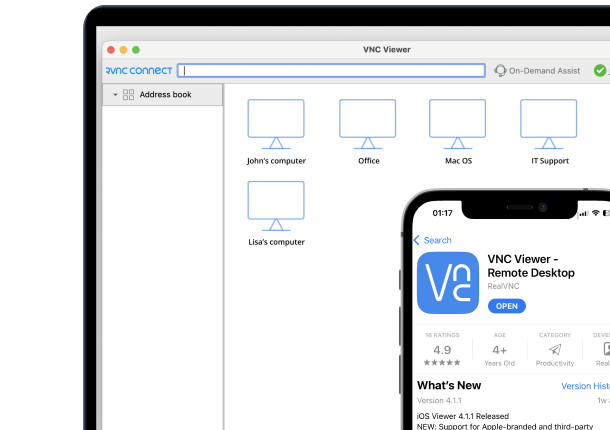
RealVNC Connect supports controlled remote operations by linking access to enterprise identity policy and defined permissions. Multi-factor authentication and single sign-on (SSO) with Microsoft Entra ID or Okta help organizations apply established identity requirements to remote sessions. Role-based access controls (RBAC) and granular action-based permissions let administrators scope keyboard, mouse, and file-transfer activity by role and support use case. Session monitoring, session recording, and detailed audit logs provide reviewable evidence for support, incident response, and audit workflows. For OEM or specialist support, Code Connect uses single-use 9-digit session codes that are valid for a fixed 120-second window and produce time-boxed, revocable sessions without standing credentials.
Connectivity maturity includes governing the people who access connected production systems, not only the data exchanged between them. RealVNC Connect gives manufacturers a defined way to align remote support with identity policy, role boundaries, and session evidence, so access decisions can be reviewed alongside network and device controls.
Final Words
Govern connectivity as a production system from the point where a device creates data to the point where an approved person uses it. Smart factory connectivity solutions need clear decisions across device integration, edge control, network transport, and enterprise/cloud exchange. Those decisions must follow service criticality: keep time-sensitive evaluation close to the line, send selected information where it has a defined business use, and preserve local fallback when central services are unavailable. NIST SP 800-82 Rev. 3 and ISA/IEC 62443 reinforce the same discipline: separate operational routes by consequence and retain accountability for each connection.
That governance is tested when an engineer, OEM, or specialist needs remote entry to a production system. RealVNC Connect brings multi-factor authentication and single sign-on (SSO) into that workflow, while role-based access controls limit activity to the permissions each role requires. Session recording and detailed audit logs leave reviewable evidence after the work is complete, helping your teams connect remote support decisions to the same access boundaries that protect factory operations. Start a free trial of RealVNC Connect to establish controlled, auditable remote access for connected production systems.
FAQs
What is the framework for industrial connectivity?
Smart factory connectivity solutions use a four-layer framework: device integration, edge control, network transport, and enterprise or cloud exchange. Each layer has a distinct responsibility, but the decisions must align with workload criticality, data ownership, resilience, and access control.
What is the difference between OPC UA and MQTT?
OPC UA supports standardized industrial information modeling and semantic interoperability, while MQTT provides lightweight publish/subscribe messaging between systems. Manufacturers may use them together when they need both consistent industrial data meaning and efficient distribution across edge, plant, and enterprise environments.
Which standards guide connected-production security?
NIST SP 800-82 Rev. 3 and ISA/IEC 62443 provide useful frameworks for securing connected production environments. NIST addresses the separation of corporate and operational networks, while ISA/IEC 62443 uses zones and conduits to group assets by shared security needs and control communication between them.
What is a private 5G network in manufacturing?
A private 5G network is a dedicated cellular network operated for a defined industrial site or organization. It may suit factories that need controlled wireless coverage, mobility, or connectivity for selected Internet of Things workloads, but it does not automatically replace Ethernet or Wi-Fi infrastructure.
What is the difference between a smart factory and smart manufacturing?
A smart factory is a connected production site where machines, systems, and people exchange data to support operational decisions. Smart manufacturing is the broader approach, covering how an organization uses connected equipment, analytics, automation, and coordinated processes across one or more factories and supply-chain activities.
What does RealVNC control in an OT support workflow?
RealVNC Connect helps organizations control who accesses production systems, which actions their role permits, and what evidence remains after a session. Multi-factor authentication, single sign-on (SSO), role-based access controls, granular action-based permissions, session monitoring, session recording, and detailed audit logs support accountable remote operations; Code Connect provides time-bound access for approved third-party support.