

A failed motor, pump, or UPS can cost far more than the replacement part. If it causes unexpected downtime in a critical process, teams may face lost production, emergency repair costs, and an urgent site visit.
Remote monitoring solutions show teams what’s happening to their industrial equipment. Predictive maintenance goes further, using temperature trends, vibration data, operating history, and other condition data to identify changes that may indicate a developing fault.
Early detection isn’t enough on its own, though. Someone still has to investigate. Secure remote access can give the right specialist access to a monitoring workstation or Human-Machine Interface (HMI) without requiring an immediate on-site visit, helping you reduce costs, minimize downtime, boost efficiency, and avoid unexpected failures.
What is remote monitoring and predictive maintenance?
Remote monitoring is the continuous collection and review of equipment health and operating data from a centralized or off-site location. Predictive maintenance uses that condition data, operating context, and analytical models to identify developing faults and schedule work before failure happens. Monitoring supplies the visibility while prediction supports the maintenance decision.
It helps to separate remote monitoring from other maintenance strategies by the evidence each one relies on. Reactive maintenance waits for failure. Time-based preventive maintenance follows a calendar, while condition-based monitoring tracks current state against a threshold. Predictive maintenance goes further and estimates fault likelihood or a component’s Remaining Useful Life, not just whether a reading has crossed a line.
This approach supports mechanical systems such as motors, pumps, conveyors, UPS units, servers, robot cells, and distributed edge infrastructure. A Swedish manufacturing survey cited by NIST estimated that downtime accounted for 13.3% of planned production time in the facilities it studied. While that’s a useful benchmark, it’s not a universal deployment outcome.
Deloitte’s paper reported a 10% to 20% higher equipment uptime and 5% to 10% lower maintenance costs. Results vary by industry and process.
How do monitoring systems predict equipment failures?
Useful predictive results depend on relevant measurements, dependable data collection and transmission, and actionable maintenance processes. Analytics complements reliability engineering, asset knowledge, and data-quality management, but it doesn’t replace them.
Industrial IoT sensors, PLCs, SCADA systems, historians, and edge devices transmit data to a sensor data ingestion pipeline. Baseline profiles need to account for equipment type, load, operating mode, and environmental conditions, because process context changes interpretation. A temperature increase might be normal under high load and abnormal when load and ambient conditions are unchanged.
Data-quality controls, including calibration-drift checks, timestamp consistency, missing-data handling, and normalized asset identifiers, determine whether that data can be trusted. Dashboards and alerts need to lead to inspections, corrective actions, and verification, but they aren’t the final outcome on their own.
How does data collection impact asset health baseline?
Building a useful baseline starts with failure-mode and root-cause mapping. Teams should identify likely failure mechanisms before choosing sensors and measurements that can reveal them.
Vibration analysis readings map to rotating-equipment issues such as imbalance, misalignment, looseness, and bearing wear, though interpretation still requires asset context. Temperature changes, pressure, flow, power quality, and operating-state data complement vibration analysis measurements and reduce the risk of an incomplete diagnosis. SCADA integration adds load, run state, alarms, and setpoints on top of sensor data.
Wired links can offer steady power and transmission where cabling is practical. Meanwhile, wireless options reduce cabling but require checks for signal strength, battery life, heat exposure, and sensor placement.
Sampling frequency should also reflect asset criticality. A high-consequence asset may justify more frequent measurements than low-risk equipment that’s redundant or easy to replace.
How does advanced analytics turn data into maintenance work?
Most programs start with threshold-based alerts and progress to more advanced data analysis once there’s enough clean history to work with. And while artificial intelligence outputs are signals to investigate, they’re not automatic proof that a component has failed.
Fixed thresholds flag readings that cross a defined limit. Dynamic baselines account for normal variation. Anomaly detection identifies behavior that differs from an established pattern, while fault classification associates a pattern with a particular failure mode. Remaining Useful Life estimates how long a component can operate before reaching an unacceptable condition.
Advanced predictive maintenance tools can analyze waveform, spectral, and historical data. Some remote monitoring solutions also support off-site review and, when sensors and configurations allow, increased sampling when anomalies appear.
False alarms are the fastest way to get a system ignored, so refining the baseline, prioritizing alerts by asset criticality, and keeping a human in the loop all matter for keeping trust in the system. Once something genuinely needs attention, the process is fairly consistent. Assign a priority, recommend an inspection, plan for parts, cut a work order, and confirm afterward that the repair actually solved the problem.
Fernando Brügge at IoT Analytics has pointed out that better AI, hardware, and data engineering are collectively pushing predictive maintenance capability forward across the industry.
Predictive maintenance vs. condition monitoring
The two concepts overlap, but they aren’t interchangeable.
Condition monitoring tracks the condition of an asset through real-time data. Predictive maintenance uses those readings and operating information to estimate what may happen and when to intervene.
A remote dashboard showing an unusually high bearing temperature provides monitoring and condition evidence, but it doesn’t automatically amount to a validated prediction of a failure.
None of this makes preventive maintenance obsolete. It still makes sense when failures are mostly age-related, data is limited, or inspection costs are low. Predictive models are most valuable where failures carry real safety, production, service, or replacement consequences.
How do equipment maintenance strategies differ?
| Approach | Primary Question | Typical Inputs | Output | Maintenance Decision |
|---|---|---|---|---|
| Reactive maintenance | Has the asset failed? | Failure event or loss of function | Repair need | Repair or replace after failure |
| Preventive maintenance | Is scheduled service due? | Calendar time, operating hours, service interval | Planned service task | Perform routine maintenance at set intervals |
| Condition-based maintenance | Is the asset outside an acceptable condition? | Inspections, sensor readings, threshold alerts | Condition exception or trend | Inspect or service when condition warrants it |
| Predictive maintenance | What is likely to fail, and when? | Condition data, operating context, historical patterns, analytical models | Fault likelihood, classification, or Remaining Useful Life estimate | Prioritize and schedule intervention before expected failure |
A threshold alert is a reading outside a defined normal range. Remaining Useful Life estimation is an estimate of the time or operating cycles before a component reaches an unacceptable condition. Neither replaces every existing maintenance program on its own, and model accuracy still needs to be validated against actual maintenance and failure outcomes.
How do machine health approaches work together?
Picture a layered operating model. Continuous monitoring gathers evidence, condition-based rules flag deviation, predictive analysis prioritizes likely failures, and maintenance teams decide on and verify the response. Reliability expertise remains essential for validating alerts and avoiding unnecessary maintenance.
A typical example would be something like this: vibration analysis reveals an increasing trend that triggers investigation, process data rules out a temporary load change, and the team schedules a bearing inspection during a planned stop rather than an emergency shutdown.
Remote data access enables maintenance teams and off-site specialists to collaborate on abnormal equipment behavior without needing everyone on site for the first look. Every finding should connect to documented inspections, corrective actions, and post-repair verification, with human review carrying extra weight for high-consequence assets and ambiguous alerts.
Real-world examples of remote asset monitoring
Teams use remote monitoring data to identify a developing issue, assess its urgency, and send the appropriate person or parts only when a remote response can’t resolve the problem. Outcomes are specific to each scenario rather than consistent across every sector.
GE Vernova reports that ACWA Power kept about 445 GWh of electricity available for the grid over twelve months by intercepting incipient failures using APM SmartSignal for remote power assets.
In an MSP or plant-floor support scenario, an engineer reviews an HMI or monitoring workstation after an alert, documents the diagnosis, and records the escalation decision.
At a remote data center, the same workflow helps determine whether UPS or temperature alerts warrant a site visit.
Authorized, time-bound remote access can support review of monitoring workstations and HMIs used to interact with SCADA and PLC data. It supports response workflows, but it doesn’t replace asset-performance-management software, maintenance systems, or a qualified technician’s diagnosis.
Where is predictive maintenance used most effectively?
The strongest candidates for predictive maintenance have meaningful failure consequences, measurable degradation patterns, and enough operating history to establish useful baselines. Low-cost, easily replaced components don’t always justify the investment in advanced analytics.
IoT Analytics CEO Knud Lasse Lueth has described predictive maintenance as a leading Industry 4.0 use case, particularly in process industries where asset failures can become expensive.
Selection criteria should include asset criticality, access difficulty, safety exposure, sensor-data availability, maintenance lead times, and remote connectivity.
Rotating equipment, such as motors, pumps, conveyors, cranes, and gear sets, tends to be a strong fit for this kind of monitoring. And for older mechanical systems, it’s often smarter to see what an existing historian or SCADA setup can already tell you before adding new hardware.
How does manufacturing use equipment health data?
Whether it’s discrete manufacturing, process manufacturing, or a remote production cell, machine health data only means something when it’s read alongside what’s happening in production. A sensor reading machine performance in isolation can be misleading.
Manufacturers get more out of equipment data when they layer it with equipment uptime, downtime, cycle time, production history, and error logs. This helps them spot worsening trends in motors, gearboxes, conveyors, pumps, and robot cells and schedule maintenance during planned production windows. That combination also supports swapping a part when it’s genuinely wearing out, instead of sticking rigidly to a fixed replacement schedule.
Why do utilities and water operators need remote visibility?
Power generation sites, grid equipment, pumping stations, and water treatment facilities share a common challenge. They’re spread out, and nobody can staff every location around the clock.
Remote visibility supports controlled response and operational continuity without a person on-site at every location.
SCADA and historian data give context to readings coming off pumps, turbines, and motors scattered across a service area.
Edge buffering can retain readings locally during an outage. Loss alerts flag the interruption, while local procedures guide the site’s response. What remote visibility really buys a team is the ability to prioritize which sites need a visit first and pull in a specialist without waiting for them to travel.
It’s worth flagging that utilities often carry extra regulatory weight, including NERC CIP where it applies, and no monitoring software checks that box by itself. NIST’s guidance on securing OT systems is a solid reference point for that broader security picture.
What trends are changing remote maintenance programs?
Remote monitoring and maintenance are getting more distributed and data-heavy, but none of the newer tech matters much if the sensor data underneath it isn’t trustworthy or the workflow around it isn’t sound.
Edge computing has become more relevant as teams run into situations where sending everything to cloud platforms isn’t practical, whether that’s latency, bandwidth cost, or a connection that drops out, and filtering data locally solves a lot of that.
Digital twins are a way to model equipment design and operating history for scenario testing and planning, but they’re not a flawless copy of how the real machine behaves.
Machine learning fault classification is showing up more often too, though it still tends to work best alongside human judgment and engineering rules rather than replacing them, particularly for the rare, high-stakes faults.
A Siemens and Senseye survey found nine out of ten industrial respondents already use some form of condition monitoring, which says more about how widespread basic monitoring has become than it does about how mature predictive programs are everywhere.
As more of this moves to cloud platforms, keeping data visibility separate from the authority to actually change production settings becomes more important, a point NIST’s OT security guidance backs up.
What security risks affect remote monitoring systems?
Remote monitoring solutions can improve visibility, but they also introduce data paths, accounts, integrations, and support workflows that require deliberate control. Encryption alone doesn’t secure a complete OT structure, so security needs to be treated as an operational design requirement from the outset.
Legacy integration gaps can lead to unmanaged remote connections, shared accounts, unsupported endpoints, and direct exposure of systems that were never designed for internet access. Network segmentation and OT DMZs pair with a core principle, which is monitoring access shouldn’t automatically grant authority to modify PLC, SCADA, or HMI settings.
Unique user identities, MFA, least-privilege role-based access, session audit logs, and time-bound contractor access all reduce this exposure, and CISA specifically recommends MFA wherever it can be applied as a baseline control for operator and remote-support accounts. Other risk areas include insecure gateways, unpatched edge devices, vendor remote-support accounts, fragmented data platforms, and remote-site connectivity loss.
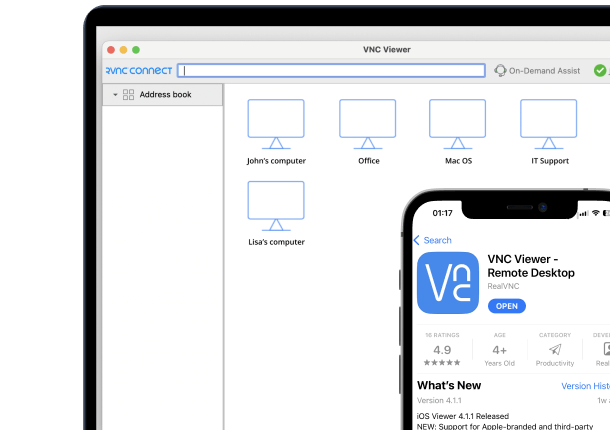
Controlled remote-session tools have a defined role here. RealVNC Connect supports MFA, encryption, role-based access, and audit logs for authorized remote sessions. It supports cloud-brokered and direct connections, while organizations that require self-hosted management can use the On-Prem Management Console.
What it doesn’t do is replace segmentation, identity and access management, endpoint protection, SIEM, or broader OT security governance.
How to deploy remote monitoring and predictive maintenance
A phased approach for implementing remote monitoring systems makes it easier to test whether predictive maintenance solutions can produce useful decisions. Start small, focus on priority assets, validate data and alerts, and expand only once maintenance teams can reliably act on the results.
1. Rank assets by operational risk
Identify equipment where failure could affect safety, production, service continuity, regulatory obligations, or repair costs. Map each priority asset to known failure modes and the maintenance action an early warning would trigger. Include the consequences of failure, parts lead time, and access difficulty.
Define the operational response before collecting data, so alerts have a clear owner and outcome, and avoid starting with broad sensor deployment across low-priority assets.
2. Define measurements and data analysis sources
Map likely failure modes to useful measurements. Check whether remote monitoring can use existing PLC, SCADA, historian, and enterprise systems data before adding new sensors.
Add sensors where existing data cannot reveal the degradation pattern you need to monitor.
3. Build baselines before automating decisions
Collect representative operating data. Establish normal ranges by load, operating state, equipment type, and environmental conditions.
Check timestamps, asset identifiers, missing data, and sensor calibration. Track false positives and refine alerts with maintenance and operations teams.
4. Connect alerts to maintenance execution
Every important alert should have an owner and a defined response. That might mean an inspection, work order, parts check, or documented decision to take no action. Meridian Energy’s AVEVA PI-based condition-monitoring program is a useful example of supporting condition-based maintenance rather than relying on fixed maintenance schedules.
Post-repair validation is also essential. If the team replaces a bearing because of a predicted fault, confirm whether the evidence and corrective action matched what was found. Then, use outcomes to improve future baselines and alert rules.
5. Secure remote investigation paths
Use network segmentation, individual accounts, MFA, least-privilege access, and logged remote sessions. Separate the ability to view equipment data from the authority to change production controls. RealVNC remote access for manufacturing supports this approach with MFA, granular permissions, and session audit logs.
6. Pilot, measure, and expand carefully
Start with comparable, high-priority assets. Measure alert quality, response time, avoided failures, maintenance costs, and operational effects against a pre-implementation baseline. Expand when maintenance teams can consistently turn reliable data into useful decisions.
When comparing providers, check integration, alert quality, access controls, and maintenance handoff. Also, weigh potential cost savings against sensor, software, and integration costs.
Conclusion: Harnessing the benefits of remote monitoring
Unplanned equipment downtime is a costly, ongoing risk, and remote monitoring solutions combined with predictive maintenance turn isolated asset data into earlier, more actionable maintenance decisions. Reliable sensor and connectivity foundations matter first. Alerting and data analytics need to be tuned to reduce false positives. Maintenance workflows have to connect actionable insights to real corrective action, or none of the rest matters.
The practical next step is to assess a single high-value asset group, establish a baseline, and build a phased business case for a secure predictive maintenance deployment.
Frequently asked questions
How does predictive maintenance reduce unplanned downtime?
Predictive maintenance uses condition data, anomaly detection, and Remaining Useful Life estimates to identify developing failures before an asset stops operating. Its value depends on linking alerts to timely inspection, repair, and scheduling decisions.
How do remote monitoring and predictive maintenance differ?
Remote monitoring solutions collect and visualize asset data from off-site or distributed locations. Predictive maintenance builds on that visibility by analyzing trends and failure patterns to recommend when maintenance should occur.
What sensors are used for predictive maintenance?
Common Industrial IoT sensors include vibration, temperature changes, pressure, current, acoustic, oil-quality, and humidity sensors. Sensor choice should follow failure-mode root-cause mapping and asset baseline profiling, not a one-size-fits-all checklist.
Can legacy SCADA systems support predictive maintenance?
Many legacy SCADA environments can contribute operational data through connectors, historians, gateways, or integration layers. Teams should assess protocol compatibility, data quality, network segmentation, and cybersecurity controls before connecting these systems.
How do you prevent false predictive maintenance alerts?
Establish normal operating baselines, calibrate sensors, and tune threshold-based alerts by asset condition and operating context. Combining time-series anomaly detection with maintenance feedback helps improve machine-learning fault classification over time.