



A production line stops at a remote site, and engineering must decide whether the problem sits in the controller, the human-machine interface (HMI), or the local network. Production leaders feel the delay quickly, while plant IT must ensure that an urgent connection does not bypass the controls built to protect the site.
Remote access for PLC systems gives authorized engineers a controlled way to reach a named engineering workstation or approved industrial asset from another location. It supports diagnosis, logic review, and permitted maintenance without travel, provided access follows the plant’s segmented network design, verifies identity, limits session rights, and retains evidence of what occurred.
The connection method shapes the risk as much as the response time. A virtual private network (VPN) may reach a defined network zone, while remote desktop keeps work on a site engineering PC and industrial gateways can narrow connectivity around specified assets. Each route creates different dependencies around local hardware, software licensing, bandwidth, session oversight, and plant-operator approval.
This article compares VPN tunnels, cellular paths, remote desktop, and industrial gateways against the access scope and operational evidence each creates. It then sets out the controls, site checks, and decision rights your team needs before connecting to controllers, HMIs, drives, or other field equipment – so remote support remains bounded, reviewable, and aligned with plant safety responsibilities.
Why PLC Remote Access Is Now an Executive Risk Decision
A remote programming request often arrives when production is already under pressure. The engineer needs to diagnose the controller quickly, yet one poorly governed connection can bypass plant ownership, weaken change control, and leave the team unable to explain what happened later.
That concern has a measurable operational backdrop. The 2025 OT Cyber Security Threat Report recorded OT incidents with physical consequences at 1,015 sites in 2024, compared with 412 sites in 2023 (Waterfall Security and ICS STRIVE, 2025). Warwick Ashford, Senior Analyst at KuppingerCole Analysts AG, told Cybersecurity Insiders: “Secure remote access is no longer a tactical add-on; it’s now a strategic pillar of operational resilience, cyber defense, and regulatory compliance in critical infrastructure environments.”
The decision is not whether off-site engineers need access. It is whether they receive a narrow, observable route to a named engineering endpoint, rather than broad standing reach into controllers, human-machine interfaces (HMIs), or the wider plant network. That distinction protects safety boundaries and gives leaders a defensible record during review.
Remote access for PLC systems is secure only when it reaches a defined engineering path through segmented OT architecture, verifies each user and session, limits actions to the task, and records what occurred. The best access method depends on the plant’s service criticality, connectivity constraints, protocol mix, and ability to maintain those controls over time.
What Makes Remote Access for PLC Systems Resilient?
Resilient PLC connectivity is a controlled service path, not permanent network reachability. It separates enterprise IT, the operational technology (OT) demilitarized zone (DMZ), engineering workstations, and control assets according to the work an engineer actually needs to perform.
That separation addresses a common weakness. Dragos found insecure remote-access conditions, including default credentials, unpatched virtual private networks (VPNs), and publicly reachable Remote Desktop Protocol sessions, at 65% of assessed OT sites (2025). NIST SP 800-82 Rev. 3 recommends a DMZ that prevents direct traffic between corporate and OT networks (National Institute of Standards and Technology, 2023).
Think of the OT DMZ as a controlled shift-handover desk between enterprise IT and plant operations. Requests and information cross under stated rules; unrestricted movement between both teams does not. That design makes the access path reviewable before an engineer reaches a controller.
Which pressures make PLC access a resilience issue?
Multi-site plants and specialist OEM support make a local-only model difficult to sustain. The control model must accommodate real maintenance needs while keeping plant operators, security teams, and engineering leaders accountable for the same session.
- Uptime pressure: Diagnosis needs to begin quickly when a controller or HMI stops behaving as expected.
- Supplier dependency: External specialists need approved, time-limited access that does not become a standing account.
- Legacy estates: Older PLCs and mixed protocols often need dedicated engineering workstations or gateways.
- Auditability expectations: Leaders need evidence of who reached which asset and under whose approval.
The U.S. Environmental Protection Agency’s network-segmentation guidance recommends monitored, logged intermediaries such as firewalls, bastion hosts, jump boxes, or DMZs between IT and OT (2024). CISA and partner agencies also advise removing PLCs and HMIs from public internet reachability and using firewalls or VPNs, strong passwords, and multi-factor authentication (MFA) where remote connectivity is necessary (2024).
| Access assumption | Operational consequence | Control-plane response |
|---|---|---|
| Engineer reaches the plant subnet | One task can reach unrelated assets | Route work through a DMZ and named target |
| Vendor keeps a standing connection | Ownership becomes unclear after the job | Approve, time-limit, and recertify access |
| Encryption alone proves control | A protected session may still be overbroad | Verify identity, scope, approval, and evidence |
Which PLC Support Architecture Fits Your Risk Profile?
)
No PLC support architecture is universally preferable. The right pattern matches the engineer’s task to the smallest practical access scope, then accounts for the local hardware, network path, and evidence the organization must maintain.
Public reachability makes that discipline urgent. Forescout Research Labs identified nearly 110,000 internet-facing OT and industrial control system devices worldwide in January 2024, with 27% in the United States (2024). A connection that is convenient for one programming session must not quietly create a broad path to every asset behind it.
Assess each option through four dimensions:
- Access scope: Which named workstation, gateway, or asset is reachable?
- Control path: Does the session pass through a managed intermediary?
- Operational dependency: Which PC, carrier, VPN service, or gateway must remain available?
- Evidence quality: Can reviewers establish identity, approval, target, and activity after the session?
Access scope and control path
A VPN establishes a protected path into a network, which may suit engineers supporting several approved assets in a defined zone. A jump host narrows that route: the engineer first reaches a managed intermediary, then uses approved tools to work on designated systems. Remote desktop narrows the boundary further when it reaches one plant-side engineering PC.
The NIST OT security guide advises a DMZ architecture that prevents direct enterprise-to-OT traffic (2023). WaterISAC advises against unnecessary internet connectivity to PLCs because it places SCADA safety, availability, and control at risk (2023). Choose the narrowest route that still supports diagnosis, programming, or approved firmware work.
Operational dependency and evidence quality
The access route also changes what must work during an incident. Remote desktop relies on a powered, patched site engineering PC with the right programming software and current licensing; a cellular path relies on carrier behavior and site signal; a gateway relies on lifecycle management and compatible protocols.
Where remote access to OT devices is necessary, CISA and partner agencies recommend MFA (2024). Your review needs to establish three facts:
- Session initiator: A named, authenticated person started the connection.
- Approved target: The session reached the specified workstation or asset path.
- Retained evidence: Records show approval, timing, and relevant session activity.
| Architecture | Access scope | Primary dependency | Best-fit use case | Executive concern |
|---|---|---|---|---|
| VPN tunnel | Defined OT network zone | Router, firewall, and VPN administration | Several approved assets need support | Scope expands beyond the immediate task |
| Jump host or bastion | Managed intermediary and named systems | Hardened host and access policy | Controlled engineering work | Host governance becomes a single control point |
| Remote desktop | Site engineering workstation | PC power, patching, licensing, and network health | Existing local programming environment | Site PC availability determines support availability |
| Industrial gateway | Defined gateway path | Gateway lifecycle and protocol fit | Distributed or specialist support | Ownership can blur across IT, OT, and supplier teams |
How Do You Secure Remote Access for PLC Systems?
A governed remote session proves more than encrypted transport. It proves that a named person had approval to reach a limited target, perform a defined task, and leave evidence for operational and audit review.
The public-exposure problem remains visible across industrial environments. Censys identified more than 7,700 internet-reachable HMIs across 80 countries (2024). CISA’s 2024 guidance requires organizations to remove PLCs and HMIs from public internet reachability where possible and apply firewall or VPN protections, strong passwords, and MFA when access is required.
- Identity assurance: Use MFA, named accounts, and approved third-party identities. This proves who requested access and prevents shared vendor credentials from becoming the default.
- Network containment: Use OT DMZs, firewall allowlists, and asset-level segmentation. This supports exposure reduction and prevents one controller task from opening a whole plant subnet.
- Task-limited permissions: Separate viewing, keyboard and mouse control, file transfer, and programming rights. This supports least-privilege design instead of treating routine maintenance as administrator work.
- Session evidence: Retain monitoring records, policy-permitted recordings, timestamps, approval records, and activity logs. This supports investigation and audit readiness when a session requires review.
- Change and safety coordination: Require plant-operator acknowledgement, maintenance windows, backup expectations, rollback planning, and clear safety-system boundaries. Technical access does not grant authority to change process logic.
| Control criterion | Leadership signal | Decision enabled | Common interpretation error |
|---|---|---|---|
| Identity assurance | A person is accountable | Approve internal or external access | MFA alone defines task scope |
| Network containment | Reachable assets are limited | Authorize a target path | VPN encryption replaces segmentation |
| Task permissions | Rights match maintenance work | Separate viewing from programming | Every session needs full control |
| Session evidence | Reviewers can reconstruct activity | Investigate and recertify access | Connection logs show what changed |
| Safety coordination | Operations retains process authority | Approve maintenance timing | Engineering approval overrides plant control |
Four Trade-Offs in PLC Remote Support Design
Remote support earns its place when it reduces diagnosis delays without creating a lasting access burden. An ABB survey of more than 3,200 plant maintenance decision-makers found that more than two-thirds reported unplanned outages at least monthly, with typical downtime close to $125,000 per hour (2023). That makes response time material, but it does not justify permanent network reach.
Consider a multi-plant OEM supporting Siemens S7 and Modbus TCP equipment. The firm may keep source code and programming tools on approved engineering workstations, then grant a specialist a limited route to the required workstation instead of distributing project files or granting standing plant-network access. The business case must price the ongoing dependencies as carefully as the avoided travel.
- Step #1: Define the service-criticality tier. Separate routine diagnostics, controlled programming, emergency support, and safety-adjacent work. Classify production consequence, maintenance windows, safety review, and recovery expectations; each asset group needs an owner and an approved remote activity set.
- Step #2: Choose the narrowest viable connection path. Compare VPNs, jump hosts, remote desktop, cellular gateways, and one-way telemetry against protocol needs, HMI dependencies, bandwidth, and existing OT zones. Firewall rules and the target inventory must match documented engineering tasks.
- Step #3: Price operational dependencies, not only deployment. Include gateway upkeep, engineering-PC reliability, cellular service, licensing, access administration, downtime exposure, and support continuity. A lower initial setup effort may create a larger support dependency later.
- Step #4: Establish exception and vendor-access decision rights. Define approval authority, time limits, evidence requirements, and revocation for urgent third-party sessions. Contractor access must not remain active after commissioning or the warranty period.
For some facilities, interactive access is not the right answer. A GE Vernova power-generation case study describes data diodes separating IT and OT alongside security information and event management monitoring of OT telemetry and centralized asset management (2025). Where operators need visibility rather than remote control, one-way information flow preserves a stronger boundary.
Which PLC Access Failures Evade an Audit?
)
An audit often finds the access path that nobody revisited after deployment. The connection still works, but the organization cannot establish who approved it, which asset it reaches, whether a change occurred, or when the permission should end.
That evidence gap is common. In its survey data, Fortinet found that only 5% of organizations reported complete visibility of OT activities in central cybersecurity operations, down from 10% in 2023 (2024). Reviews must treat access evidence as an operational record, not paperwork produced after an event.
- Direct exposure: Publicly reachable PLCs, HMIs, or engineering gateways remain discoverable when maintenance work has ended.
- Identity ambiguity: Shared accounts and unmanaged OEM credentials prevent reliable attribution.
- Session-boundary gaps: Network records may show a connection without approval, target scope, or activity detail.
- Lifecycle drift: Firewall rules, contractor rights, and engineering PCs outlive the work that justified them.
| Audit blind spot | Why it persists | Evidence or control required |
|---|---|---|
| Publicly reachable asset | Temporary access was never withdrawn | External exposure review and approved routing |
| Shared supplier account | Convenience overrides accountability | Named identity, MFA, and recertification |
| Unclear session scope | Network logs lack business context | Approval, target record, and session evidence |
| Stale exception | No owner reviews lifecycle dates | Expiry, revocation, and periodic review |
The CISA advisory on Unitronics PLC activity documented the compromise of at least 75 Unitronics PLCs at U.S. water facilities after internet-connected devices were accessed with default credentials (2023; updated 2024). It illustrates why public reachability and default identities require active review. Emergency access still needs a named approver, a defined expiry, and a record that the exception closed.
RealVNC and the Controlled PLC Support Access Problem
A segmented OT design still leaves a practical last-mile question: how does an approved engineer reach the designated plant-side workstation without receiving broad, persistent access to PLC networks? That question is familiar in sites supporting Siemens, Rockwell, Modbus TCP, or mixed-vendor automation equipment from a managed engineering PC.
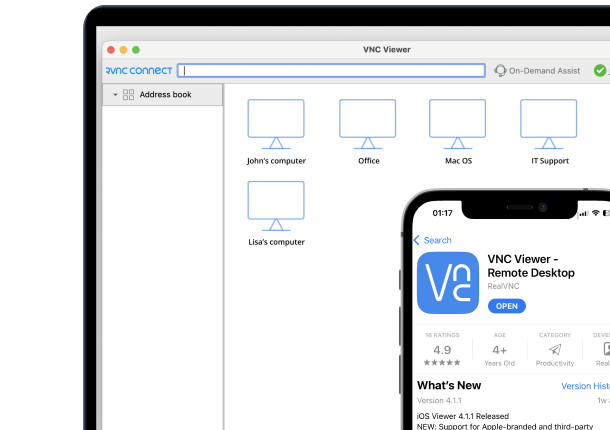
RealVNC Connect provides a controlled remote-desktop layer for that approved endpoint. It does not replace OT segmentation zones, firewall policy, PLC vendor software, safety processes, or plant change control. Within that boundary, the product maps remote-session controls to the support workflow:
- Multi-factor authentication and single sign-on (SSO): Microsoft Entra ID or Okta support identity assurance for internal engineers and approved external personnel.
- Role-based access controls (RBAC): Granular action-based permissions separate keyboard, mouse, and file-transfer rights according to the maintenance task.
- Session monitoring, recording, and detailed audit logs: Authorized administrators retain evidence for post-session review, investigation, and access recertification.
- Code Connect: Single-use nine-digit session codes provide time-limited third-party access when an OEM specialist needs supervised assistance.
The outcome is governed connectivity to an approved engineering endpoint rather than unrestricted control of industrial processes. Your organization still owns OT network segmentation, operator coordination, firewall allowlists, PLC logic authorization, and IEC 62443-aligned governance. RealVNC Connect helps make the remote interaction observable and bounded, which gives plant and security leaders a record they can review.
Final Words
Start with the engineering task, then work backward to the controls that make it defensible. Remote access for PLC systems works when the connection follows a defined OT path, reaches only the required engineering workstation or asset route, and preserves plant-operator authority over programming and process changes. Your architecture choice – VPN, jump host, remote desktop, gateway, or one-way visibility – must reflect service criticality, local dependencies, and the evidence reviewers need after each session.
Leaving those decisions unmanaged creates more than a delayed troubleshooting response. It leaves standing supplier access, unclear approval boundaries, and incomplete records that make an audit or incident review harder to resolve. RealVNC Connect adds a controlled remote-desktop layer for approved engineering endpoints through multi-factor authentication and single sign-on (SSO), role-based access controls with granular permissions, and session recording with detailed audit logs. That gives your team a clearer way to limit remote interaction while retaining responsibility for OT segmentation, firewall policy, PLC logic authorization, and safety coordination. Arrange a meeting to assess how RealVNC Connect can support controlled, auditable access to approved PLC engineering workstations.
FAQs
What framework should guide PLC remote access?
Remote access for PLC systems should be assessed through access scope, control path, operational dependency, and evidence quality. This framework helps leaders decide between a VPN, jump host, remote desktop, industrial gateway, or one-way telemetry without treating any option as universally suitable. NIST SP 800-82 Rev. 3 supports an OT demilitarized zone (DMZ) that prevents direct traffic between enterprise and OT networks.
How does a VPN compare with an industrial remote access gateway?
A VPN creates a protected path into a defined network, while an industrial remote access gateway provides a managed route to specified equipment or services. The gateway may offer tighter scope, but it adds lifecycle, protocol, and ownership responsibilities. Choose the option that reaches the fewest assets while still supporting the approved engineering task.
What is the best remote access approach for PLC support?
The best approach is the one that matches the task, asset consequence, site architecture, and evidence requirement. Remote desktop suits work performed through an approved plant engineering PC, while a VPN or gateway may suit access to several defined assets or remote sites. Require named identities, multi-factor authentication (MFA), segmented routing, task-specific permissions, and an expiry process before approving the design.
How can I communicate between my PLC and PC during remote support?
A PLC and PC communicate through the plant’s approved protocol path, such as a vendor-supported connection within the designated OT zone. Remote support should reach the engineering PC or managed gateway rather than place the controller directly on the public internet. Confirm protocol compatibility, firewall rules, software licensing, operator approval, and the rollback process before permitting programming or configuration work.
How does IEC 62443 shape industrial remote access?
IEC 62443 shapes industrial remote access by promoting defense in depth across zones, conduits, identity, least privilege, and operational responsibility. The applicable standard part and system context must be reviewed before making requirement-specific claims. A remote-access product alone does not establish conformity; the organization must also govern network design, safety boundaries, change control, and evidence.
How does RealVNC support PLC remote access workflows?
RealVNC Connect supports controlled access to an approved engineering workstation through role-based access controls (RBAC), granular permissions, session monitoring, recording, and detailed audit logs. Code Connect provides time-bound, single-use nine-digit session codes for approved third-party assistance, while MFA and single sign-on (SSO) support identity assurance. The organization remains responsible for OT segmentation, firewall policy, PLC logic authorization, and plant safety approval.