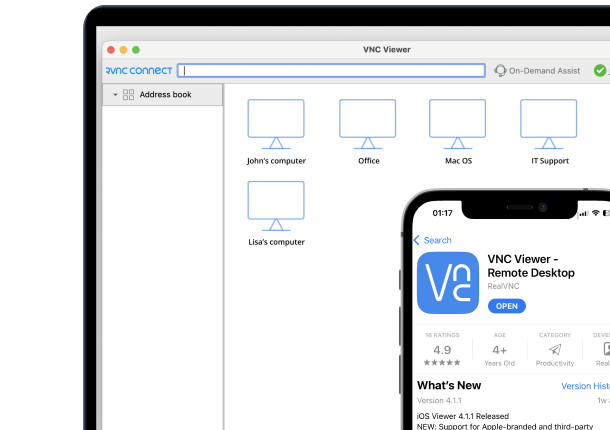




If you’ve ever tried to fix a production issue or patch hosts in an air-gapped environment, you know the lack of online access makes remote administration harder. Many remote access solutions rely on endpoints being online and reachable from outside the network. On-premise remote access gives teams a way to reach critical servers while keeping every single packet inside your racks.
For security-focused organizations in sectors like defense, critical infrastructure, or finance, secure remote access with offline licensing and direct peer-to-peer connections is standard practice and not an optional extra. An on-premise solution that stays secure by design and still provides IT with a practical solution is where RealVNC Connect Enterprise comes in.
Understanding On-Premise Remote Access with RealVNC Connect
Most IT teams rely on remote access, but with IT infrastructure that’s offline and air-gapped, the real question is how those connections can work safely and reliably. With the RealVNC Connect on-premise solution, the focus sits on direct remote connections between computer systems and devices, controlled entirely inside your own environment. Understanding how this technology works is integral to designing a deployment you can trust.
Direct Connection Methodology for On-Premise Deployments
In an offline on-prem deployment, every connection starts with a static IP address or hostnames already known to admins, with routing configuration already in place. A viewer connects directly to the server, so remote sessions run peer-to-peer (P2P) on the same network with no cloud relay in the path.
RealVNC Connect direct connection sessions in an on-prem environment use TCP and UDP connections over port 5900. Depending on your environment, firewalls, and network access control, the traffic is always confined to internal subnets where routing permits RealVNC Connect traffic to transit.
Encryption is handled end-to-end by software, giving secure access with 256-bit AES for Enterprise. Engineers gain remote control of the remote desktop and can use built-in file transfer, all delivered by a remote desktop solution that never needs internet access.
Enterprise Offline Licensing for Air-Gapped Environments
Offline licensing is what turns RealVNC Connect into a truly self-hosted platform. Keys are applied to servers and viewers that reside entirely on premises. The software all runs on your own devices, and there is no standing dependency on cloud brokers, proxy servers, or licensing validation to external servers.
Internal identity systems handle sign-in, including two-factor authentication, which keeps users secure even in the most tightly-controlled environments.
Why Organizations Choose On-Premise Solutions
Teams that stay on premises do so out of necessity. They usually run systems that auditors question, and attackers study and frequently attempt to access. An on-premises solution with enhanced security keeps servers, data, and admin work completely under local control, with clear access permissions, granular access controls, and dependable support.
Regulatory Compliance and Security Excellence
Regulated teams need secure remote access that policy owners trust. RealVNC Connect Enterprise focuses on features like end-to-end security, encryption, and logging so access to sensitive data stays visible and auditable across air-gapped environments.
Typical regulated sectors include:
- Government and defense environments that require complete isolation from external services, while RealVNC direct connections provide remote support inside controlled networks.
- Critical infrastructure operators who want audited sessions and predictable access paths as part of their compliance story.
Operational Control and Network Independence
Operational teams care who really owns the network and the runbook. With RealVNC Connect Enterprise hosted internally, admins keep full control while servers stay in protected zones and engineers still have remote access when something fails after hours.
Common patterns include:
- Industrial and manufacturing sites that rely on closed networks, while engineers remote into each computer for diagnostics and tuning.
- Financial and healthcare environments that need strict separation for trading or clinical systems, yet still value incident response through RealVNC.
RealVNC Connect Enterprise On-Premise Capabilities
On-prem is where RealVNC Connect Enterprise starts to feel very different from open-source VNC and remote access solutions that require cloud-brokering. It gives teams fully integrated remote access and support that lives inside their own environment. It provides teams with enterprise-grade features so admin staff can manage users, policies, and support sessions under their control.
Advanced offline licensing and deployment
Offline licensing keeps RealVNC Connect Enterprise strictly under the control of enterprises. Teams apply keys during MSI-based deployment, at install time, through the command line, or with Group Policy, so each computer joins quietly in the background.
License periods match internal practices, with a clear renewal window rather than surprises from a third-party service. Admin staff keep a fully managed workflow while remote environments stay independent of external connectivity and still support unattended access when engineers need to reach machines out of hours.
On-Prem Management Console and centralized control
The On-Prem Management Console acts as a command center for your offline estate. It runs entirely inside your network, treating RealVNC components as fully integrated parts of your own stack rather than someone else’s portal.
From a browser, Admins see licensed devices, activity, and key metrics, then adjust access and authorization for people and machines that use shared resources. Auditing provides a clear record of who connected where and when, which keeps compliance teams happy while still allowing practical unattended access in secure environments.
Implementation Architecture and Requirements
A RealVNC on-prem deployment works best when the underlying network design supports predictable remote workflows, reliable routing, and consistent, neat handling of servers, IP addresses, and traffic paths. This is where early deployment planning really pays off.
Network Infrastructure Planning
Teams start by laying out the core technical prerequisites for clean, supportable connectivity.
- Build routing, DNS, and firewall rules that give VNC traffic predictable connections.
- Configure port 5900 over TCP and UDP so traffic passes cleanly through approved segments.
- Maintain structured planning for IP addresses and hostnames that operators rely on daily.
- Keep access aligned with least privilege to protect core resources.
- Shape traffic paths to optimize performance during maintenance windows and remote workflows.
Management and Operational Considerations
Once the base network is set, operations teams define how the environment will integrate with the Management Console.
- Use the On-Prem Management Console to supervise licenses, devices, and activity.
- Follow offline renewal cycles so each end user keeps uninterrupted access.
Provide clear paths for engineers delivering technical support. - Use built-in audit trails as tools to validate every remote action and connection.
Security Architecture for Air-Gapped Networks
In air-gapped environments, security depends on cryptography and architecture, and then usability across WANs and online sites. RealVNC Connect provides strong security features such as AES GCM to keep traffic secure, with 128-bit as standard and 256-bit for Enterprise.
The RFB protocol is built for hostile networks, so remote sessions run end to end without trusted intermediaries. Elliptic Curve Diffie-Hellman provides Perfect Forward Secrecy, while 2048-bit RSA keys anchor identity so servers and users can validate each other. VNC Server enforces access decisions locally, keeping data protection under your policies.
Deployment Best Practices
An on-premises RealVNC Connect deployment requires a lot of the same policies and procedures you likely already have in place:
- Group Policy deployment: Use existing AD DS and GPO to push authentication and identity policy to maintain consistency.
- MSI installation: Application deployment software like Intune and SCCM can be used to push the unified application via MSI installers.
- Parameterized deployment: Apply transforms and parameters so remote access inherits your encryption and logging policies.
- Firewall rules: Lock down port 5900 and related traffic to trusted paths only. Keep VNC ports closed on perimeter firewalls to avoid exposing hosts.
- Segmentation strategy: Shape zones so remote support traffic stays inside approved security boundaries.
Decision Framework for On-Premise Deployment
Choosing on-premises remote access begins with asking whether your business truly needs hard isolation or simply wants tighter control. Teams review security mandates, data sovereignty rules, and how much internal capability they have to run a solution that lives entirely inside their own environment.
If the answer points toward offline licensing and direct connectivity, RealVNC Connect Enterprise gives you a predictable path forward, along with guidance from specialists who help shape deployments that match your operational reality.
Frequently Asked Questions (FAQ)
Can RealVNC Connect operate completely offline?
Yes. RealVNC Connect Enterprise can run entirely offline via an offline license that activates servers and viewers in your network. Admins can then connect using known static IP addresses and hostnames directly without the internet.
Are cloud connections available with offline licensing?
No. As offline licensing is designed for RealVNC Connect remote access services to strictly stay within your network, cloud connections are not available. This is to keep all sessions secure and safe within internal networks. However, some organizations do adopt a hybrid between on-prem and cloud-brokering.
Is the On-Premise Management Console included with Enterprise?
Yes. Enterprise users are provided with the On-Premise Management Console. This is designed to run on Windows Server 2022 and runs inside your network, serving as a secure gateway for licensing and device visibility.
How do I deploy offline licenses at scale?
There are multiple flexible deployment options for offline license models with RealVNC Connect Enterprise. Keys can be applied during MSI installs, through Group Policy, or by scripted command line, so devices pick up licensing automatically with consistent policies and reduced risk.