



NoMachine is a remote desktop software that uses its proprietary NX protocol to deliver high-performance access to computers, with particular strength in multimedia and graphics-intensive workflows. The Luxembourg-based company serves individual users, technical professionals, and organizations that need Linux remote access. However, several factors drive organizations to seek a NoMachine alternative.
NoMachine’s licensing model spans multiple product tiers and requires platform-specific purchases for Enterprise deployments. While the software excels at X11 optimization and offers a free tier for personal non-commercial use across Windows, macOS, Linux, iOS, Android, and Raspberry Pi platforms, its multiple product tiers and the newer NoMachine Network subscription service create complexity for budget planning.
The company does not publish third-party security certifications, which creates challenges for procurement in regulated industries. The proprietary NX protocol, which became closed-source with version 4 in 2013, limits vendor independence compared to standardized protocols like VNC. Additionally, annual subscription requirements replaced perpetual licensing in version 7.
Therefore, this guide analyzes this remote control solution and explores a NoMachine alternative better suited for remote support and secure connections.
How to Evaluate Remote Desktop Alternatives
When IT teams assess remote access solutions, six criteria separate tools that work in pilot environments from those that scale across an enterprise.
1. Licensing Transparency and Cost Predictability
Remote desktop software varies widely in how vendors structure their pricing. Many offer simple tier structures with a single subscription, while others require separate licenses for Windows, macOS, and Linux.
Published pricing allows you to forecast annual costs accurately. Contact-for-quote models, by contrast, introduce uncertainty into budget planning. As teams grow, scalability becomes critical. Look for solutions where adding users or devices follows predictable cost curves rather than requiring license renegotiation.
Hidden costs sometimes appear in support tiers, infrastructure requirements, and mandatory annual renewals. A “free” solution may require server provisioning, SSL certificate management, and ongoing maintenance that outweigh subscription fees for managed alternatives.
2. Security Certifications and Compliance Validation
ISO 27001 certification confirms that an organization maintains a structured information security management system. SOC 2 Type II attestation validates that security controls operate effectively over time.
For organizations in healthcare, finance, or government, vendor certifications directly affect procurement timelines. HIPAA, PCI-DSS, and FedRAMP requirements mandate that remote access vendors demonstrate certified security practices. Self-reported security features, while valuable, require additional due diligence compared to published audit reports and penetration testing results.
RealVNC, for example, holds ISO 27001:2022 certification and SOC 2 Type II + HIPAA attestation. The company maintains UK Cyber Essentials certification, has undergone Cure53 security audits, operates a 24×7 Security Operations Center, and publishes penetration test reports through its Trust Center at trust.realvnc.com.
3. Protocol Architecture and Vendor Independence
The protocol of a remote desktop solution determines long-term flexibility. The VNC protocol follows the IETF RFC 6143 specification, which means multiple vendors implement compatible solutions. Organizations can switch providers or use different clients and servers without complete infrastructure replacement.
Proprietary protocols, in contrast, deliver performance optimizations, particularly for graphics-intensive workflows. However, they create vendor dependency, as migration away from proprietary solutions implies replacing both server and client components across all endpoints.
Essentially, open standards allow for gradual transitions, mixed-vendor environments, and greater negotiating leverage during contract renewals.
4. Enterprise Support Infrastructure
Support models range from community forums and email tickets to dedicated account management with guaranteed response times. For production environments where remote access outages affect business operations, SLA-backed support becomes essential.
Key distinctions include support availability (business hours versus 24/7 coverage), response time guarantees, and technical depth. Some vendors offer tiered support where faster response translates into premium pricing, while others include professional support across all paid plans.
Vendor stability also matters. Companies with decades of market presence, validated customer deployments, and sustained product investment reduce the risk that a critical tool becomes abandoned or unsupported. For a full side-by-side, read NoMachine vs RealVNC.
5. Deployment Architecture and Operational Simplicity
Cloud-native solutions deploy in minutes with zero infrastructure requirements. The vendor manages relay servers, handles software updates, and provides global connectivity.
Self-hosted deployments offer data sovereignty and work in air-gapped environments, but they require server provisioning, network configuration, SSL certificate management, and ongoing patching. Time-to-deployment extends from minutes to days or weeks, depending on organizational complexity.
The best solutions offer both options. Cloud-brokered connections serve most use cases, while direct LAN connections and on-premises deployments address environments with specific regulatory or network-isolation requirements. RealVNC Connect offers a 7-day free trial that demonstrates both deployment models.
6. Cross-Platform Consistency
Remote desktop tools should deliver identical (or very similar) features across Windows, macOS, Linux, and mobile platforms. Evaluate if file transfer, session recording, chat, and administrative controls work identically regardless of which platforms connect. A unified interface reduces the learning curve and helps you apply procedures consistently.
Licensing Complexity and Transparency Challenges
When IT teams evaluate remote desktop software, licensing structure is a strong factor that determines if a solution can scale or will create more administrative burden.
How NoMachine Structures Its Licensing
- The free NoMachine allows personal, non-commercial use with a limit of one incoming connection per host computer. Users can connect to any computer using its IP address, and the free version includes features like file transfer, screen recording, and multi-monitor support.
- Enterprise products, where organizations that need multiple users to access the same physical desktop must purchase Enterprise Desktop subscriptions (starting at $44.50/year). Those who want to host multiple virtual desktops on Linux require Terminal Server products (starting at $3,494.50/year). Centralized access across an enterprise calls for Cloud Server deployments.
Each Enterprise product category requires separate licenses for Windows, macOS, and Linux. You cannot purchase unified license packs that cover mixed operating system environments.
You can access computers behind firewalls or without public IP addresses. Publishing machines to the network is free and unlimited. Since version 7, NoMachine requires annual subscription renewals to maintain functionality.
How RealVNC Structures its Licensing
RealVNC Connect uses a concurrent sessions model with three primary tiers:
- Essentials: Starting at $8.25/month (1 concurrent session, 1 user, up to 3 devices)
- Plus: $16.50/month (unlimited users, up to 50 devices)
- Premium: $29.75/month (up to 150 devices, On-Demand Assist included)
- Enterprise: Custom pricing for larger deployments
A single subscription covers all platforms. Installation setup on a Mac, followed by access from a Windows laptop and an Android phone, requires no additional licensing steps. RealVNC offers a free tier (Lite) and also provides a trial period for evaluation.
RealVNC’s model accommodates growth through added concurrent sessions rather than renegotiated contracts.
Security Certification Gap and Enterprise Requirements
Healthcare organizations must demonstrate HIPAA compliance. Financial institutions operate under PCI-DSS mandates. Government contractors follow FedRAMP guidelines. Each framework expects vendors to provide third-party security validation rather than self-reported capabilities.
NoMachine’s Security Capabilities
NoMachine implements encryption for all connections. The NX protocol uses OpenSSL TLS/SSL with ECDHE-RSA-AES128-GCM-SHA256 as the default cipher suite running TLS 1.2. Enterprise products add SSH tunneling for connections and integration with authentication backends including LDAP, PAM, and Active Directory. Two-factor authentication provides permission controls for desktop sharing sessions, with push notifications available on mobile devices for connection approvals.
The self-hosted architecture means connection data does not traverse NoMachine’s servers, which appeals to organizations that prefer to manage their own infrastructure.
However, NoMachine does not publish ISO 27001, SOC 2 Type II, or FIPS 140-2 certifications. Vendor risk assessments must rely on technical documentation and self-reported security features rather than independent audit reports.
RealVNC’s Certified Security Approach
RealVNC received ISO/IEC 27001:2022 certification. Our certification reinforces that security is at the forefront of everything we do, not only in the products we build, but how we operate as a business.
Beyond ISO 27001, RealVNC maintains SOC 2 Type II + HIPAA attestation and publishes extensive security documentation through its Trust Center (trust.realvnc.com).
We use 256-bit AES end-to-end encryption for sessions and operate a 24/7 Security Operations Center for threat monitoring. Independent security audits by Cure53 have examined the codebase, with published findings accessible to enterprise customers conducting due diligence.
Protocol Standardization vs. Proprietary NX Lock-In
When evaluating remote access solutions for long-term deployment, protocol architecture affects vendor flexibility, ecosystem compatibility, and migration options.
NX Protocol and Vendor Dependency
NoMachine’s proprietary NX protocol delivers compression optimized for X11 environments. Originally developed for Linux and Unix systems, the protocol later expanded to support Windows and macOS. The performance benefits come from tight integration between protocol and application, which allows NoMachine to optimize screen sharing and file sharing operations.
However, this approach creates vendor lock-in. The command structures, session management, and advanced features depend on NX-specific implementations that do not transfer to competing products.
Unlike free alternatives such as Chrome Remote Desktop (which uses Google’s WebRTC protocol) or standard VNC implementations, NoMachine connections require both ends to run NoMachine software. This constraint can complicate deployments in environments with multiple monitors, mixed operating systems, or strict software approval processes.
VNC Protocol and Open Standards
The VNC protocol follows IETF RFC 6143. RealVNC’s founders authored this standard in March 2011, when they establoshed the Remote Framebuffer (RFB) protocol as an industry reference.
This open standard provides ecosystem flexibility. Multiple VNC implementations exist across platforms and allow you to choose vendors based on features and pricing rather than protocol compatibility.
RealVNC maintains the RFB protocol specification and contributes encoding types registered with IANA. The company’s commercial version adds security, performance, and multi-monitor support enhancements while maintaining backward compatibility with the RFC 6143 standard.
Feature Comparison – NoMachine vs. RealVNC Connect
| Feature | NoMachine | RealVNC Connect |
| Licensing Model | Per-OS licenses for Enterprise products; Network subscriptions based on concurrent connections | Unified subscription covering all platforms; concurrent sessions model |
| Free Version | Personal use only, 1 incoming connection limit | 7-day free trial; no permanent free tier |
| Enterprise Pricing | Enterprise Desktop from $44.50/year; Terminal Server from $3,494.50/year; Network from $8.50/month | Essentials from $8.25/month; Plus from $16.50/month; Premium from $29.75/month |
| Security Certifications | No published ISO 27001, SOC 2, or FIPS 140-2 certifications | ISO 27001:2022 certified; SOC 2 Type II + HIPAA attested (November 2025) |
| Encryption | TLS/SSL with AES-128-GCM (ECDHE-RSA cipher suite) | 256-bit AES end-to-end encryption |
| Protocol | Proprietary NX protocol | VNC (IETF RFC 6143 open standard) |
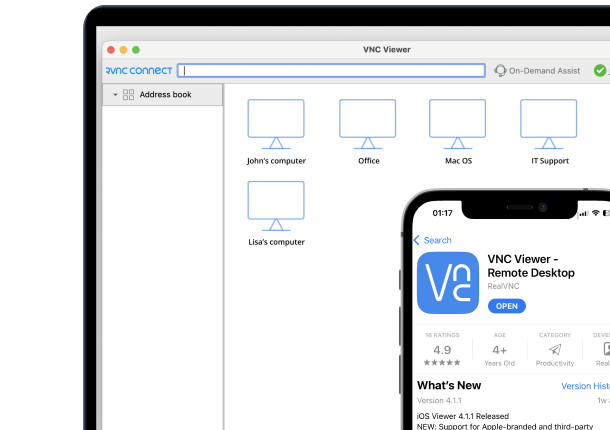
| Application Architecture | Separate server and client installations | Unified desktop app combining Viewer and Server (v8, April 2025) |
| Interface | Consistent menu panel across platforms | Completely redesigned UI with Dark Mode; movable, minimizable toolbar |
| Multi-Monitor Support | Switch between monitors via menu; view all monitors in one window; keyboard shortcuts (Ctrl+Alt+I) | Break out each remote monitor into separate windows; choose monitor from toolbar |
| File Transfer | Disk sharing and file transfer via Monitor panel | Dual-pane File Transfer tool with side-by-side local/remote view |
| Session Recording | Screen recording via menu panel | WebM video recording; configurable automatic recording for all sessions |
| Platform Support | Windows, macOS, Linux, iOS, Android, Raspberry Pi, ARM | Windows, macOS, Linux, iOS, Android, Raspberry Pi |
| Two-Factor Authentication | Available via PAM modules; mobile push notifications | Built-in MFA support |
| Web Access | Browser-based access via Web Player (Enterprise products) | Cloud connections via RealVNC account |
| Instant Support | Desktop sharing with guest authorization | On-Demand Assist (no install needed); Code Connect with self-expiring session codes |
| In-Session Communication | Whiteboard for messaging and drawing | Two-way in-session chat |
| Self-Hosted Option | Fully self-hosted; no external service dependency | Cloud-brokered or direct connections; Enterprise supports on-premises |
| Support | Standard Support (24h response Mon-Fri) with subscriptions; Premium/Mission tiers available | Support included with paid plans |
Use Cases and Selection Criteria
Different organizations have different priorities when selecting remote desktop software.
Choose NoMachine when:
- X11 optimization and VirtualGL integration matter for scientific visualization or CAD workflows
- Self-hosted infrastructure with no cloud dependencies is mandatory
- The organization operates primarily within a single OS environment (avoiding per-OS licensing complexity)
- Personal use scenarios where the free version’s single-connection limit suffices
- Access to computers behind firewalls via NoMachine Network meets connectivity needs
Choose RealVNC Connect when:
- You need high performance remote access
- Third-party security certifications (ISO 27001, SOC 2) are required for procurement approval
- Mixed OS environments need unified licensing across Windows, macOS, Linux, and mobile devices
- IT helpdesk teams require instant support capabilities without pre-installed client software
- Audit logging and session recording must integrate with compliance documentation
- Budget predictability matters, with published pricing and clear scaling costs
- Choice between combined Viewer-Server architecture simplifies deployment
Consider Chrome Remote Desktop or other free alternatives when:
- Basic screen sharing between Google accounts meets all requirements
- No enterprise security certifications are needed
- Limited functionality is acceptable for occasional personal use
- Cost must be zero, and some advanced features are unnecessary
How to Make the Transition
If you’ve made up your mind and want to move to the best alternative to NoMachine, follow this straightforward migration path:
Step 1: Evaluate Requirements
Start with the 7-day free trial to test RealVNC Connect across representative remote computers in your environment. Verify that file transfer, multi-monitor support, and session recording meet operational needs before committing. If you’re interested, find the free registration link here.
Step 2: Plan Deployment
Download the unified desktop app for Windows, macOS, or Linux. Unlike previous versions that required separate Viewer and Server installations, v8 combines both into a single application. You can toggle between providing and receiving remote access within the same interface. It’s a good option if you prefer simplicity and performance in one.
Step 3: Configure Team Structure
Use the RealVNC Connect Portal to organize devices by department, location, or function. Multi-Level Device Lists help IT teams manage large fleets efficiently.
Step 4: Establish Security Policies
Enable multi-factor authentication, configure session recording preferences, and review encryption settings. Reference the Trust Center documentation when aligning RealVNC Connect with existing compliance requirements.
Step 5: Train Users
The redesigned interface in Version 8 simplifies onboarding. Share the Code Connect workflow with external collaborators who need temporary access without persistent credentials.
Migration usually completes within days rather than weeks, especially if you’re an organizations already familiar with remote desktop concepts. The cloud-brokered connection model eliminates VPN dependencies and firewall configuration tasks that complicate some alternative deployments.
The Best NoMachine Alternative Is Here. Try It Free Today.
NoMachine delivers strong technical capabilities for graphics-intensive workflows and self-hosted environments, with good encryption and a privacy-focused architecture. However, its per-OS licensing model for Enterprise products and certification gap add friction for enterprise procurement in regulated industries.
RealVNC Connect offers a better approach with unified platform licensing, ISO 27001 and SOC 2 Type II certifications, and features designed for IT support operations. The concurrent sessions pricing model aligns costs with actual usage, while published documentation accelerates vendor risk assessments in regulated industries. Version 8’s unified application and redesigned interface represent a significant step forward in usability compared to past versions.
If you’re ready to switch, give it a try. The first 7-days are on us.