



A maintenance issue can leave a remote engineer waiting for a control-system session as automated accounts continue exchanging data in the background. When either route depends on a permanent credential, a single account can receive authority far beyond its intended task, putting recovery work, plant teams, and production schedules under pressure.
MFA for industrial environments applies identity assurance at the point where people enter operational technology and uses separate, bounded identities for automated work. Privileged human sessions need stronger verification, legacy assets need controls at remote-entry boundaries, and non-human accounts need certificates or scoped tokens rather than interactive prompts. Every route needs a recovery path that plant teams have tested.
A prompt-based factor suits a person who is about to administer an engineering workstation. It does not suit a programmable logic controller, a supervisory control and data acquisition system, or an unattended service account. Think of the identity layer as a staffed gate outside the factory floor: it verifies the person entering, and the equipment inside keeps running under its established operating rules.
The leadership challenge is to separate those access models without creating a central dependency that delays maintenance or local recovery. That means ranking routes by privilege, operational consequence, and recovery dependency, then assigning a named owner to every exception and privileged pathway.
This article explains where human authentication ends and machine identity controls begin. It compares factors for privileged users, certificates and scoped tokens for automated accounts, gateway-based controls for legacy operational technology, and the governance practices that keep vendor access, break-glass procedures, session evidence, and exceptions reviewable.
What makes MFA for industrial environments different?
MFA for industrial environments must govern entry into operational technology (OT) zones without assuming every device can complete an interactive challenge. The decision starts with the access path, the destination, and the consequence of delay. In a Purdue reference model, authentication is strongest at the boundary before a user reaches a sensitive zone; by contrast, field assets use compensating controls where native identity functions are unavailable.
Workforce identity programs usually optimize access to corporate applications. Plant environments add maintenance windows, local operations, segmented networks, and deterministic processes that cannot wait for a prompt failure to be resolved. SANS Institute’s 2024 State of ICS/OT Cybersecurity Survey found that 75% of respondents had implemented MFA for remote access to industrial sites.
The SANS ICS/OT research team wrote in its 2024 analysis: “Thankfully, multifactor authentication (MFA) has become the norm for remote access into ICS/OT networks, with 75% of respondents leveraging the technology. That said, basic capabilities like logging and access verification are still absent for many practitioners.” Authentication and review evidence must move together.
- Safety and uptime: Set controls that preserve approved emergency and maintenance access.
- Shared and privileged access: Assign a named owner to every administrative pathway.
- Legacy protocol limits: Use gateways or network controls when endpoints lack modern identity functions.
- Network-zone boundaries: Verify users before they enter the zone that contains sensitive systems.
| Legacy IT MFA assumption | Industrial operating reality | Governance implication |
|---|---|---|
| Every endpoint can prompt a user | Many assets are unattended or legacy systems | Place controls at remote-entry boundaries |
| One policy fits all users | Engineers, operators, and vendors hold different privileges | Match assurance to the activity |
| Authentication completes the control | Sessions and permissions still need review | Retain evidence and assign reviewers |
| Availability is an application concern | Access failure can delay maintenance or recovery | Test fallback procedures with plant teams |
Which access paths need the strongest assurance?
The strongest identity checks belong on routes that reach engineering workstations, SCADA administration, remote maintenance, or safety-adjacent systems. Rank each route by who enters, what they can change, and whether the plant can recover if the session fails. This turns authentication governance into a service-criticality decision rather than a product comparison.
Use four dimensions together. Think of them as controlled gates before a restricted plant area: a visitor reaching a meeting room needs less scrutiny than someone entering a control room with authority to change equipment settings. The more consequential the destination and activity, the more identity checks and review evidence the access route requires.
- Access Path: Identify VPNs, jump hosts, remote desktop services, and support gateways. Does this route cross from enterprise IT into an OT zone?
- Privilege: Record whether the identity can view, administer, or change settings. Can the session alter a production-relevant configuration?
- Operational Consequence: Assess the effect of misuse or lost access. Would a failed session delay maintenance, recovery, or response?
- Recovery Dependency: Establish who can restore access locally. Does recovery depend on a central service, vendor, or named engineer?
The framework gives asset teams a shared evidence request before expanding controls. Kaspersky ICS-CERT’s 2024 threat landscape report reported that 38.6% of ICS computers were targeted at least once globally during 2023. That figure does not rank individual plants, but it reinforces why broad inventories and privilege discovery come before rollout decisions.
| Framework dimension | Evidence to collect | High-risk signal | Decision supported | Common misread |
|---|---|---|---|---|
| Access Path | Network route and entry method | Direct route into an OT zone | Require stronger entry verification | Treating all VPN sessions alike |
| Privilege | Role and permitted actions | Configuration or administrative rights | Apply approval and tighter permissions | Equating login with authority |
| Operational Consequence | Service criticality and recovery plan | Maintenance or safety dependency | Set fallback and escalation rules | Rating only data sensitivity |
| Recovery Dependency | Local staffing and recovery ownership | One remote identity controls restoration | Test local alternatives | Assuming central identity is always available |
How do you classify human remote access?
Remote engineers, administrators, contractors, and vendors need assurance based on destination, session duration, and permitted actions. CISA’s 2025 OT mitigation guidance advises private IP connections, VPN functionality, strong passwords, and phishing-resistant MFA where remote access is necessary.
Dale Peterson, ICS Security Catalyst, stated in 2025: “The limited OT cyber incident data we have clearly shows that multi-factor authentication (MFA) for OT remote access is a critical control.” MFA does not secure the full architecture alone; segmentation, destination controls, and session review remain necessary.
- Identity type: Prioritize privileged engineers and external maintainers before routine users.
- Destination criticality: Require more assurance before access reaches administration or control systems.
- Session duration: Make elevated access time-bounded and subject to approval where the workflow permits.
How do non-human identities change the model?
A service account is not an MFA user as it cannot approve a prompt or produce a human second factor. For machine-to-machine communication, replace broad, permanent credentials with managed identities that limit what the account may reach and how long authority lasts. This separates human session verification from controls for automated work.
- Certificates: Use cryptographic identities for defined machine-to-machine connections.
- Scoped tokens: Limit automated access to a stated workload and permission set.
- Just-in-time privileged credentials: Issue administrative authority for a defined task, then remove it.
That boundary keeps teams from forcing an unsuitable human workflow onto equipment without leaving automated credentials unmanaged.
How should leaders select OT authentication methods?
)
Select authentication methods by access path and operational consequence, not by a universal ranking of factors. Hardware-backed authenticators suit sensitive human administration; certificates and scoped tokens suit non-human workflows; and gateways provide a practical control point when legacy equipment cannot handle modern identity protocols. Each method must include a recovery path that plant teams have reviewed.
Adoption gaps make this choice practical and technical. Cyber Readiness Institute’s 2024 Global Multifactor Authentication Survey found that 65% of surveyed global small and medium-sized businesses did not use MFA and did not plan near-term implementation. Leaders need a staged plan that concentrates effort on privileged routes first.
- FIDO2 and hardware-backed authenticators: FIDO2 uses public-key authentication for human sessions. Use it for privileged engineers and administrators where phishing-resistant assurance matters most. The decision is whether the role can change sensitive systems; the pitfall is assuming every operational workflow has compatible client support. The National Institute of Standards and Technology (NIST) stated in 2024: “FIDO authenticators paired with W3C’s Web Authentication API are the most common form of phishing resistant authenticators widely available today.”
- OTP and push-based factors: One-time passcodes and approval prompts offer a transitional option for human users. Use them where the workflow needs an interim control, then review their suitability for privileged OT access. The pitfall is treating convenience as equivalent to phishing resistance.
- Certificates and scoped tokens for machines: Use these identities for service accounts, APIs, and automated exchanges. The decision is whether the workload has a defined purpose and limited permission set; the pitfall is leaving credentials permanent and broadly reusable.
- Gateway-based controls for legacy OT: Authenticate users at a support gateway or remote-entry boundary when a device cannot authenticate directly. The pitfall is allowing the gateway to become an unmanaged route into a sensitive zone.
| Authentication pattern | Best-fit access path | Leadership signal | Common deployment error |
|---|---|---|---|
| FIDO2 or hardware-backed authenticator | Privileged human administration | Strong assurance for sensitive changes | Ignoring endpoint compatibility |
| OTP or push factor | Transitional human access | Interim control with review need | Using it as the permanent standard |
| Certificate or scoped token | Service accounts and APIs | Defined machine identity | Keeping broad, long-lived permissions |
| Gateway authentication | Legacy device support | Control placed before the OT destination | Treating the gateway as the only safeguard |
CISA’s 2024 USDA FIDO implementation example is a public-sector illustration of implementation planning, not proof of industrial performance. In plants, service criticality and recoverability decide whether a factor is appropriate.
Where do industrial MFA rollouts commonly fail?
Industrial MFA rollout fails when identity controls are designed without local recovery, accountable ownership, or a tested exception process. A rollout must account for disconnected operations, emergency access, token lifecycle management, and maintenance tolerance before controls reach sensitive zones. The following sequence gives leadership a way to govern those decisions.
- Map access paths and accountable owners: Build a verified inventory from asset records, network zones, and vendor contracts. Decide which pathways need attention first. Do not treat shared accounts as individual identities. Every privileged route needs an owner and stated business purpose.
- Set assurance levels by consequence: Use service criticality and recovery plans to choose FIDO2, OTP, certificates, or gateway controls. Do not mandate one factor for every workflow. Sensitive pathways require stronger verification; by contrast, non-human processes need bounded machine identities.
- Design disconnected and break-glass workflows: Define whether a plant uses synchronized validation, local validation, or compensating controls during connectivity loss. Do not create a central identity dependency without a tested local fallback. Plant teams need to validate emergency access during an approved exercise.
- Pilot, observe, and govern exceptions: Use maintenance windows and change-control records before broader deployment. Do not leave pilot exceptions in place indefinitely. Each exception needs an owner, expiry date, and review cadence.
CISA and USCG’s 2025 advisory on a proactive threat hunt at a U.S. critical-infrastructure organization identified a need for phishing-resistant MFA for administrative access, including remote desktop protocol (RDP) and VPN connections. The finding illustrates why privileged remote routes deserve early attention, even when device-level controls vary.
| Rollout decision | Availability implication | Governance evidence |
|---|---|---|
| Prioritize access paths | Focuses change on consequential routes | Named owner and business purpose |
| Choose assurance by consequence | Avoids unsuitable factors | Documented risk and recovery review |
| Define break-glass access | Preserves local recovery options | Approved exercise record |
| Govern exceptions | Prevents temporary workarounds becoming permanent | Expiry date and review record |
Vendor access requires the same discipline. ENISA’s 2025 technical implementation guidance advises phishing-resistant MFA where possible, access limited by need and duration, and separation from third-party systems. Those requirements turn vendor support from a standing connection into a reviewable, bounded activity.
The governance traps that weaken plant authentication
A policy does little if nobody owns the accounts, exceptions, and evidence behind it. IEC 62443-2-1:2024 places “USER 1.9: Multifactor authentication (MFA)” within the industrial automation and control systems asset-owner security program, as documented by the International Electrotechnical Commission in 2024. It does not certify an individual MFA product or replace plant-level risk analysis.
The joint FBI, CISA, and NSA guidance from 2024 recommends MFA for all access to the OT network. NIST SP 800-63 identity guidance informs assurance concepts, but industrial teams still need to apply zone-and-conduit design, safety processes, and operational risk decisions to their own environment.
- Policy without ownership: Assign an accountable leader for each privileged pathway.
- Shared privileged identities: Replace them with attributable access wherever the workflow allows.
- Unbounded third-party access: Set purpose, duration, and destination limits.
- Permanent exceptions: Require expiry dates and compensating controls.
- Unactioned access evidence: Name who reviews records and what triggers follow-up.
| Governance trap | Control and review evidence |
|---|---|
| Policy without ownership | Accountable owner and review schedule |
| Shared privileged identities | Attributable session records and access register |
| Unbounded third-party access | Approved purpose, duration, and destination |
| Permanent exceptions | Expiry date, compensating control, and approval |
| Unactioned access evidence | Named reviewer and documented follow-up |
Audit readiness comes from repeatable decisions: who approved access, what authority was granted, when it ended, and who reviewed the evidence.
How RealVNC Closes the Industrial MFA Gap
)
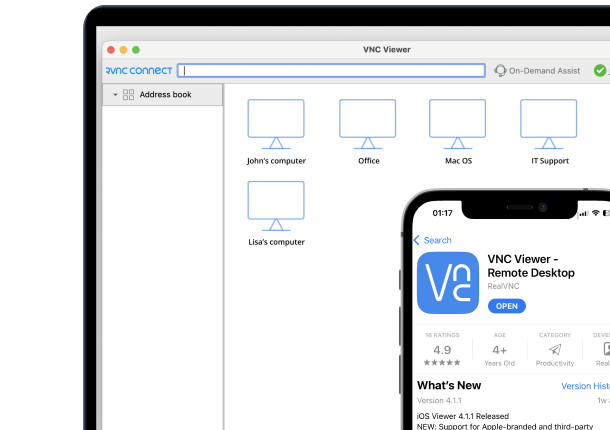
Industrial authentication often breaks down at the human entry points around a plant: a support engineer needs remote troubleshooting access, an IT team needs to oversee a privileged session, or an external specialist needs short-term maintenance access. These workflows sit beside segmentation, machine identity, and local operating procedures. They need controlled remote access without implying that every PLC or service account will authenticate natively.
RealVNC Connect addresses the human remote-support layer through controls that map to those workflows:
- Multi-factor authentication and single sign-on (SSO): MFA and SSO with Microsoft Entra ID or Okta support centralized identity verification for authorized remote users.
- Role-based access controls: Role-based access controls and granular action-based permissions separate viewing, keyboard and mouse control, and file-transfer rights during sensitive sessions.
- Session evidence: Session monitoring, recording, and detailed audit logs provide reviewable records of who connected, when they connected, and what permissions applied.
- Temporary vendor access: Code Connect uses single-use 9-digit session codes for time-bound third-party support, rather than issuing standing credentials for an external maintenance task.
This aligns with ENISA’s guidance to limit third-party access by need and duration, and it keeps the product’s role defined: RealVNC Connect governs remote human sessions, not industrial protocols, network segmentation, or machine identity. For IT and OT leaders, the operational outcome is an attributable support route with controlled permissions and retained evidence that can be reviewed alongside plant access governance.
Final Words
When a remote engineer needs urgent access, the identity decision has to protect the plant without delaying recovery. MFA for industrial environments works when you rank access paths by privilege, operational consequence, and local recovery needs; apply phishing-resistant checks to sensitive human sessions; and use certificates or scoped tokens for automated accounts. Gateways and compensating controls matter where legacy assets cannot authenticate directly. The program needs tested break-glass access, time-bound vendor pathways, and a named owner for every exception.
RealVNC Connect addresses the remote human-support layer within that wider industrial authentication architecture. Multi-factor authentication and single sign-on (SSO) with Microsoft Entra ID or Okta verify authorized users before a session begins, with role-based access controls and granular action permissions limiting what each user may do. Session recording and detailed audit logs give leaders evidence to review after privileged troubleshooting or external maintenance work. That leaves segmentation, machine identity, and plant-level recovery procedures in their proper places, and makes remote support attributable and governed. Arrange a meeting to assess how RealVNC Connect can strengthen governed remote-support access across your industrial environment.
FAQs
What is the industrial authentication framework?
The industrial authentication framework for MFA for industrial environments assigns controls according to access path, privilege, operational consequence, and recovery dependency. It separates human remote access from service accounts, vendors, and legacy devices, so each route receives an appropriate level of assurance. CISA recommends phishing-resistant MFA where remote access to OT is necessary (CISA, 2025).
What is replacing MFA for industrial devices?
Nothing replaces MFA for human users; industrial programs add machine-identity controls where devices cannot complete an interactive challenge. Certificates, scoped tokens, managed credentials, and lifecycle reviews protect service accounts and machine-to-machine communication. The result is a divided model: stronger verification for people and bounded cryptographic identity for automated systems.
Which MFA method is the strongest?
Phishing-resistant FIDO authenticators are the strongest general choice for sensitive human administration when the workflow and endpoint support them. The National Institute of Standards and Technology (NIST) identified FIDO authenticators paired with the Web Authentication API as the most common widely available phishing-resistant option in 2024. Plants still need to assess recovery, local availability, and compatibility before applying that method to every access route.
What are the three types of MFA?
The three common factor categories are knowledge factors, possession factors, and inherence factors. Knowledge means something the user knows, possession means something they hold, and inherence uses a biometric characteristic; MFA combines factors from different categories. In industrial settings, leaders further need to distinguish the factor type from the access path, privilege level, and recovery plan.
Which standards guide OT access governance?
IEC 62443-2-1:2024 guides IACS asset-owner security programs and includes “USER 1.9: Multifactor authentication (MFA)” in its control set (International Electrotechnical Commission, 2024). NIST identity guidance informs assurance decisions, and ENISA recommends phishing-resistant MFA where possible and third-party access limited by need and duration (ENISA, 2025). NIS2 applicability remains dependent on jurisdiction, sector, and the organization’s role.
Which is better, SSO or MFA?
SSO and MFA solve different access problems, so neither replaces the other. Single sign-on reduces the number of identity systems users must access, and MFA adds assurance when they authenticate; together, they provide centralized access with stronger verification. For industrial remote support, leaders must still govern permissions, session duration, vendor pathways, and recovery procedures.
How does RealVNC Connect support OT remote access?
RealVNC Connect supports the human remote-support layer through MFA, single sign-on with Microsoft Entra ID and Okta, role-based access controls, and granular action-based permissions. Session monitoring, session recording, detailed audit logs, and Code Connect time-bound session codes provide oversight and controlled third-party access. These controls complement OT segmentation, industrial protocols, and machine-identity controls rather than replacing them.