



When a production line stops, the problem moves quickly beyond the plant floor. Customer commitments slip, engineering must establish what changed, and operations and finance need a recovery decision before delays spread through the schedule.
A manufacturing cybersecurity risk assessment is a structured review of the systems, equipment, supplier connections, and access routes that keep production running. It maps where a disruption could begin, ranks its likely operational and financial effect, and assigns a treatment decision and accountable owner before an event interrupts output.
Connected manufacturing makes that review harder than a conventional IT exercise. Programmable logic controllers (PLCs), supervisory control and data acquisition (SCADA) systems, engineering workstations, cloud services, and maintenance links can connect business networks to production processes. Think of the assessment as checking a working plant’s entrances: you need to know every route in, who holds access, and which route reaches a critical process.
This article explains how to define scope across IT and operational technology (OT), connect assets to process criticality, and map credible paths through identities, suppliers, and remote support. It then shows how to score likelihood and business impact, align the review with NIST Cybersecurity Framework (NIST CSF), NIST SP 800-82 Rev. 3, and IEC 62443 concepts, and record treatment decisions in a risk register.
You will also see how leaders can prioritize segmentation, constrained third-party access, compensating controls for legacy equipment, and tested recovery. The goal is a shared record that lets security, engineering, operations, and finance decide what protects production continuity first.
Why Does a Manufacturing Cybersecurity Risk Assessment Matter?
A board report that records only affected data misses the decision plant leaders need to make. They need to know which disruption paths could interrupt a line, delay a customer commitment, or prevent a supplier from completing work.
A manufacturing cybersecurity risk assessment turns plant exposure into accountable production-continuity decisions. It identifies the systems and dependencies that matter, tests realistic routes into them, ranks the business effect, and records who owns each treatment. That gives security, engineering, operations, and finance one basis for deciding what to address first.
The scale of the problem explains why this work belongs in executive reporting. Verizon’s 2024 Data Breach Investigations Report – Manufacturing Snapshot recorded 2,305 manufacturing security incidents, including 849 confirmed data breaches, in 2024. The operational consequence is not theoretical: MKS Instruments disclosed production halts after its 2023 cyber incident, as reported by Comparitech in 2024.
A defensible review identifies the assets and dependencies that affect output, models credible threat paths, scores business impact, and assigns accountable treatments. It replaces a generic technology checklist with a record leaders can use when production priorities compete for funding.
What Makes Plant Cyber Risk Different From IT Risk?
Plant cyber risk is cyber-physical risk: a compromise of a digital system can affect equipment, process quality, and delivery commitments. An IT-only review often captures servers and applications while missing the engineering workstation, controller connection, supplier link, or shared identity that joins business systems to production.
That connection deserves sustained attention. IBM’s X-Force 2025 Threat Intelligence Index reported that manufacturing accounted for 26% of incidents handled by X-Force in 2024. The figure speaks to targeting, but leaders still need to score the local consequence: which process stops, how long restoration takes, and which customers or suppliers depend on it.
Consider a hypothetical corporate email compromise. A user’s account reaches a shared engineering file store, the file store supports a remote-support workflow, and that workflow reaches a production network. The initial event sits in IT, yet its business effect may appear on the plant floor. Brunswick Corporation’s 2023 incident disrupted operations for nine days, according to WTW’s manufacturing cyber analysis (2026).
Which Conditions Expand Factory Cyber Exposure?
- Convergence: IT pathways can reach production assets through shared services and identities.
- Legacy dependency: Patching may affect equipment availability, so teams need documented compensating controls.
- External connectivity: Vendors and suppliers create trust paths into plant-support workflows.
- Time pressure: Recovery decisions happen while production schedules and delivery commitments are already under strain.
| Traditional IT risk lens | Plant risk lens | Executive implication |
|---|---|---|
| Data confidentiality | Production availability and process integrity | Fund controls against business interruption, not only data loss. |
| Individual system weakness | Dependency across systems and equipment | Map the route between enterprise services and production zones. |
| Patch status | Patch feasibility and operational effect | Approve isolation or monitored access where immediate patching is unsafe. |
| Technical recovery | Sequenced restoration of production capability | Set recovery priorities with operations, not security alone. |
Which Framework Aligns OT, IT, and Plant Risk?
)
A shared framework prevents each team from scoring the same issue through a different lens. Use the NIST Cybersecurity Framework (NIST CSF) to organize management activity, NIST SP 800-82 Rev. 3 to guide operational technology (OT) safeguards, and IEC 62443 concepts to discuss system boundaries and connections.
The visibility gap makes that common language necessary. Only 5% of organizations reported complete visibility of OT activity in central cybersecurity operations, according to the Fortinet 2024 State of Operational Technology and Cybersecurity Report. A review cannot score dependencies that neither security nor engineering has recorded.
How Do the Three Frameworks Divide the Work?
NIST CSF gives leaders the management cycle of Identify, Protect, Detect, Respond, and Recover. NIST SP 800-82 Rev. 3 applies OT-specific guidance to industrial control systems, including supervisory control and data acquisition (SCADA) systems and programmable logic controllers (PLCs). IEC 62443-3-2 material describes grouping industrial automation and control system assets into zones and identifying conduits between them, as outlined by ISASecure (2022). Use it as an architectural discussion aid while validating implementation requirements for your environment.
- Scope and ownership: Define the plants, systems, suppliers, and leaders included in the review.
- Asset criticality: Record the production function and recovery dependency for each material asset.
- Threat paths: Map how an identity, connection, or device could cross a boundary.
- Control effectiveness: Test whether safeguards operate under plant conditions.
- Recovery dependency: Identify the systems that must return first for production to resume.
| Assessment dimension | NIST CSF contribution | NIST SP 800-82 contribution | IEC 62443 contribution | Leadership decision enabled |
|---|---|---|---|---|
| Governance | Organizes program activity | Connects controls to OT context | Informs system risk discussion | Assign decision rights. |
| Assets | Identifies material systems | Covers OT components | Groups related assets | Set criticality tiers. |
| Architecture | Frames protection needs | Recommends OT-aware safeguards | Discusses zones and conduits | Approve segmentation work. |
| Detection | Defines detection outcomes | Addresses OT monitoring context | Identifies boundary visibility needs | Fund telemetry priorities. |
| Recovery | Defines recovery outcomes | Accounts for operational restoration | Connects dependencies across zones | Set production recovery order. |
What Does a Shared Risk Model Prevent?
A common taxonomy stops the IT inventory, engineering records, supplier register, and executive risk report from describing the same asset in incompatible ways. CISA’s OT asset-inventory guidance calls for defined scope, asset attributes, taxonomy, inventory data management, and asset life-cycle management.
It also keeps identity context in view. Nidec confirmed that stolen employee virtual private network credentials reached a subsidiary server, and reporting described business-partner documents among the files taken, according to SecurityWeek (2024). Record who has access, what they can reach, and which business relationships depend on that access.
How Do You Score Risks That Could Stop Production?
Risk scoring must rank the consequence of a plausible event, rather than count technical weaknesses in isolation. A controller with a deferred patch may carry limited risk in one zone and material production consequences in another, depending on its process role, connectivity, and recovery options.
Use likelihood and impact together, then capture the reasoning in a risk register. Remote access belongs in that analysis: Dragos’ 8th Annual OT Cybersecurity Year in Review found insecure remote-access conditions at 65% of assessed OT sites in 2025. The register needs an owner, a treatment choice, evidence of completion, and a documented residual-risk decision.
- Asset and process criticality: Identify the production function, product line, safety dependency, or revenue stream the asset supports.
- Exposure path: Record network routes, remote connections, removable media, vendor links, and shared identities.
- Threat-vulnerability pairing: Connect a credible scenario to the weakness that makes it plausible.
- Operational impact: Score downtime, quality, recovery duration, delivery obligations, legal exposure, and financial effect.
- Treatment and residual risk: Document mitigation, transfer, acceptance, or retirement, with an accountable executive owner.
| Assessment component | Evidence to collect | Decision supported | Common scoring error |
|---|---|---|---|
| Criticality | Process maps and recovery order | Which assets need priority treatment | Ranking by asset type alone |
| Exposure | Access records and network paths | Which routes need containment | Ignoring third-party connectivity |
| Scenario | Threat and weakness pairing | Whether a risk is credible | Treating every finding equally |
| Impact | Production and delivery consequences | Investment priority | Counting data impact only |
| Treatment | Owner, evidence, and residual risk | Whether to fund or accept action | Closing findings without validation |
Felix Gaehtgens, Analyst at Gartner, told BankInfoSecurity in 2025: “To enhance privileged access management for operational technology, organizations should use specialized remote access solutions for vendors that are allowed to access OT networks.” Apply that principle where vendor access reaches sensitive zones, while keeping segmentation, monitoring, and recovery as separate parts of the program.
How Should Leaders Prioritize Risk Treatments?
Leaders should sequence treatments by their effect on likelihood, impact containment, production disruption, cost, and feasible maintenance windows. The first action is rarely a wholesale redesign; for legacy equipment, an isolation measure or narrower access rule may reduce immediate exposure while a modernization plan moves through capital approval.
Remote-session control is one useful test of treatment maturity. Just 54% of ICS/OT respondents could terminate a remote-access session after detecting an anomaly, according to the SANS Institute’s 2024 State of ICS/OT Cybersecurity. That gap makes it reasonable to prioritize pathways that reach critical zones or shared administrative functions.
- Contain material pathways first: Prioritize routes that reach production zones or shared administrative services.
- Use compensating controls for legacy assets: Pair deferred patching with isolation, monitored access, hardening, and named ownership.
- Assess suppliers by access and dependency: Review what each third party reaches, how access is authenticated, and which process depends on it.
- Test recovery as a production capability: Run tabletop exercises with engineering, safety, production, communications, and executive decision-makers.
| Treatment category | When it takes priority | Implication for production continuity |
|---|---|---|
| Access restriction | A connection reaches sensitive production support | Reduces unnecessary standing access. |
| Segmentation | IT and OT share poorly defined routes | Limits movement between zones. |
| Legacy compensation | Patching requires safety or availability validation | Documents interim protection and ownership. |
| Recovery exercise | Restoration order remains untested | Reveals decision gaps before an outage. |
Investment sequencing needs to reflect plant reality. A security team must not schedule a change that disrupts validated operations; it needs engineering review, a maintenance window, and evidence that the new control works as intended.
Three Failures That Weaken Plant Risk Reviews
)
False confidence often starts with an inventory that lists devices but says nothing about process dependency. The corrective action is to connect each material asset to its production role, owner, access routes, and restoration priority.
Ken Deitz, CISO at Brown & Brown, told Help Net Security in 2025: “Always start by knowing what to defend and then applying least privilege principles.” That principle fits plant reviews because access decisions are only defensible when teams know what each user, supplier, and service account can reach.
- Inventory without criticality: A device list does not show process dependency or recovery priority.
- Controls without validation: A written policy does not prove that access, segmentation, or recovery operates under plant conditions.
- Findings without decision rights: A risk register cannot direct action when no leader accepts or funds the treatment.
| Assessment failure | Corrective governance action |
|---|---|
| Isolated-network assumption | Validate actual connections, supplier paths, and identity dependencies. |
| Technical-only scoring | Include production, quality, delivery, and recovery consequences. |
| Unowned remediation | Name an owner, due date, evidence requirement, and residual-risk approver. |
Review the record on a regular annual cycle and after material architecture, production, supplier, or incident changes. The assessment stays useful when it changes with the plant.
What RealVNC Adds to Plant-Access Evidence
Remote maintenance and vendor support create an evidence gap when access exists but its scope, identity assurance, and activity record remain unclear. The Dragos 2025 OT review documents insecure remote-access conditions across assessed sites, reinforcing why access controls need to appear in the risk register and in remediation validation.
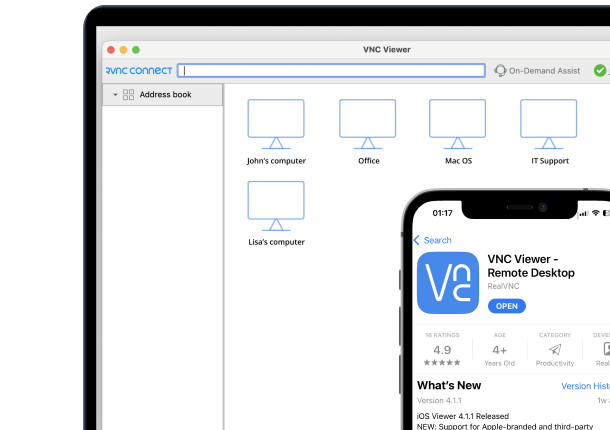
RealVNC Connect addresses the controlled-access layer of that workflow. It does not replace network segmentation, OT monitoring, incident response, or the governance model described above. It gives teams a defined way to apply access decisions and retain evidence that those decisions operate in practice.
- Role-based access controls and granular action-based permissions: Differentiate the permissions available to technicians, vendors, and internal administrators, including separate control of keyboard, mouse, and file transfer.
- Multi-factor authentication and single sign-on (SSO): Strengthen identity assurance for sensitive support workflows; Account SSO is supported with Microsoft Entra ID and Okta on Enterprise plans.
- Session monitoring, recording, and detailed audit logs: Give authorized administrators reviewable records of access activity for treatment validation and incident follow-up.
For a plant team, the outcome is a clearer link between an assessment finding and operating evidence. When a risk record requires restricted vendor access, the access model, session activity, and review trail can be assessed together. That makes remote support one accountable control surface within a broader production-environment resilience review.
Final Words
A manufacturing cybersecurity risk assessment earns its place when it gives leaders a shared view of what keeps production running, where connections cross IT and OT boundaries, and who must act. The work starts with an asset inventory tied to process criticality, then traces supplier and remote-support paths, scores plausible scenarios against operational impact, and records a treatment decision with an accountable owner. NIST CSF, NIST SP 800-82 Rev. 3, and IEC 62443 concepts give security, engineering, and operations a common structure for those decisions.
That structure only holds when the record stays current and treatments are validated under plant conditions. Segmentation, constrained supplier access, compensating controls for legacy equipment, and tested recovery each protect production continuity in different ways. RealVNC Connect supports the controlled-access evidence layer through multi-factor authentication, single sign-on (SSO), role-based access controls, session recording, and detailed audit logs. Those controls give your team a clearer way to demonstrate that remote-support restrictions operate as intended and to review activity when a risk record requires evidence. Arrange a meeting to discuss how RealVNC Connect can support controlled, auditable access in your production-support workflows.
FAQs
What Is the Core Framework for Plant Cyber Risk?
A manufacturing cybersecurity risk assessment combines NIST CSF governance, OT-specific guidance from NIST SP 800-82 Rev. 3, and IEC 62443 concepts for system segmentation and risk design. NIST CSF organizes activity around Identify, Protect, Detect, Respond, and Recover, while NIST SP 800-82 addresses operational technology security. IEC 62443 concepts add a way to discuss system boundaries, zones, and conduits; detailed implementation requirements need validation for each environment.
How Does OT Risk Differ From Enterprise IT Risk?
OT risk includes the possibility that a digital compromise affects production availability, process quality, safety-adjacent operations, or recovery sequencing. An enterprise IT review may prioritize data and service access, while a plant review must also connect systems to production functions, engineering workstations, controllers, suppliers, and restoration priorities. The assessment is useful when security and operations score the same dependency against business consequences.
How Do You Perform a Cybersecurity Risk Assessment?
You perform one by defining scope, mapping assets and dependencies, tracing access routes, pairing credible scenarios with weaknesses, scoring operational impact, and assigning treatment ownership. The resulting risk register needs evidence for each finding, a decision such as mitigation or acceptance, and a named person accountable for residual risk. A spreadsheet or cybersecurity risk assessment template is useful only when it captures production context rather than recording technical findings alone.
What Should a Manufacturing Risk Assessment Example Include?
A useful example links one production process to its supporting assets, access paths, business impact, and treatment decision. For instance, a vendor connection to an engineering workstation should record the systems it reaches, the permissions required, the process affected if access is misused, and the evidence needed to confirm the control works. That structure makes a manufacturing cybersecurity risk assessment easier to compare across plants and suppliers.
How Often Should OT Risk Reviews Be Updated?
OT risk reviews should be updated on a planned cycle and after material changes to systems, production, suppliers, network design, or incident conditions. CISA’s OT asset-inventory guidance treats inventory as a managed process that includes asset attributes, taxonomy, data management, and life-cycle activity. Treat the review as a living governance record, not a document produced once for an audit.
How Does RealVNC Support OT Support Workflows?
RealVNC Connect supports controlled-access evidence through role-based access controls, multi-factor authentication, single sign-on (SSO), session monitoring, session recording, and detailed audit logs. These controls help teams restrict technician and vendor permissions, review support activity, and connect remote-access treatments to evidence in the risk register. They address the access-control layer of plant support and do not replace segmentation, OT monitoring, incident response, or wider governance.