


When a team needs a tool by Friday, the purchase often happens before IT has reviewed the vendor, its permissions, or the business data it will handle. The invoice arrives later, leaving security and finance to reconstruct who uses the application and why.
Managing SaaS sprawl means finding every cloud application in use, assessing its access and data risk, then giving teams a straightforward route to approve, secure, consolidate, or shut down software. This approach reduces unknown access paths, duplicate subscriptions, and audit gaps. It does so without forcing employees back to slow, email-based purchasing.
This article explains how to build that control: start with identity-based discovery, prioritize the applications that carry the greatest exposure, and establish recurring governance that keeps new tools visible from day one.
Why Does Managing SaaS Sprawl Require a New Model?
Managing SaaS sprawl requires continuous governance of applications, identities, contracts, and data access rather than periodic procurement checks. The aim is to keep useful business-led adoption moving. Every application needs an accountable owner, a justified purpose, and controls proportionate to its role.
Annual audits miss the point. The application estate changes between review cycles. Bubble’s 2024 SaaS statistics reported that the number of apps used by each team or department grew 14% in 2023, reaching an average of 73. That growth does not prove poor governance, but it does show why spreadsheets and annual budget reviews soon fall behind daily buying and access decisions.
Myles F. Suer, Head of Enterprise Strategy at Cloud Software Group, wrote in 2024: “A methodical approach is required – starting with a formal audit to inventory existing SaaS applications, recognizing sprawl as a form of technical debt, and beginning the process of rationalization.” Inventory is the starting point. Decision rights and recurring evidence make it durable.
The four pressures behind decentralized SaaS growth
Several forces keep decentralized cloud-tool growth in motion:
- Buying friction: Teams choose a readily available tool when a formal route takes too long for an immediate project need.
- Distributed budgets: Departmental cards and local cost centres make subscriptions easy to start without a shared view of renewals.
- Identity fragmentation: Users, contractors, and service accounts accumulate across apps when identity records do not reconcile.
- Integration growth: Each connected service creates permissions and data flows that require review beyond the original purchase.
Think of a SaaS inventory as a city street list. It tells you where places are. Governance shows who owns each route, where traffic moves, and which junctions need attention. That distinction keeps the response focused on operating design rather than blaming business functions.
From application list to governed service portfolio
A governed service portfolio joins business purpose, criticality, data sensitivity, identity model, contract exposure, and functional overlap. IBM Think’s guidance on SaaS sprawl connects a cross-department application map with accountable tracking of licenses, subscriptions, access control, and security.
| Legacy oversight model | Continuous governance model | Executive consequence |
|---|---|---|
| Annual inventory exercise | Ongoing discovery and owner attestation | Fewer unknown services at renewal time |
| Procurement record as source of truth | Procurement, identity, finance, and owner evidence combined | Better view of actual use |
| Cost-led review | Business, access, and third-party review | More defensible portfolio decisions |
| Manual exception records | Time-bound exceptions with named owners | Stronger audit evidence |
The model changes the leadership question from “What did we buy?” to “What service are we running, for whom, and under whose authority?”
What Framework Governs a Distributed SaaS Estate?
A SaaS governance framework needs five connected dimensions: Discovery, Ownership, Rationalization, Lifecycle Control, and Assurance. Each answers a different executive question, and none delivers durable control alone. Together, they turn scattered application records into a repeatable management discipline.
The visibility gap gives this structure urgency. Waldo Security’s 2025 SaaS & Cloud Discovery Report found that 97% of SaaS apps operated outside IT visibility among surveyed organizations. Treat that finding as evidence of a discovery problem, not a universal benchmark: procurement data alone rarely captures every account, integration, and employee-led subscription.
- Discovery: What applications, accounts, integrations, and data routes exist?
- Ownership: Which executive and operational owner is accountable for each service?
- Rationalization: Should the organization retain, consolidate, replace, downgrade, or retire it?
- Lifecycle Control: How are intake, approval, access changes, renewals, and offboarding managed?
- Assurance: What evidence shows that the intended controls operate over time?
Discovery and ownership establish the control plane
Discovery must reconcile purchase records with identity-provider events, expense data, permitted browser or network signals, and business-owner attestations. The resulting SaaS application inventory needs to show approved and unmanaged services, associated users, authentication methods, data classifications, and accountable owners.
Ownership then gives leaders someone who can make a decision when an integration changes, a renewal arrives, or an account remains active after a role change. An application without an owner is not simply incomplete documentation; it is an unresolved decision right. That is where shadow IT detection becomes useful: it allows teams to assess, approve, replace, or retire a service rather than merely naming it as an exception.
Rationalization, lifecycle control, and assurance sustain it
Rationalization assesses whether a service still earns its place in the portfolio. Lifecycle control then carries that decision through intake, provisioning, access changes, renewal review, offboarding, and evidence retention. Assurance checks whether those steps occurred as intended and whether exceptions remain justified.
| Framework dimension | Executive question | Primary evidence | Decision right | Failure signal |
|---|---|---|---|---|
| Discovery | What is in use? | Identity and spend records | Confirm service existence | Unknown accounts |
| Ownership | Who answers for it? | Named business owner | Approve accountability | Unassigned service |
| Rationalization | Does it earn renewal? | Usage, cost, and criticality | Retain or retire | Overlapping tools |
| Lifecycle Control | Are actions timely? | Intake and access records | Grant, change, or remove access | Dormant accounts |
| Assurance | Are controls operating? | Attestations and review evidence | Accept or close exceptions | Missing evidence |
A framework becomes real when each dimension produces evidence for a decision, not when it produces another dashboard.
Which Signals Should Prioritize SaaS Rationalization?
)
Rationalization priorities must combine business value, usage, cost, risk, and replacement feasibility. A modestly priced application holding sensitive data or using weak identity controls may need earlier attention than a costly service that supports a business-critical workflow. The portfolio decision is about the combined consequence of keeping, changing, or removing a service.
IT directly manages 15% of SaaS spend; business units control 81%, according to Zylo’s 2026 SaaS Management Index.
- Business criticality and workflow dependency: Define the process, service, revenue activity, or regulatory obligation the application supports. Popularity is not criticality; an infrequently used service may still support a critical reporting or recovery process.
- Adoption and entitlement efficiency: Compare active use with assigned licenses, dormant accounts, and role appropriateness. Login activity alone does not prove that an application delivers meaningful value.
- Total cost and renewal exposure: Review subscription, implementation, integration, support, training, and exit costs. FinOps cost allocation makes the accountable budget owner visible before a renewal decision.
- Identity, data, and third-party risk: Assess single sign-on (SSO) coverage, multi-factor authentication (MFA), privileged roles, OAuth grants, data classification, and supplier review. A questionnaire is evidence, not a complete assessment.
- Functional overlap and migration feasibility: Identify duplicate capabilities, portability limits, switching costs, and business-change effects before consolidation. Removing a tool without a workable transition simply moves the problem into operations.
Kamal Goel, Senior Vice President – IT at Hitachi Systems India, told CIO in 2023: “Gather data on software adoption, utilization, and user feedback to determine which tools are genuinely adding value to the organization and which ones are underutilized or redundant.”
| Criterion | Evidence to review | Decision supported | Common error |
|---|---|---|---|
| Criticality | Workflow dependency and service impact | Retain and protect | Equating popularity with importance |
| Entitlements | Active users, roles, dormant accounts | Reclaim or resize licenses | Treating logins as value |
| Cost | Contract and operating costs | Renew, renegotiate, or retire | Reviewing subscription price only |
| Identity and data | SSO, MFA, OAuth, and data class | Strengthen controls | Relying on one questionnaire |
| Overlap | Capability map and migration effort | Consolidate or replace | Ignoring transition work |
Watch the direction of travel across these signals. A portfolio with fewer unowned services, more complete access records, and earlier renewal decisions is improving even when no single utilization threshold tells the whole story.
How Should Leaders Sequence SaaS Governance Decisions?
Start by assigning decision rights before selecting another management product. A governance council gives IT, security, finance, procurement, legal, and business owners a shared way to decide who approves a service, who accepts an exception, and who owns a renewal. Calero’s SaaS governance guidance identifies employee awareness and cross-functional collaboration as necessary parts of maintaining control.
The sequence matters: a slow approval route drives people back to informal buying. Kamal Goel, Senior Vice President – IT at Hitachi Systems India, advised CIO in 2023: “To preempt such instances of shadow IT, IT leaders should require teams to justify the need for the new tool, demonstrate its value, and explain how it complements the existing technology stack.”
- Establish a governance council and decision-rights map: Assign accountable owners for intake, approval, risk acceptance, renewal, and retirement. A concise RACI-style record prevents a contract decision from landing between functions.
- Make new-application intake proportionate to risk: Low-impact tools need a light route. Services handling regulated data, privileged access, or material spend require deeper review before approval.
- Build renewal and rationalization into the operating calendar: Review evidence before renewal windows, with owner attestations and usage records available as choices remain open.
- Connect workforce events to access and license actions: Role changes and exits must trigger deprovisioning, access certification reviews, and license reclamation across connected systems.
- Measure governance outcomes rather than policy activity: Track owner coverage, unmanaged spend, dormant-account remediation, application overlap, and exception aging. A completed policy document does not demonstrate control.
| Operating choice | When it fits | Implication |
|---|---|---|
| Centralized governance | Common controls and concentrated risk | Consistent review, with a need for responsive intake |
| Federated governance | Distinct units with local expertise | Faster local decisions, with stronger reporting needs |
| Hybrid governance | Shared standards with varied business needs | Central policy and local ownership work together |
| Exception management | A justified need falls outside normal policy | Time-bound approval and recorded review are required |
Before approving or renewing a service, confirm five basics: named owner, business justification, risk tier, renewal date, and offboarding path. If one is missing, the service is not ready for routine operation.
Where Do SaaS Controls Break Under Audit Pressure?
Audit pressure exposes the gap between finding applications once and proving that controls continue to operate. Security teams need evidence that identities, permissions, integrations, renewals, and exceptions receive recurring review. SOC 2, ISO/IEC 27001:2022, GDPR, and HIPAA create different obligations, but each raises familiar questions about access, accountability, supplier oversight, and retained evidence.
- Unverified OAuth grants: OAuth permissions can let one service reach data held in another. Abnormal Security’s SaaS governance practices identify recurring OAuth-grant reviews and least-privilege permissions as necessary control activities.
- Orphaned identities: An account left behind after a role change makes access records unreliable. Tie workforce events to identity and application actions, then retain proof of completion.
- Unowned renewals: A contract that renews without a business owner may preserve redundant spend and unnecessary data processing. Renewal evidence must name both the owner and the decision.
- Unrecorded exceptions: A legitimate exception without scope, approver, expiry date, and review path soon becomes an invisible standing arrangement.
| Audit or operational failure mode | Evidence and control response |
|---|---|
| Unknown integration permissions | Recurring OAuth review and documented approval |
| Access remains after role change | Offboarding record and access certification evidence |
| Contract renews without review | Owner attestation, usage review, and renewal decision |
| Exception remains open indefinitely | Named approver, expiry date, and reassessment record |
SaaS Security Posture Management helps identify configuration and permission issues, but it does not replace assigned ownership or lifecycle discipline. The test is practical: when an auditor asks why access exists, your team needs a current answer and evidence to support it.
How RealVNC Closes the SaaS Sprawl Gap
)
Application rationalization and SaaS Security Posture Management leave an adjacent operational gap. Administrators, support teams, and third parties often need remote access to endpoints or systems as they remove dormant accounts, review integrations, or address a service issue. That access requires the same ownership, least-privilege approach, and evidence trail used across the wider governance framework.
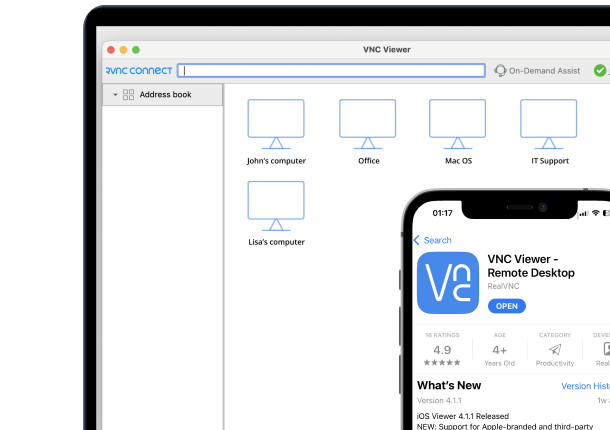
RealVNC Connect provides a controlled remote-access layer for those workflows. Single sign-on (SSO) with Microsoft Entra ID or Okta and multi-factor authentication (MFA) connect remote sessions to established identity controls. Role-based access controls (RBAC) and granular action-based permissions let administrators limit keyboard, mouse, and file-transfer actions according to the support task. Session monitoring, recording, and detailed audit logs provide authorized administrators with evidence of who connected, when, and under which permissions. Code Connect uses single-use 9-digit session codes valid for 120 seconds, providing time-boxed third-party access per RealVNC Code Connect.
This does not replace SaaS discovery, spend review, or portfolio governance. It strengthens the operational side of assurance by documenting access used during remediation and support activity, so leaders can connect a governance decision with evidence of how the resulting work was carried out.
Final Words
Managing SaaS sprawl means turning discovery, ownership, rationalization, lifecycle control, and assurance into decisions. RealVNC Connect reinforces remediation with SSO, MFA, role-based access controls, and audit logs.
Reliable evidence makes support work easier to explain. Book a 30-minute demo to see controlled, auditable remote access in your environment.
FAQs
What does SaaS sprawl mean?
SaaS sprawl is the uncontrolled growth of cloud applications, accounts, and integrations across an organization — tools spread faster than IT can see, secure, or fund them. Managing SaaS sprawl means connecting discovery, ownership, rationalization, lifecycle control, and assurance, so leaders can govern applications, access, spend, and renewal decisions.
Which standards inform cloud-application governance?
SaaS governance programs most often align with the evidence expectations of SOC 2, ISO 27001, GDPR, and HIPAA, depending on industry and the data each application handles. These frameworks share common demands — documented ownership, periodic access reviews, third-party risk assessment, and audit evidence — so mapping application controls to the standards you already report against avoids duplicate compliance work.
What is AI sprawl?
AI sprawl is the unmanaged growth of artificial intelligence tools, accounts, integrations, and data connections across an organization. It creates many of the same governance concerns as broader SaaS growth, including unclear ownership, duplicated capabilities, and uncertain data handling.
How is shadow IT different from SaaS sprawl?
Shadow IT refers to applications used outside formal approval or visibility processes. SaaS sprawl is broader: approved tools can contribute when ownership, usage, access, or renewal decisions remain unclear.
How should IT leaders assess SaaS governance maturity?
Assess visibility, accountable ownership, repeatable lifecycle workflows, risk-tiered controls, and evidence of ongoing review. Progress is more apparent when unassigned services, dormant accounts, and unresolved exceptions decline over time.
How does RealVNC support SaaS governance workflows?
RealVNC Connect supports controlled remediation and support access through multi-factor authentication, single sign-on with Microsoft Entra ID and Okta, role-based access controls, and granular action-based permissions. Session monitoring, session recording, detailed audit logs, and Code Connect support accountable administrative and third-party access without replacing SaaS discovery or spend governance.