


A missed handoff, a late-night message, and a meeting where only two people speak can slow work across an entire IT function. Your team may be distributed, but unclear decisions and uneven communication still land on the same projects, service levels, and business commitments.
Managing remote IT teams means creating deliberate ways for people to communicate, make decisions, and deliver outcomes without relying on office visibility. It requires clear expectations, defined decision rights, and regular human contact that supports autonomy rather than constant supervision.
This article sets out practical ways to build those working habits: clarify roles and priorities, assign each communication channel a purpose, run meetings that produce decisions, protect working boundaries across time zones, and spot problems before a missed deadline becomes a larger delivery issue.
Why Does Managing Remote IT Teams Require a New Model?
Distributed delivery creates a coordination problem that office routines used to hide. A service owner may finish work in one time zone; the next engineer may lack the decision context, the current runbook, or authority to act. The resulting delay reaches customers, business teams, and service commitments.
Managing remote IT teams requires an operating model that makes decisions, handoffs, outcomes, and access accountable without treating online presence as evidence of work. Leaders need explicit decision rights, documented workflows, outcome-based measurement, and risk-based access controls that match the criticality of each service.
The central question is not how often managers see employees. It is whether leaders can trace a service issue from the responsible owner through the handoff, escalation route, and access event that shaped the response. Cloud services, third-party support, and hybrid schedules make those links part of day-to-day IT governance.
Distributed IT teams need clear coordination: distance can obscure decisions, handoffs, and accountability. Without shared context, service issues take longer to resolve and ownership becomes harder to trace. A shared way of working replaces the informal office context that distributed teams no longer share.
Why Do Distributed IT Teams Need an Operating Model?
A distributed IT operating model sets the rules for how work moves when people do not share the same room or working day. It defines ownership, escalation, communication, and availability by service need, so leaders can govern delivery without forcing every team into the same meeting schedule.
Managing remote IT teams means moving from visible activity to visible work. An engineer’s status indicator or message volume says little about whether a critical dependency has an owner, whether a change received approval, or whether an incident handoff contains enough context for the next responder.
The work itself determines the right coordination pattern. eMonitor’s Remote Work Productivity Study 2026 found a median productivity effect of plus 10% for focused individual tasks and minus 4% for collaborative work across more than 50 studies. That gap argues for protecting focused time. Design live sessions around decisions, ambiguity, and relationship work.
“Being ‘async-first’ is not about being ‘async-only’. It’s about recognising the benefits of asynchronous and synchronous communication patterns and being thoughtful about when you use either,” Andrew Burrell, Principal Consultant at Equal Experts, wrote in InfoQ (2023). A routine status update belongs in a written record; an incident handoff with unresolved customer impact needs a live conversation and a documented next owner.
Atlassian’s Team Anywhere case study reported that its asynchronous documentation approach reduced time in synchronous meetings by 13% and improved employees’ reported ability to focus by 32% (2026). The point is not to copy another organization’s policy. It is to test whether meetings in your environment create decisions that written context cannot.
Which Pressures Make Remote IT Governance Urgent?
Think of the operating model as a rail network’s signal system. It does not direct every passenger’s trip, but it establishes routes, handoffs, and escalation rules so people know who acts when conditions change.
- Service criticality across time zones: A customer-facing service needs an accountable owner and an escalation route that works outside one office’s hours.
- Cloud and SaaS dependencies: Shared services require decision records, change context, and clear dependency ownership.
- Fragmented informal context: Information that once surfaced in corridor conversations must enter runbooks, decision logs, or handoff notes.
- Compliance-bound privileged access: Remote support requires an identity, device, and authorization trail that reviewers can inspect.
| Management dimension | Office-centric assumption | Distributed operating-model response |
|---|---|---|
| Ownership | Colleagues know who to ask | Publish accountable service owners and escalation routes |
| Communication | A meeting resolves most uncertainty | Match written or live channels to the work required |
| Availability | Shared hours are assumed | Define coverage, response expectations, and rotation rules |
| Evidence | Presence signals commitment | Review delivery, service, and access records |
The operating model turns location into a design input rather than an unmanaged source of delay. That gives leaders a basis for deciding where live coordination earns its cost.
Which Controls Create Visibility Without Surveillance?
)
Useful visibility comes from shared artifacts and service signals, not from watching screens or counting messages. Leaders need evidence that work is owned, services remain reliable, teams have sustainable capacity, and access to sensitive systems follows policy.
This framework joins Direction, Work Visibility, Team Sustainability, and Access Assurance. It groups service ownership and communication rules under Direction, treats performance evidence as Work Visibility, and carries sustainable availability and access assurance forward unchanged. Each dimension depends on the others: a delivery dashboard without accountable owners produces noise, but an access policy without device evidence leaves a material gap in the control record.
- Direction: Connect service priorities, decision rights, and escalation authority to business commitments.
- Work Visibility: Use delivery plans, decision logs, incident records, and handoff notes to show progress and dependencies.
- Team Sustainability: Review on-call distribution, workload exceptions, and recurring after-hours demand before capacity becomes a service issue.
- Access Assurance: Verify identity, device status, authorization, and session evidence for remote work on critical systems.
| Dimension | Leadership signal | Primary evidence source | Common misread |
|---|---|---|---|
| Direction | Named owner for each critical service | Service catalog and escalation map | Assuming a job title establishes decision authority |
| Work Visibility | Decisions and handoffs are traceable | Delivery board, decision log, runbook | Treating message volume as delivery progress |
| Team Sustainability | Workload patterns remain sustainable | On-call records and capacity review | Reading long hours as commitment |
| Access Assurance | Remote sessions follow approved access paths | Identity, device, and session records | Assuming authentication alone proves appropriate access |
Device inventory belongs in this model. Access assurance starts before a user opens a remote session. an average 68% of organizational devices are centrally managed, meaning roughly 32% are not centrally managed, according to ESG’s Endpoint Management 2025 report. Leaders need to know which endpoints fall outside management and whether those endpoints can reach services with material operational impact.
Zero trust provides a practical architecture path rather than a slogan. NIST’s SP 1800-35 announcement describes 19 example architectures using off-the-shelf technologies (2025). NIST’s zero-trust guidance defines the goal as secure, authorized access to distributed enterprise resources. Use those patterns to connect identity, device condition, and service authorization to the evidence your operating reviews require.
How Should Leaders Measure Remote IT Performance?
Performance measurement should show whether services and teams are healthy, not whether people appear busy. A remote IT scorecard combines delivery, reliability, collaboration, security hygiene, and sustainability so leaders can intervene on patterns before they become missed commitments or retention problems.
Use trends and operating context rather than rigid thresholds. A ticket backlog may reflect a temporary release, an unresolved dependency, or a capacity issue; it becomes useful only when the service owner explains the cause, decision needed, and expected recovery path. Best Practice Institute’s 2023 research describes Toggl’s results-based approach, where teams set goals and work toward outcomes rather than hours worked.
- Delivery predictability: Review commitment reliability, aging work, and sprint-goal completion. This supports priority and staffing decisions; avoid treating a single delayed item as proof of weak execution.
- Service reliability: Track service-level agreement adherence, incident recurrence, mean time to restore, and backlog aging. This supports investment choices; avoid reading a low ticket count as proof that users face no friction.
- Collaboration quality: Review completed decision logs, handoff quality, and unresolved dependency age. This supports workflow changes; avoid judging collaboration by meeting attendance alone.
- Security hygiene: Review managed-device coverage, patch compliance, and privileged-access review completion. This supports control ownership; avoid assuming an approved policy proves consistent practice.
- Team sustainability: Review on-call distribution, after-hours escalation patterns, workload exceptions, and attrition signals. This supports capacity and coaching decisions; avoid praising repeated late-night work as resilience.
| KPI category | Example measure | Decision supported | Misread to avoid |
|---|---|---|---|
| Delivery predictability | Aging work items | Reprioritize work or capacity | More work in progress means more progress |
| Service reliability | Incident recurrence | Address recurring service causes | A closed incident equals a resolved cause |
| Collaboration quality | Unresolved dependency age | Escalate blocked decisions | More meetings create better alignment |
| Security hygiene | Privileged-access review completion | Assign control ownership | Policy publication equals compliance |
| Team sustainability | On-call load distribution | Rebalance coverage | Availability means unlimited capacity |
Treat a missed commitment as a prompt for an early conversation. Ask what constraint changed, what support is required, and whether the issue points to role ambiguity, an overloaded service, or a personal circumstance. That discussion protects accountability: it turns a late outcome into an actionable management decision.
Build the Remote IT Management Playbook in 4 Steps
A playbook gives distributed engineering and support functions a repeatable way to make operating decisions. Start with the work that already creates friction: unclear service ownership, recurring handoff questions, meetings without decisions, or staff who rely on private messages to find critical context.
How Do Teams Define Decision Rights and Cadence?
- Step 1 – Map service ownership and decision rights. Set the goal of making every critical service accountable. Use the service catalog, a RACI or decision-rights map, criticality tiers, and escalation data; then decide which matters require live alignment and which proceed through documented delegation. The common error is assuming role descriptions settle authority. Your check is simple: each critical service has an accountable owner and escalation route.
- Step 2 – Establish communication and planning cadences. Match live time to ambiguity, incident coordination, and relationship work, and place status updates and handoffs in written channels. Review time zones, incident patterns, planning cycles, and the meeting inventory; then set channel purpose, response expectations, focus periods, and rotation rules. Teams should publish decisions, action owners, and handoffs in a shared record.
“Asynchronous work is a simple concept: Do as much as you can with what you have, document everything, transfer ownership of the project to the next person, then start working on something else,” Darren Murph, Head of Remote at GitLab, explains (2026). That standard gives managers a concrete test for whether a handoff contains enough context.
How Do Teams Scale Knowledge and Feedback Loops?
- Step 3 – Make documentation the default handoff mechanism. Build a knowledge base for onboarding, changes, runbooks, architecture decisions, and post-incident learning. Define ownership, review cadence, and the minimum record required before a decision meeting. A repository without lifecycle ownership soon loses authority. New staff should be able to trace a critical service’s owner, dependencies, runbook, and recent decisions without searching private conversations.
- Step 4 – Review outcomes, capacity, and team health. Bring delivery, reliability, workload, employee feedback, and security-hygiene trends into the operating review. Decide whether to rebalance work, adjust staffing, change a workflow, or address a performance concern, then record an owner and review date. Do not wait for a quarterly review when repeated overload already appears in the service record.
IDC’s Business Value Case Study of Remote and Notion estimated a 491% four-year return from Remote’s centralized documentation and collaboration environment, alongside more than an additional productive week per user annually (2023). It is one organization’s result, not a forecast, but it shows why leaders should treat shared knowledge as operating infrastructure.
Akash Deep, Founder and Engineering Leader at Akash-Deep.com, writes: “In an async team, a meeting is a failure of documentation.” The useful leadership interpretation is narrower: reserve meetings for questions that need interaction, then record the outcome so the same question does not return next week.
Where Do Remote IT Teams Create Security Gaps?
)
Remote work creates security gaps when identity, device condition, privileged access, and third-party support operate outside a common control process. The concern is operational continuity as much as compliance: an unreviewed access path or poorly documented support session makes it harder to restore service and explain what happened afterward.
Coalition’s Cyber Threat Index 2025 reports that 58% of ransomware claims in 2024 began with compromised perimeter security appliances, including VPNs and firewalls; remote desktop products accounted for 18%. Leaders should respond by reviewing access paths and evidence, rather than adding blanket friction to every employee workflow.
- Identity and privileged access: Multi-factor authentication (MFA), role-based authorization, and access reviews must align to service criticality and job responsibility.
- Endpoint drift: Device management must show whether systems meet configuration and patch requirements before they reach sensitive services.
- Knowledge and secrets exposure: Teams need controlled storage and documented handling for credentials, configuration data, and operational records.
- Third-party and incident access: Temporary support access needs a named owner, limited scope, and a record suitable for later review.
| Risk category | Governance control | Leadership evidence to review |
|---|---|---|
| Identity and privileged access | MFA and least-privilege authorization | Access-review completion and entitlement records |
| Endpoint drift | Device enrollment and patch governance | Managed-device and compliance reports |
| Knowledge and secrets exposure | Approved secret storage and review process | Exception records and remediation ownership |
| Third-party and incident access | Time-bound authorization and session evidence | Access approvals, session records, and closure review |
The National Security Agency Cybersecurity Directorate states in its Device Pillar guidance: “Use automated solutions to manage device configurations, vulnerabilities, and patches.” The same guidance treats remote access as a higher-risk environment that requires risk-based assessment and dynamic authorization (2023).
Microsoft Security’s zero-trust guidance for remote and hybrid work provides a useful control pattern: verify identity, device health, and data permissions before access, then maintain device enrollment and health monitoring. Organizations subject to ISO/IEC 27001:2022 (information security), SOC 2 (service-organization controls), HIPAA (health information), PCI DSS (payment-card security), or NIS2 (cybersecurity requirements) need to map those controls to their own scope and evidence obligations.
How RealVNC Closes the Remote IT Team Gap
Clear decision rights and documented handoffs still leave a sensitive moment: an IT employee, managed service provider, or specialist needs remote access to a production endpoint during support or remediation. Service ownership, endpoint health, and incident accountability all depend on knowing who connected, what authority they held, and what they were permitted to do.
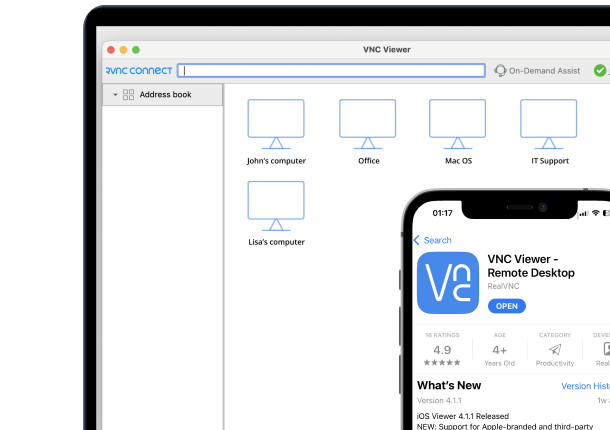
RealVNC Connect ties remote-support access to controlled workflows. Multi-factor authentication and single sign-on (SSO) with Microsoft Entra ID or Okta strengthen identity assurance for distributed support. Role-based access controls and granular action-based permissions let teams align keyboard, mouse, and file-transfer rights with the person’s responsibility. Session monitoring, session recording, and detailed audit logs give authorized administrators evidence for access reviews, incident investigation, and compliance reporting. Code Connect uses single-use nine-digit session codes for temporary third-party assistance, avoiding standing credentials when an external technician needs attended access.
These controls do not replace the service catalog, operating review, or identity program described earlier. They make the access event observable within that wider model, so leaders can connect remote control activity to accountable owners, service records, and post-incident review. The outcome is governed support work rather than an untracked exception.
Final Words
Managing remote IT teams works when decision rights, documented handoffs, outcome measures, and access assurance make service ownership visible.
RealVNC Connect adds multi-factor authentication, role-based access controls, session recording, and audit logs to governed support. Start a free trial of RealVNC Connect to build controlled, auditable remote-support workflows for your distributed IT organization.
FAQs
What is the operating model for distributed IT teams?
A distributed IT operating model defines decision rights, service ownership, communication rules, documentation standards, outcome measures, and access controls. Direction, Work Visibility, Team Sustainability, and Access Assurance give leaders a consistent structure and allow controls to vary by service criticality and coverage needs.
What is the difference between async-first and async-only?
Async-first makes written context, updates, and handoffs the default; async-only avoids live interaction even when it would improve a decision. Leaders should reserve synchronous time for ambiguity, conflict, complex decisions, and collaborative work. Teams should document the outcome for the wider team.
Which governance standards apply to distributed IT work?
Relevant requirements depend on the organization’s industry, data, and services. ISO 27001 (information security), SOC 2 (service-organization controls), NIST guidance (zero-trust architecture), HIPAA (health information), PCI DSS (payment-card security), GDPR (data protection), and NIS2 (cybersecurity requirements) may shape access controls, audit evidence, risk management, and incident response. NIST’s zero-trust guidance focuses on secure, authorized access to distributed resources.
How does RealVNC support distributed IT governance?
RealVNC Connect provides controlled remote access through multi-factor authentication, role-based access controls, Code Connect, and session monitoring, recording, and audit logs. These features support least-privilege support, temporary third-party access, and evidence-based access reviews.
How should leaders assess managing remote IT teams maturity?
Managing remote IT teams is mature when leaders can see service outcomes, team capacity, and access accountability without constant supervision. Review service ownership, documented handoffs, outcome-based performance, sustainable on-call practices, and governed remote access together.