



The service desk queue grows after every change. Project teams still need capacity for the next priority. Employees feel the delay as access issues, slower work, and unclear updates. IT leaders then face the same question: which work needs a controlled process, and which work should users resolve themselves?
An IT service management strategy is the operating plan for how IT defines, delivers, measures, and improves services. It connects service goals to business priorities, gives teams repeatable ways to handle incidents and changes, and makes demand visible before it overwhelms available capacity.
This article explains the foundational practices behind that plan: ITIL-informed process control, self-service, Knowledge-Centered Service, change management, and resource capacity planning. You’ll then see how to introduce the right level of structure for your organization, rather than imposing a framework your teams cannot sustain.
Why Has ITSM Strategy Become a Governance Issue?
Service management needs shared decision rights: service choices determine where money, capacity, and operational attention go. An it service management strategy gives leaders a way to decide which services matter, who owns them, what level of disruption is acceptable, and how results connect to business outcomes.
When service ownership is fragmented, urgent requests crowd out planned work and investment decisions lose their business context. Digital CXO’s 2024 coverage of an NTT Data report found that 51% of organizations had technology approaches fully aligned with business-strategy needs. The remaining gap is where duplicate tools, unclear priorities, and uneven service expectations accumulate.
Treating ITSM as a help-desk concern is like running an airport through its lost-luggage desk. That desk matters, but it cannot set flight schedules, allocate gates, or establish safety procedures. Service governance needs the same wider view of capacity, criticality, and accountability.
Which pressures turn service delivery into governance?
Service architecture shapes resilience as every operational dependency eventually reaches a business service. Raúl Cals, CIO at Unicaja, said in IBM’s 2026 Tech Leader Study, “Architecture is the foundational element of resilience.” Leaders need to connect architecture choices to service ownership and recovery expectations.
- Service criticality: Define which services support revenue, regulated activity, or business-critical employee work.
- Modernization debt: Record aging dependencies that make changes slower or less predictable.
- Distributed work: Set consistent ownership when users, providers, and systems sit across locations.
- Investment scrutiny: Tie improvement funding to service value, cost, and operational evidence.
| Dimension | Legacy service-management focus | Strategic service-management focus |
|---|---|---|
| Ownership | Queue assignment | Accountable service owner |
| Demand | Ticket volume | Business demand and capacity |
| Change | Process completion | Service impact and approval evidence |
| Reporting | Operational activity | Portfolio and resilience decisions |
The practical test is simple: if leaders cannot name the owner, criticality, cost, and improvement decision for a service, governance remains incomplete.
Which Framework Fits Service Value and Oversight?
ITIL 4 and COBIT work best as complementary frameworks. ITIL 4 organizes service value and operating practices. COBIT clarifies oversight, accountability, and performance direction. Together, they help leaders connect daily service work with enterprise decisions without forcing every team into the same process depth.
Framework selection starts with the decision you need to improve. ITIL-informed practices guide how teams design, transition, operate, and improve services. COBIT’s Evaluate, Direct, Monitor model gives leadership a structure for setting policy direction, reviewing performance, and assigning accountability. Sana Su, a GRC and ITSM governance specialist, explains this relationship as ITIL governance within the Service Value System alongside COBIT’s oversight objectives.
Use ITIL 4 to shape the service value system
ITIL 4 helps teams choose practices that improve a service’s actual value rather than pursuing exhaustive framework coverage. Start with the service catalog, request pathways, knowledge reuse, change enablement, and continual service improvement that address current operating gaps. AIMultiple’s 2024 ITSM case-study collection reported that Big Brothers Big Sisters of America achieved 40% faster ticket resolution after introducing a unified service portal, knowledge base, and workflow automation. That result illustrates the value of connected service design; it is not a universal benchmark.
Use COBIT to clarify oversight and accountability
COBIT is useful when executives need a formal way to distinguish process ownership from accountability for business outcomes. It asks who evaluates demand, who directs priorities, and who monitors whether services meet agreed objectives. That distinction matters in regulated, multi-business-unit, or resource-constrained organizations where local teams may operate services but leadership still owns the risk and investment choices.
Use four dimensions to assess fit:
- Service Value: Does the framework show how a service creates a defined outcome for users or the business?
- Governance Accountability: Does it make decision owners and escalation authority explicit?
- Portfolio Decisions: Does it connect demand, cost, and capacity to investment choices?
- Improvement Evidence: Does it produce evidence that leaders can use to change priorities?
| Framework dimension | Executive question | Primary framework emphasis | Evidence source | Common misread |
|---|---|---|---|---|
| Service Value | What outcome does this service deliver? | ITIL 4 | Service performance and user feedback | Treating activity as value |
| Governance Accountability | Who directs the decision? | COBIT | Decision records and ownership | Assuming process owner means executive owner |
| Portfolio Decisions | Where should capacity go next? | Both | Demand, cost, and criticality | Funding only visible incidents |
| Improvement Evidence | What needs to change? | ITIL 4 | Trends, root causes, and review actions | Counting closed tickets alone |
No framework removes the need for judgment. Risk tolerance, organizational change capacity, and regulatory obligations determine how much structure your teams need.
Which ITSM Measures Guide Executive Decisions?
)
Executive measurement must combine reliability, demand, cost, risk, and stakeholder outcomes. Service-level agreement attainment shows whether a target was met, but it does not show whether a service remains worth its cost or whether demand is overtaking available capacity.
Reliability deserves board attention: disruption quickly becomes a financial and operational issue. Fewer operators reported an impactful outage in the past three years, and one in ten outages was classified as serious or severe, according to Uptime Institute’s 2026 survey summary. Segment measures by business service, then examine trends rather than applying one universal threshold.
- Service criticality and availability: Measure availability and impact by business service, not infrastructure components alone.
- Demand-to-capacity balance: Compare incident, request, change, and project demand with available capability.
- Cost-to-serve: Connect service unit cost and quality to portfolio and vendor-consolidation decisions.
- Change success and recurrence: Track change outcomes, incident correlation, and recurring root causes.
- Experience and self-service effectiveness: Assess user effort, knowledge usefulness, and resolution pathways alongside speed.
| Measure | Leadership signal | Decision supported | Common error |
|---|---|---|---|
| Service availability | Critical-service resilience | Investment priority | Averaging unlike services |
| Demand-to-capacity balance | Workload pressure | Staffing and sequencing | Counting requests without complexity |
| Cost-to-serve | Economic value | Portfolio review | Cutting cost without measuring quality |
| Change recurrence | Operational learning | Control improvement | Reviewing changes in isolation |
| User effort | Service usability | Knowledge and portal investment | Equating speed with satisfaction |
A balanced scorecard changes the conversation from “Did the team meet the target?” to “Which service decision will improve resilience and value next?”
How Do Leaders Build an ITSM Strategy Roadmap?
A roadmap begins with service decisions, not a platform rollout. Leaders need to agree which services are critical, where ownership sits, and what evidence supports investment before automating request flows or expanding a catalog. PwC’s US CIO Program argues that defined guardrails allow organizations to move quickly and remain resilient; service governance supplies those guardrails.
- Set business outcomes and service boundaries: Define critical services, customer groups, risk tolerance, and intended outcomes.
- Run an ITSM maturity assessment: Identify gaps in ownership, catalog design, knowledge, change control, and reporting.
- Map capabilities and decision rights: Use capability mapping workshops to assign ownership, escalation authority, and cross-functional governance roles.
- Sequence service-catalog and automation investments: Prioritize frequent, repeatable work after request data, knowledge quality, and routing ownership are reliable.
- Establish the strategic IT planning cycle: Review portfolio value, demand, cost, risk, and the improvement backlog at an agreed executive cadence.
| Roadmap step | Leadership decision | Evidence of readiness |
|---|---|---|
| Set outcomes | Which services need priority? | Criticality and stakeholder agreement |
| Assess maturity | Where are control gaps? | Current-state ownership and process evidence |
| Map decision rights | Who decides and escalates? | Named roles and governance forum |
| Sequence investments | What work merits automation? | Reliable demand and knowledge data |
| Set planning cycle | When will priorities change? | Review calendar and decision records |
A mid-market team may begin with a small set of business-critical services and a named owner for each. A regulated enterprise needs more formal approval records and review evidence. AIMultiple’s case-study collection reports that Texas A&M University reduced ticket-resolution time by 30% after service-desk workflow automation; the relevant lesson is phased sequencing, not a promised outcome.
Where Do ITSM Programs Lose Governance Control?
Governance weakens when teams add workflows without clarifying who owns the decisions those workflows automate. The visible result is often a growing queue, but the underlying issue is conflicting priorities between service owners, business leaders, and operations teams.
Artificial intelligence adds another decision layer. AI-assisted classification and virtual agents require quality checks, human escalation routes, monitoring, and a named accountable owner.
- Decision-right ambiguity: Business owners, service owners, and operations teams set conflicting priorities.
- Process overreach: Teams adopt controls their evidence discipline cannot sustain.
- Automation without guardrails: Automated routing or knowledge responses lack review rules and escalation paths.
- Uncontrolled privileged support access: Responders enter critical systems without a consistent record of authorization and activity.
Bugge Holm, Danish futurist and Imagining the Digital Future Center contributor, wrote in 2026: “Actions to take now are straightforward and urgent: 1) Treat AI as governance, not just adoption. 2) Require clear accountability for AI-influenced decisions, basic quality assurance and verification practices and risk management that covers dependency, concentration,” The same principle applies to service automation: controls must make responsible speed possible, not create paperwork with no accountable outcome.
How RealVNC Closes the ITSM Strategy Gap
)
A service process can define ownership, approval, and escalation, yet the live support session still needs its own evidence. During an incident, production change, or third-party remediation task, leaders need to know who reached a critical device, under which authorization, and what activity occurred. That connection between service records and support execution is where remote-access governance becomes part of the operating model.
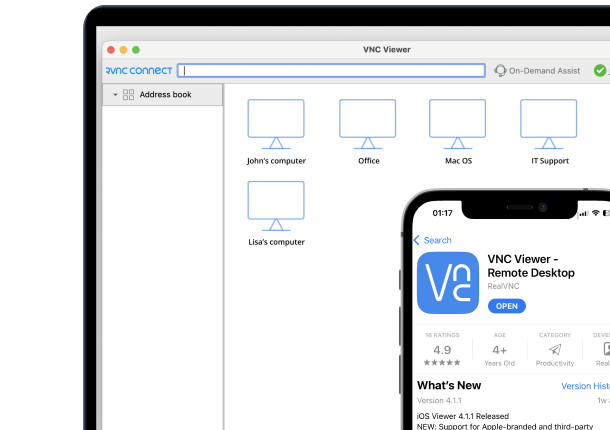
RealVNC Connect supports controlled support workflows with multi-factor authentication (MFA) and single sign-on (SSO) with Microsoft Entra ID or Okta, so access begins with authenticated identity. Role-based access controls (RBAC) and granular action-based permissions let administrators limit keyboard, mouse, and file-transfer activity according to the task. Session monitoring, session recording, and detailed audit logs create evidence that authorized administrators can review. For third-party access, Code Connect uses single-use 9-digit session codes that are valid for 120 seconds before refreshing and create time-boxed, revocable sessions rather than standing credentials.
These controls do not replace service ownership, change approval, or portfolio review. They give those governance practices a clearer operational record when support work reaches a live system. For IT leaders, that means incident evidence, approved remediation, and accountable access can remain connected without adding a separate manual trail for every session.
Final Words
An it service management strategy turns service data into decisions on value, resilience, capacity, and change. Controlled remote support connects approved workflows to live work.
RealVNC Connect uses MFA, role-based access controls, and audit logs for accountable remediation evidence. Arrange a meeting to map controlled access to your workflows.
FAQs
What framework should guide service-management decisions?
An IT service management strategy combines service value, governance, portfolio decisions, resilience, and continual improvement. ITIL 4 structures service practices and value streams. COBIT supports oversight, accountability, and performance direction. Larger or regulated organizations may use both, based on operating complexity and obligations.
What is the difference between ITSM and IT strategy?
IT strategy sets technology direction, investment priorities, architecture principles, and transformation goals. IT service management turns those priorities into accountable services that users and business units can rely on. Both need shared outcomes, service criticality definitions, and portfolio evidence.
How often should a service strategy be reviewed?
A service strategy should be reviewed through a recurring executive planning cycle that covers demand, value, cost, risk, performance, and improvement priorities. Operational reviews should happen more often for major changes, service issues, and emerging risk. Budget changes or a significant business shift should trigger an additional review.
What are the 5 stages of ITIL?
The five stages commonly associated with the earlier ITIL service lifecycle are service strategy, service design, service transition, service operation, and continual service improvement. ITIL 4 uses the Service Value System and a more flexible practice-based model, so organizations need not adopt every practice at once.
How does RealVNC Connect support service governance?
RealVNC Connect supports controlled remote support through multi-factor authentication, role-based access controls, granular permissions, session recording, and detailed audit logs. These controls help connect incident response and approved remediation with accountable access evidence, and Code Connect supports time-bound third-party sessions.