


A growth spike can expose every weak handoff in IT. Decisions sit in inboxes, teams duplicate work, and client delivery slows as leaders try to see which system or owner is accountable.
An it operating model for fast-growing companies defines how people, processes, technology, and decision rights work together to turn strategy into reliable daily delivery. Think of it as the route map for a growing city: without clear routes and ownership, traffic builds at every intersection.
This article explains how to spot the strategy-to-execution gap, choose an integration approach, clarify governance, and build the architecture, talent, and service measures that let growth remain controlled.
Why Does Hypergrowth Expose an IT Operating Model Gap?
Growth rarely fails simply from lacking another application. It fails when decisions about demand, funding, ownership, and service delivery still depend on informal conversations that no longer reach everyone involved.
An it operating model for fast-growing companies sets decision rights, roles, service relationships, funding routes, and controls for technology work. It gives leaders a visible way to connect technology choices to business delivery as teams, vendors, and obligations multiply. Without it, sensible local decisions create conflicting priorities across the company.
Technology investment makes this coordination problem more pressing. IT Jungle’s Gartner forecast put worldwide IT spending at about US$6.08 trillion in 2026, showing the scale of decisions competing for executive attention. A company that doubles headcount and SaaS spend may give separate teams authority to buy tools and approve access; each team acts reasonably, and duplicate ownership and approval routes soon slow delivery.
Which Growth Pressures Break Informal IT First?
Demand volatility: New products, markets, and client commitments change the order of work faster than a founder-led prioritization process can keep pace.
SaaS and vendor proliferation: Each new supplier adds renewal decisions, integration dependencies, data handling questions, and an owner who must remain accountable.
Distributed workforce growth: Hiring across locations requires repeatable onboarding, support, and escalation routes rather than personal knowledge held by a few administrators.
Rising security and accountability requirements: More users and third parties require clear authority for access, exceptions, and evidence review.
| Growth signal | Informal-model symptom | Operating-model implication |
|---|---|---|
| New product lines | Priorities change through private conversations | Create a common demand and portfolio review |
| Rapid hiring | Onboarding depends on individual administrators | Define service owners and fulfillment expectations |
| More SaaS suppliers | Renewals arrive without a business owner | Assign lifecycle and commercial accountability |
| Wider client commitments | Exceptions become routine | Set escalation paths and risk thresholds |
The warning sign is simple: when leaders cannot explain who decides, who pays, and who owns a service, growth has become a business-performance issue.
Which IT Operating Model Fits a Fast-Growing Company?
The right structure matches decision centralization to service criticality, regulatory exposure, business volatility, and scarce capability. Most growing companies need a deliberate hybrid: enterprise teams own guardrails and shared foundations; teams closest to customers retain authority over context-specific delivery choices.
Think of the structure as a rail network. Central teams set safe track standards and run shared stations; product teams decide which services run where and when. If every route sets its own standards, travel becomes unreliable. If a central office schedules every train, local demand goes unanswered.
Use four dimensions to assess the fit:
- Decision rights: Define which decisions belong to enterprise leaders, domain leaders, or a joint forum.
- Capability ownership: Place scarce expertise where it serves the most material business need.
- Service delivery: Decide which services require consistency and which need local context.
- Control mechanisms: Set mandatory guardrails, exception routes, and evidence requirements.
Centralize the Controls That Need Consistency
Centralized accountability works best for identity, security policy, financial controls, enterprise architecture standards, core infrastructure, and vendor governance. Centralization does not mean that an enterprise team approves every delivery choice. It means that the team sets non-negotiable requirements, runs shared services, and owns escalation when a domain needs an exception.
NIST’s Cybersecurity Framework 2.0 states that the framework applies regardless of organization type, size, sector, or cybersecurity sophistication (National Institute of Standards and Technology, 2024). CISA’s Zero Trust Maturity Model gives leaders a practical reference across identity, devices, networks, applications and workloads, and data (Cybersecurity and Infrastructure Security Agency, 2024). Those references do not prescribe an organization chart; they clarify the domains where enterprise accountability must remain visible.
Federate Delivery Where Context Drives Value
Product, market, and value-stream teams need authority when local customer context determines prioritization or delivery sequencing. Forrester’s operating-model guidance states, “Shift to platform operating models coowned by business and tech. A common move is to reorganize around platforms and value streams, with business and technology leaders jointly accountable for outcomes.”
Federation still requires boundaries. A domain team may select the sequence for customer-facing work, but it does not independently set architecture exceptions, security policy, or SaaS procurement rules. Toyota Financial Services CIO Vipin Gupta described a shift to a products-not-projects digital-factory model
| Model pattern | Best-fit context | Central responsibilities | Local autonomy | Primary trade-off |
|---|---|---|---|---|
| Centralized shared services | Early scale or tightly regulated operations | Identity, infrastructure, finance, vendor governance | Limited service configuration | Consistency can slow local response |
| Federated platforms | Several products with common technology needs | Platform standards and shared capabilities | Prioritization within domains | Requires clear platform customer accountability |
| Product teams with enterprise guardrails | Mature product portfolio and varied client needs | Policy, architecture, risk thresholds | Delivery sequence and customer choices | Coordination demand increases |
The practical test is whether a decision needs universal consistency or local knowledge. Put the first in enterprise hands and the second near the work.
What Capabilities Need to Scale First?
)
Capability-based planning directs investment toward the few services and controls where growth creates recurring friction. Rather than attempting to mature every function at once, leaders should fund capabilities according to business criticality, operational pressure, and the evidence needed to show that a service is working.
A capability matrix turns broad ambition into choices about people, funding, and ownership. PlatformEngineering.org’s 2025 State of Platform Engineering Report Volume 4 found that 40.9% of platform initiatives could not demonstrate measurable value in their first year. That result points to a leadership issue: shared capabilities need defined internal consumers and outcome measures before teams expand them.
- Demand and portfolio management: Create a common intake and prioritization process. It supports investment trade-offs; the pitfall is treating every executive request as a strategic commitment. Check for a visible ranked portfolio with named sponsors.
- Service cataloging and onboarding: Define repeatable employee, device, access, and support services. It supports headcount planning; the pitfall is documenting services that no team owns. Check for named owners and measurable fulfillment expectations.
- Architecture and platform engineering: Build reusable cloud-native infrastructure and engineering patterns. It informs build-versus-buy choices; the pitfall is launching a platform without adoption measures. Check for documented internal consumers and outcome metrics.
- SaaS portfolio governance and vendor rationalization: Track ownership, spend, integration, and lifecycle status. It informs renewal decisions; the pitfall is confusing a procurement list with an application portfolio. Check that each material application has an owner and a lifecycle decision.
- Security, resilience, and access governance: Put risk ownership into delivery workflows. It informs control investment; the pitfall is measuring security through compliance completion alone. Check that service-critical systems have accountable owners and tested response paths.
| Capability | Leadership signal | Evidence source | Common interpretation error |
|---|---|---|---|
| Demand management | Work has a visible order | Ranked portfolio and sponsor list | Intake equals prioritization |
| Service cataloging | Growth does not depend on personal knowledge | Service owner and fulfillment data | Documentation equals service ownership |
| Platform enablement | Reuse improves delivery work | Adoption and outcome measures | Platform launch equals value |
| SaaS governance | Renewals have accountable decisions | Application ownership and lifecycle record | Spend list equals portfolio governance |
| Access governance | Control requirements work in operations | Exception and review records | Compliance completion equals resilience |
Cloud spending needs the same accountability. The FinOps Framework defines FinOps as “the operating model for the cloud,” linking principles, capabilities, lifecycle phases, and cross-functional accountability for cloud value (FinOps Foundation / Linux Foundation, 2026). Examine whether operating friction declines across quarters; one maturity score rarely tells the full story.
How Can Leaders Redesign IT Without Slowing Growth?
Redesign works when leaders treat it as a sequence of decisions, rather than a large reorganization announced before the underlying work is understood. Start with recurring friction, then change only the authority, service design, or capability investment that removes it.
A credible baseline maps how work actually travels through the company: handoffs, bottlenecks, service owners, and exceptions. The published organization chart rarely reveals where decisions stall. ITIL describes its guidance as practical and adaptable across industries, operating models, and maturity levels (ITIL / PeopleCert, 2026).
Step 1–2: Diagnose Friction and Set Decision Rights
- Diagnose the growth constraint. Goal: identify the recurring friction affecting delivery, cost, or risk. Inputs: service data, application records, delivery delays, and stakeholder interviews. Executive decision: select the constraint to address first. Pitfall: treating every concern as equally urgent. Success check: leaders agree on a baseline and accountable owner.
- Assign decision rights. Goal: separate enterprise guardrails from domain delivery autonomy. Inputs: a decision inventory, risk thresholds, and value-stream maps. Executive decision: define who decides, advises, and escalates. Pitfall: forming a committee without changing authority. Success check: unresolved cross-functional decisions decline.
Step 3–4: Sequence Capabilities and Govern Outcomes
- Fund the capabilities that support scale. Goal: connect roadmap spend to gaps and outcome measures. Inputs: the capability matrix, demand portfolio, total cost of ownership, and workforce plan. Executive decision: choose what to build, standardize, source, or retire. Pitfall: fund transformation and continue lower-value work. Success check: every funded capability has a sponsor and an outcome metric.
- Establish a lightweight operating cadence. Goal: review service performance, spend, risk, and delivery choices consistently. Inputs: an agreed scorecard and exception record. Executive decision: approve priority or risk-tolerance changes. Pitfall: turning reviews into status meetings. Success check: decisions, owners, and follow-through remain visible between reviews.
Acquis Consulting’s case study of a life sciences data science and technology company shows how a redesign can address structure, decision rights, and growth alignment after a leadership transition (Acquis Consulting, 2023).
Use this executive checklist before changing the structure:
- Is the recurring constraint visible in service, cost, or delivery evidence?
- Does each affected decision have one accountable owner?
- Will the proposed change remove a handoff or simply add another review?
- Does the funding choice both stop lower-value work and start new work?
- Can leaders review outcomes without asking teams to build a separate reporting exercise?
A redesign earns trust when teams see fewer stalled decisions and clearer ownership in the work they already do.
Where Does Governance Fail During Rapid Expansion?
Governance breaks when formal rules and day-to-day delivery follow different paths. Leaders then see cost allocation, policy documents, and committee minutes; administrators and product teams still resolve key decisions through informal escalation.
The growing use of shared platforms makes this gap visible. Practical Logix projected platform engineering adoption would reach 80% of large software engineering organizations by 2026. Treat that as a directional signal, not proof that every company needs the same structure: shared services require a clear service promise and accountable internal customers.
Decision-right ambiguity: Several leaders believe they can approve an exception, so work waits for agreement.
Portfolio opacity: Applications remain in use without a business owner, lifecycle choice, or renewal decision.
Control bypasses: Third-party and support access develops around urgent needs without a consistent approval and evidence route.
Unmeasured shared services: Platform teams report activity but cannot show whether they reduce friction for their users.
| Governance failure | Business consequence | Executive control |
|---|---|---|
| Unclear decision rights | Delayed priorities and repeated escalation | Decision inventory with escalation thresholds |
| Invisible application ownership | Renewal exposure and duplicated spend | Named owner and lifecycle review |
| Informal access exceptions | Weak review evidence for service-critical work | Central identity and documented exception route |
| Shared services without measures | Funding continues without user value | Service promise and internal customer measures |
Microsoft Learn’s platform-engineering case-study collection documents Siemens Healthineers using centralized platform capabilities for compliant technology delivery (Microsoft Learn, 2025). The lesson is practical: central capabilities need a defined purpose and a way to show that teams can use them in real delivery work.
Ask four questions: Are exceptions visible? Does every material application have an owner? Do shared services publish service expectations? Do reviews result in decisions rather than reports? If the answer is unclear, governance needs redesign before growth adds more complexity.
How RealVNC Closes the Fast-Growth Operating Gap
)
Growth-stage governance often improves demand management and service ownership, yet remote support access can remain fragmented. Administrators, external providers, and business units may use separate routes to reach devices, leaving unclear authority for third-party support and inconsistent evidence for supplier, resilience, and audit reviews.
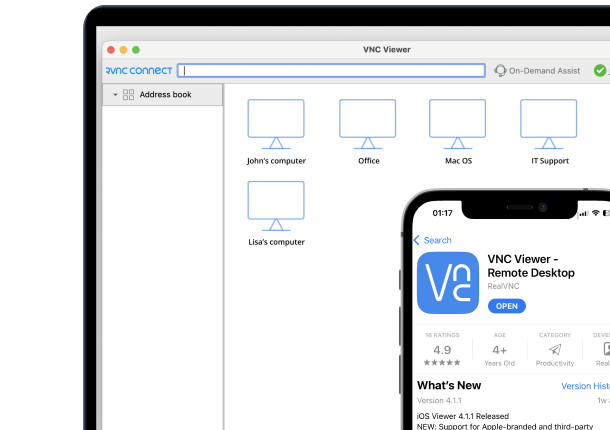
RealVNC Connect applies centralized identity and access requirements to remote-support workflows without removing role-appropriate delivery access. Multi-factor authentication (MFA) and single sign-on (SSO) with Microsoft Entra ID or Okta align remote sessions with centralized identity policies. Role-based access controls (RBAC) and granular action-based permissions let leaders limit keyboard, mouse, and file-transfer activity by role. Session monitoring, session recording, and detailed audit logs provide reviewable records of who connected, when they connected, and which permissions applied. Cloud and Direct deployment options let organizations align the remote-support architecture with their cloud, network, and compliance requirements.
This makes controlled support access a working test of the wider operating design. When a service owner can show who approved access, what actions were permitted, and what evidence exists after the session, decision rights are operating in daily work rather than sitting only in policy documents.
Final Words
An it operating model for fast-growing companies turns growth friction into decisions: centralize guardrails, federate customer delivery, and fund capabilities that remove bottlenecks.
RealVNC Connect brings MFA, SSO, RBAC, and audit logs to governed remote support. Start a free trial of RealVNC Connect to make controlled access part of daily delivery.
FAQs
What is a growth-stage IT operating framework?
An IT operating model for fast-growing companies assigns decision rights, service ownership, capability priorities, and funding responsibilities as the organization expands. It gives leaders a repeatable way to connect technology work with business outcomes.
How do centralized and federated IT differ?
Centralized IT keeps enterprise controls and shared services under common ownership; federated IT places delivery authority closer to business domains. A hybrid approach usually centralizes identity, security, architecture, and vendor rules, with product teams managing context-specific priorities.
What are the four common IT operating model types?
Four commonly used lenses are centralized shared services, federated platforms, product or value-stream teams, and a hybrid model. The right choice depends on service criticality, regulatory exposure, local customer needs, and available expertise.
Which standards support scalable IT governance?
NIST Cybersecurity Framework 2.0 supports organization-wide cybersecurity governance. ITIL offers adaptable guidance for managing IT services. The FinOps Framework adds accountability for cloud value and cloud-cost decisions; none provides a ready-made organization chart.
What examples show an IT operating model working in practice?
Useful examples include platform teams serving multiple product groups, shared identity services, and business-aligned teams with clear enterprise guardrails. The strongest examples show named owners, visible decision rights, measurable service outcomes, and an exception route.
How does RealVNC support governed growth workflows?
RealVNC Connect applies multi-factor authentication, single sign-on, role-based access controls, granular permissions, and audit logs to remote-support workflows. Session monitoring and recording provide evidence for reviewing access after approved third-party support sessions, and delivery teams retain role-appropriate access.