



Growth exposes every informal handoff in IT. A founder still approves routine spend, teams build overlapping tools, and a customer-facing release waits with no one assigned ownership of the decision.
An IT operating model for fast-growing companies defines how technology teams make decisions, assign accountability, manage investment, and deliver ongoing business outcomes. It gives routine decisions to the people doing the work as leadership retains authority over strategy, capital allocation, and enterprise controls.
This article explains the core operating-model choices, from centralized and federated structures to product-centric teams and shared platforms. You’ll see how to set decision rights, modernize architecture in manageable phases, measure business outcomes, and grow without losing execution control.
When Do Growing Companies Need a Formal IT Model?
Formalize IT operations when leaders repeatedly need personal intervention to settle routine technology decisions. The trigger is not headcount alone; it is recurring delay across products, regions, systems, and control domains. An it operating model for fast-growing companies gives those decisions an agreed owner, escalation route, and record of the outcome.
Identity growth makes that discipline more urgent: access decisions now move at machine speed. In its 2026 Data and Identity Security Report, Netwrix found that 43% of organizations where artificial intelligence significantly expanded identities reported a breach in the prior 12 months, compared with 11% where AI had not materially changed access patterns. That gap does not diagnose every organization, but it shows why identity ownership cannot remain informal.
Think of informal coordination as directing a small intersection with hand signals. It works in light traffic; once routes, vehicles, and safety rules multiply, someone needs to define who directs each lane and what happens when signals conflict.
Which growth signals add up to an operating-model trigger?
One delayed approval is normal. A pattern of delayed approvals, duplicate buying, and recurring exceptions means the coordination method no longer matches the business.
- Repeated executive escalations: Leaders keep resolving routine architecture, funding, or service disputes personally.
- Overlapping SaaS purchases: Teams acquire tools with similar purposes when nobody owns portfolio visibility.
- Unclear service ownership: Incidents linger amid team debates over ownership of the affected service.
- Recurring standards exceptions: Delivery work repeatedly bypasses identity, architecture, or security decisions.
- Weak outcome visibility: Finance and IT cannot connect technology spending to product, customer, or service results.
| Trigger signal | What it reveals | Executive consequence |
|---|---|---|
| Repeated escalations | Decision rights sit with individuals, not roles | Leadership time shifts from strategy to arbitration |
| Overlapping purchases | Demand and procurement lack shared visibility | Spend and renewal commitments become harder to govern |
| Unclear service ownership | Accountability ends at team boundaries | Recovery decisions slow when services fail |
| Standards exceptions | Guardrails do not fit delivery reality | Risk acceptance becomes inconsistent |
| Weak outcome visibility | Investment lacks a common measurement model | Portfolio choices rely on incomplete evidence |
The practical test is simple: if the same issue returns through a different team, product, or region, treat it as a design problem rather than a one-off delivery problem.
Which IT Operating Model Fits Hypergrowth?
No single archetype fits every expanding business. The right choice depends on service criticality, regulatory duties, product diversity, geographic complexity, and whether shared technology teams operate as service enablers rather than approval queues.
Most organizations combine patterns by capability. Security architecture, identity policy, and FinOps cost governance may sit centrally. Product teams own delivery priorities and customer-facing systems. This preserves enterprise guardrails without forcing every decision through one department.
The value of shared enablement is visible in Google Cloud’s 2024 platform-engineering research: 71% of leading adopters reported significantly accelerated time to market, compared with 28% of less-mature adopters. The figure does not make a platform team the answer by itself. It does show why reusable capabilities deserve product-level ownership.
- Centralized Control: Set common architecture, identity, security, and investment rules where consistency matters.
- Federated Execution: Put delivery responsibility close to products, regions, or customer segments and retain enterprise standards.
- Product-Aligned Delivery: Give persistent teams responsibility for outcomes across a product’s working life.
- Platform Enablement: Build reusable internal services that reduce repeated engineering effort across delivery teams.
| Model archetype | Best-fit conditions | Decision rights | Primary trade-off |
|---|---|---|---|
| Centralized Control | Common controls and regulated services matter most | Enterprise teams set standards and approve exceptions | Consistency may slow local response |
| Federated Execution | Products or regions need local context | Local leaders deliver within central guardrails | Boundaries must remain explicit |
| Product-Aligned Delivery | Customer outcomes need sustained ownership | Product teams prioritize and improve their services | Portfolio discipline becomes important |
| Platform Enablement | Several teams need the same technical foundations | Platform teams own reusable internal services | Adoption must be earned, not mandated |
Centralize enterprise guardrails, not every decision
Centralization works best when a capability needs one consistent enterprise rule, such as identity policy or security architecture. Federated execution works best when teams need close knowledge of customers, regulations, or product priorities. The dividing line is decision consequence: centralize choices that create enterprise-wide obligations, and locate routine delivery choices with the teams accountable for outcomes.
Sanjeev Vohra, Global Lead – Applications & Platforms at Accenture, wrote: “Provide freedom within a framework of common processes, data and technology. Organize customer facing product teams around growth and shared services teams for efficiency and scale.” That principle makes governance visible in daily work rather than leaving it in committee papers.
Treat shared platforms as an enablement capability
A platform operating model provides reusable services – such as deployment routes, data services, or cloud provisioning – that product teams consume to deliver their own work. The platform team has customers inside the company, so it needs a service owner, adoption path, and evidence that its users receive value.
When internal teams build a shared capability without those conditions, the result is another central queue. When they treat it as a managed service with defined interfaces, product teams spend less time rebuilding common foundations.
How Do Leaders Assess IT Model Maturity?
)
Operating-model maturity is the ability to make technology decisions consistently, execute them through accountable teams, and demonstrate results across delivery, cost, resilience, and risk. It is evidence that a company can scale decisions without depending on heroic intervention from a few experienced people.
Use maturity as a directional diagnostic, not a scorecard for process volume. A board or investment committee needs to know whether the organization can explain who decides, how work is funded, where control evidence sits, and what happens when an exception occurs.
- Decision Rights and Escalation: Define authority for investment, architecture exceptions, service ownership, and risk acceptance. A RACI matrix only works when it connects to actual funding and escalation decisions.
- Capability and Talent Coverage: Review whether product management, platform engineering, service management, security, data, and vendor management have accountable owners.
- Process Reliability and Automation: Test repeatability across incident response, change activity, access lifecycle, and service requests. Automation needs an owner who maintains the runbook when conditions change.
- Financial and Portfolio Discipline: Track unit costs, shared-service consumption, renewal exposure, and investment trade-offs. Cost allocation must inform a decision, not merely produce a report.
- Risk and Control Evidence: Confirm that access, exceptions, changes, and third-party activity create evidence suitable for review.
Control evidence matters: interconnected services rarely fail in isolation. Across more than 750 incident-response engagements, the Palo Alto Networks Unit 42 2026 Global Incident Response Report found that 87% of intrusions involved activity across multiple attack surfaces. Leaders therefore need lifecycle accountability for identity and connected services, rather than separate teams maintaining disconnected records.
| Maturity dimension | Observable signal | Leadership decision | Common misread |
|---|---|---|---|
| Decision Rights and Escalation | Teams know who approves exceptions | Set authority boundaries | Publishing a RACI equals accountability |
| Capability and Talent Coverage | Named owners cover critical disciplines | Fund gaps or adjust scope | Automation removes ownership needs |
| Process Reliability and Automation | Repeatable services have maintained runbooks | Prioritize reliability investment | Every automated workflow is dependable |
| Financial and Portfolio Discipline | Consumption data changes funding choices | Rebalance product and platform spend | Cost reports alone create discipline |
| Risk and Control Evidence | Reviews trace access and change decisions | Close evidence gaps | Siloed records provide enterprise assurance |
Track whether decisions become more readily understood and outcomes become easier to demonstrate. That is the maturity signal worth carrying into the next investment review.
How Should IT Balance Speed, Control, and Cost?
Operating-model design is a set of trade-offs, not a search for maximum autonomy or maximum control. A regulated healthcare provider, an international SaaS business, and an industrial operator will place decision rights differently to reflect their differing service obligations, talent constraints, and regulatory duties.
Four design choices leaders need to make
- Standardize the controls, not every workflow: Set enterprise rules for identity, architecture, data, and risk. Let delivery teams adapt their work to the customers and services they own.
- Fund products and platforms differently: Use product portfolios for customer outcomes and separate platform investment for reusable internal capabilities. FinOps cost governance should show consumption and the choices it creates.
- Retain strategic knowledge and use partners selectively: Keep enterprise architecture, security accountability, product ownership, and vendor governance close to the business. Use specialist providers where they add scarce skills or flexible capacity.
- Automate repeatable work without removing accountable ownership: Automate stable, measurable workflows only when a named service owner remains responsible for outcomes.
| Design choice | Favors speed when | Favors control when | Implication |
|---|---|---|---|
| Workflow standardization | Teams tailor delivery methods | Enterprise rules remain consistent | Separate policy from local execution |
| Product and platform funding | Teams own clear customer outcomes | Shared services receive deliberate investment | Avoid competing for one generic budget |
| Selective sourcing | Specialist capacity is time-bound | Strategic knowledge stays internal | Contract terms need ownership and review |
| Accountable automation | Work is stable and measurable | Exceptions have a clear route | Automation remains a managed service |
The reported Ericsson case shows what a deliberate shift can look like in one company. Everest Group and HCLTech’s 2025 Ericsson case study describes 80% greater user efficiency, 50% faster time to market, and 40% lower total cost of ownership after its move toward a product-aligned approach. Those are company-specific results, not a forecast for another organization.
The decision for leaders is to make each trade-off explicit. Hidden trade-offs surface later as delayed delivery, uncontrolled spend, or a service team carrying obligations it never agreed to own.
Where Do IT Model Redesigns Create Risk?
Redesign risk usually comes from sequencing and ownership gaps, rather than from the target structure itself. Protect critical services by changing one constrained value stream first, defining decision rights and success measures, and expanding only after the new operating rhythm has produced usable evidence.
- Big-bang restructuring: Disrupts critical services before teams have learned the new roles and decision routes.
- Dual ownership: Leaves legacy and emerging teams with competing authority over the same service.
- Platform theater: Funds shared capabilities without a defined customer, service owner, adoption path, or cost model.
- Metric drift: Rewards delivery volume while hiding customer, financial, resilience, or risk outcomes.
Markus Löffler, Managing Director & Senior Partner at Boston Consulting Group, advised: “Forget the big-bang approach. Start small and prioritize by identifying parts of the organization where the impact of change will be high and resistance is likely to be comparatively low.” The sequence is diagnose, pilot, prove, codify, and expand. Each stage answers a different leadership question before more of the business depends on the change.
Reusable automation needs the same discipline. Dataiku’s 2026 account of Toyota reports 1,600 hours saved per month through AI use across manufacturing and operations. As this is a vendor-authored case, treat it as an illustration of accountable automation ownership rather than an independent benchmark. The useful lesson is that reusable capability needs a designated operating owner after the pilot ends.
How RealVNC Closes the Scaling IT Operations Gap
)
A governance design only becomes real when it shapes daily support and remediation work. During remote support, incident remediation, third-party assistance, and work on production-adjacent systems, teams need to show who authorized access, what a technician could do, and what evidence remains after the session ends. RACI matrices and service ownership documents lose force when those answers vary by team or location.
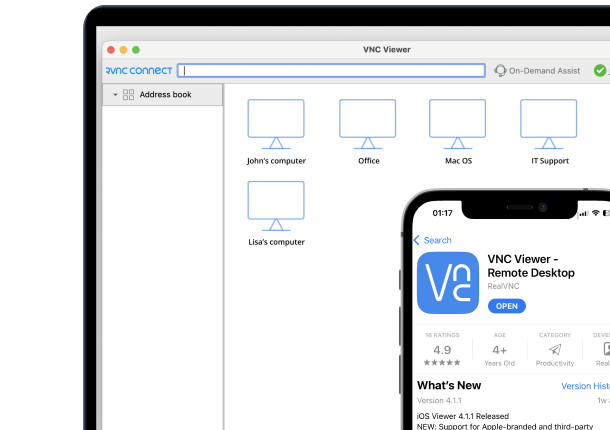
RealVNC Connect provides an operational control surface for that work. It does not replace an identity provider, governance process, or investment forum. It applies defined access boundaries to remote sessions through a focused set of controls:
- Multi-factor authentication and single sign-on (SSO): MFA and SSO with Microsoft Entra ID or Okta align session entry with enterprise identity governance and workforce lifecycle controls.
- Role-based access controls (RBAC): RBAC and granular action-based permissions let administrators manage keyboard, mouse, and file-transfer access separately, translating role ownership into session restrictions.
- Session oversight and evidence: Session monitoring, session recording, and detailed audit logs give authorized administrators evidence for incident review, operational assurance, and audit preparation.
- Bounded third-party access: Code Connect uses single-use 9-digit session codes within a short, configurable window, allowing specialist intervention without issuing persistent credentials.
For a growing organization, the outcome is traceable support activity that matches the accountability model leaders have defined. RealVNC Connect helps teams enforce access boundaries, retain reviewable records, and keep service ownership visible as distributed operations expand.
Final Words
Growth makes informal coordination costly. An it operating model for fast-growing companies sets decision rights, measures maturity, and pilots change.
RealVNC Connect brings MFA and audit evidence to support work. Book a meeting to discuss how RealVNC Connect supports controlled, audit-ready remote access as your IT operating model scales.
FAQs
These answers clarify the main operating-model choices for growing IT organizations.
What is the framework for an IT operating model?
An IT operating model for fast-growing companies defines how technology decisions, capabilities, funding, governance, and service accountability scale with business complexity. It usually covers decision rights, organization and talent, service processes, architecture and platforms, and sourcing boundaries.
What is the difference between centralized and federated IT?
A centralized model concentrates technology standards, budgets, staff, and decisions in one department. A federated model keeps enterprise guardrails central and gives local or product teams responsibility for delivery, so the right balance may differ by capability.
What are the four types of operating models?
Four commonly used patterns are Centralized Control, Federated Execution, Product-Aligned Delivery, and Platform Enablement. Organizations often combine them, such as centralizing identity and security and assigning customer-facing delivery to product teams.
Which governance practices support scale-ready IT operations?
Scale-ready governance maps decision rights, service ownership, risk acceptance, access lifecycle accountability, and technology spending to named owners. Architecture review, investment forums, and FinOps visibility make decisions more consistent without creating unnecessary approval queues.
How does RealVNC Connect support a scaling IT model?
RealVNC Connect applies MFA, SSO, RBAC, and granular action-based permissions to remote-support workflows. Session monitoring, recording, detailed audit logs, and Code Connect’s time-bound session codes support accountable access and reviewable evidence for internal teams and third parties.