



A gateway stops reporting at a remote site, a maintenance window is closing, and the one engineer who knows the last configuration change is unavailable. Operations loses a clear picture first, but production planning and customer commitments soon feel the delay.
IIoT device management is the disciplined process of identifying, configuring, monitoring, maintaining, diagnosing, and retiring connected industrial equipment throughout its working life. It gives IT, engineering, and operations a current record of each asset, its approved state, its owner, and the access needed to restore service without treating every site visit as the only option.
The pressure builds as devices remain in service across remote locations, uneven network conditions, and changing ownership. A device list alone does not show whether credentials remain valid, configuration still matches policy, or a technician has a tested route to recover approved operation. Think of it as running a distributed vehicle fleet with no shared dispatch board: each vehicle may still move, yet nobody can reliably see its condition, assignment, or next maintenance need.
This article sets out a five-part lifecycle framework: Inventory, Identity, Intent, Intervention, and Exit. It explains which executive signals reveal gaps in lifecycle control, how to weigh centralized and edge-assisted management models, and which blind spots leave residual access or weak recovery evidence. The goal is a connected-asset program that keeps device history, decision rights, and service recovery visible before a remote-site issue forces your teams to reconstruct them under pressure.
What makes industrial device fleets hard to govern?
Industrial fleets become hard to govern when device records, support access, and change history sit in separate systems. Leaders need a current view of each asset’s identity, operating context, approved state, and accountable owner before they can judge continuity risk or approve expansion.
The exposure context is clear without describing any individual organization’s posture. Fortinet’s State of Operational Technology and Cybersecurity Report (2024) found that 73% of surveyed organizations reported an intrusion affecting OT systems only or both IT and OT systems. A fleet record that cannot show what is connected, who supports it, or which configuration applies leaves leaders with incomplete evidence when disruption occurs.
Consider a fragmented fleet record as an incomplete shift-handover log. Engineering may hold the configuration, operations may know the site context, and IT may manage credentials, yet no operator has a complete current view. That makes a routine diagnostic request harder to assess and a recovery decision slower to authorize.
Madhu Gottumukkala, Acting Director at CISA, said in CISA’s 2025 asset-inventory guidance: “As cyber threats continue to evolve, CISA through this guidance provides deeper visibility into OT assets as a critical first step in reducing risk and ensuring operational resilience.” Visibility must therefore connect to ownership and operational action.
Which pressures turn fleet operations into governance?
- Long service lives: Equipment can remain active beyond its original software-support assumptions, so ownership and update decisions need lasting records.
- Heterogeneous estates: Gateways, sensors, engineering workstations, and cellular equipment often use different interfaces and support models.
- Intermittent connectivity: A device may miss a maintenance window or report late, requiring teams to distinguish a network issue from an asset issue.
- Shared IT/OT accountability: IT, engineering, operations, and service partners need defined decision rights without collapsing their separate responsibilities.
Legacy device administration vs. lifecycle control
| Operating dimension | Fragmented approach | Lifecycle-control approach |
|---|---|---|
| Inventory | Separate procurement, engineering, and support records | One accountable record linked to operational context |
| Change | Local changes recorded unevenly | Approved baselines and change evidence travel with the asset |
| Incident response | Teams reconstruct device state during the event | Teams begin with known identity, owner, and recent activity |
| Retirement | Hardware removal closes the task | Credentials, connectivity, records, and disposal are addressed together |
How do you assess the industrial device lifecycle?
A mature industrial device lifecycle program keeps control intact from onboarding through retirement. It evaluates whether the organization can identify each asset, define its approved behavior, intervene safely when conditions change, and close access when service ends.
The framework has five connected dimensions: Inventory, Identity, Intent, Intervention, and Exit. A strong onboarding process does not offset unmanaged updates or undocumented retirement. The weakest link determines how much confidence leaders can place in fleet records.
That continuity matters because OneKey’s Cybersecurity Report 2024 (2025) reported that 52% of industrial-company respondents had already experienced cyberattacks through OT or IoT devices. This is an industry indicator, not a finding about your environment, but it shows why lifecycle gaps deserve executive review.
Inventory and identity establish what is trusted
Inventory creates the authoritative record of devices that are active, stored, under repair, or leaving service. It needs an owner, criticality tier, site context, hardware and software details, plus the connection path the equipment uses.
Identity confirms which device, user, or service is permitted to act. Certificates, credentials, network context, and access roles turn a device list into a trusted population rather than a collection of serial numbers.
Intent, intervention, and exit govern change
Intent records approved configuration, telemetry behavior, and policy state. Intervention covers monitoring, diagnostics, patches, and rollback during service. Exit handles replacement, data migration, credential revocation, and disposal when an asset leaves use.
ENISA’s Secure by Design and Default Playbook (2026) calls for patch intake and service-level agreements, vulnerability monitoring, incident handling, end-of-support planning, and secure disposal. The framework below translates those expectations into executive evidence.
- Inventory: Establishes the known population and accountable owner.
- Identity: Limits which devices, users, and services may participate.
- Intent: Records the approved configuration, data behavior, and policy state.
- Intervention: Controls monitoring, diagnosis, and change during service.
- Exit: Removes residual access and preserves lifecycle evidence at retirement.
Five dimensions of lifecycle control
| Dimension | Executive purpose | Evidence to review | Failure signal | Decision enabled |
|---|---|---|---|---|
| Inventory | Establish accountability | Owner, location, criticality, status | Unknown active asset | Pause expansion or correct records |
| Identity | Confirm authorized participation | Certificates, credentials, roles | Shared or unmanaged credentials | Strengthen access governance |
| Intent | Define approved behavior | Baseline configuration and routing rules | Unexplained configuration drift | Review exceptions or automate remediation |
| Intervention | Recover service safely | Update history, diagnostics, rollback tests | Change without recovery evidence | Fund support paths and maintenance controls |
| Exit | Close lifecycle obligations | Revocation, inventory update, disposal record | Retired hardware retains access | Remove residual operational liability |
The relative weight of each dimension depends on service criticality and sector obligations. The labels give IT, engineering, and operations a common language while leaving their decision rights clear.
Which IIoT device management signals matter most?
)
Leadership scorecards should show whether connected assets remain known, compliant, supportable, and recoverable as the fleet changes. The useful measure is a trend by device class, site, and criticality tier, because one fleet-wide average can hide a serious local gap.
NSA and CISA’s Advancing Zero Trust Maturity Throughout the Device Pillar (2023) identifies inventory, authentication, unknown-device detection, configuration checks, remote-access protections, updates, and device-management capability as maturity elements. Use those categories to test control quality, rather than seeking a universal threshold.
- Known-and-owned coverage: Assess active assets with a unique identity, accountable owner, site context, and criticality tier. A procurement list is not an operational inventory.
- Configuration conformance: Assess devices that match approved credentials, data-routing rules, access policy, and reporting behavior. Documented exceptions need separate review.
- Update and rollback readiness: Assess in-scope assets able to receive an authenticated staged update and recover through a tested rollback path. Deployment status alone is incomplete evidence.
- Service recoverability: Assess the time and effort required to diagnose a field device, gateway, or connection and restore approved operation. Ticket closure does not always mean service restoration.
- Retirement completeness: Assess decommissioned assets with revoked credentials, disconnected connectivity, updated records, retained evidence, and approved disposal.
Executive scorecard for connected assets
| Signal | How to calculate or assess it | Strategic interpretation | Common error |
|---|---|---|---|
| Known-and-owned coverage | Review identity, owner, site, and criticality fields | Indicates whether growth rests on reliable records | Counting purchased assets as active assets |
| Configuration conformance | Compare actual settings with approved baselines | Shows where drift needs investigation | Treating approved exceptions as drift |
| Update and rollback readiness | Test staged deployment and recovery paths | Shows whether vulnerability response is feasible | Recording deployment without recovery outcomes |
| Service recoverability | Review diagnosis-to-restoration effort | Identifies where remote support or local spares are justified | Using ticket closure as the service measure |
| Retirement completeness | Check revocation, status, evidence, and disposal | Shows whether lifecycle liabilities remain | Removing hardware while access persists |
Trend lines carry the decision value. A declining result for one critical device class tells leaders where to assign funding, ownership, or technical attention before the issue becomes an operational interruption.
How should IIoT leaders weigh platform trade-offs?
Platform selection starts with the operating conditions at each site, not a preferred architecture. Central control improves consistency where networks are dependable, while edge-assisted or hybrid arrangements preserve local functions when connectivity drops.
The management layer also has to fit the wider IT and OT environment. Effective integrations connect lifecycle capabilities with analytics, IT service management, security operations, enterprise resource planning, and manufacturing workflows through application programming interfaces (APIs) and automation.
- Central policy versus local autonomy: Define which configurations, updates, and approvals require central control, and which functions must continue locally during a connection loss.
- Open integration versus operating simplicity: Review API access, protocol support, device twins, event export, and portability against the work needed to run several specialized systems.
- Scale versus segmentation: Test whether one control plane can apply common policies while keeping access, data handling, and change windows separate by plant or criticality tier.
- Automation versus recoverability: Require staged changes, approvals, maintenance windows, observability, and rollback before expanding automated change.
Platform decision trade-offs
| Decision area | When a centralized approach fits | When an edge-assisted or hybrid approach fits | Implication |
|---|---|---|---|
| Policy control | Stable links and common fleet standards | Sites need local continuity during outages | Define central and local decision rights |
| Data exchange | Shared enterprise reporting is the priority | Local processing limits latency or bandwidth demand | Set data-routing and retention rules |
| Support access | Central specialists manage common equipment | Site teams need immediate local intervention | Document escalation and recovery paths |
| Provider migration | Connectivity and APIs are portable | Regional coverage needs differ by site | Verify migration evidence before commitment |
Telenor IoT’s 2026 logistics case studies describe Toyota Material Handling using managed connectivity and local access for its I_Site fleet-management environment across complex markets. The example illustrates an integration choice, not a performance benchmark. Architecture needs to preserve options when connectivity, providers, or site requirements change.
Which lifecycle blind spots create IIoT risk?
Monitoring and provisioning do not remove lifecycle risk when teams leave orphaned assets, standing credentials, or untested recovery paths behind. Leaders need evidence that every operational intervention has an owner, a permitted scope, and a route back to approved operation.
The retirement issue has material reach. Ricardo Yaben and colleagues’ 2024 research identified 1,019,887 IoT or industrial-protocol systems reachable from the public internet, including 675,896 neglected, obsolete, or abandoned devices. Those internet-wide findings do not establish exposure in any one fleet, but they show why retirement records need the same attention as deployment records.
- Orphaned devices: Assets remain reachable after ownership, contract, or operational context changes.
- Change without recovery: Updates proceed without staged deployment, approved rollback, or site-level validation.
- Access beyond the task: Support personnel or third parties retain standing access broader than a diagnostic activity requires.
- Retirement without evidence: Hardware leaves service while credentials, SIMs, network rules, or inventory records remain active.
Lifecycle blind spot to governance response
| Blind spot | Control evidence | Executive owner |
|---|---|---|
| Orphaned devices | Current owner, status, and access review | Operations and asset owner |
| Change without recovery | Approved maintenance plan and rollback test | Engineering change authority |
| Access beyond the task | Role scope and session record | IT access owner |
| Retirement without evidence | Revocation, connectivity closure, and disposal record | Asset owner and procurement |
Chris Butera, Acting Executive Assistant Director for Cybersecurity at CISA, urged OT owners and operators in CISA’s 2026 isolation guidance announcement to maintain “robust isolation and recovery plans so essential services can continue under degraded conditions through manual or alternative SCADA paths.” Recovery planning preserves operating options when primary systems are unavailable.
What RealVNC Adds to IIoT Device Management Evidence
)
A lifecycle program may identify a device, define its approved configuration, and detect a support issue, yet still lack evidence of who remotely accessed a gateway, engineering workstation, or edge-management host. That gap sits between Identity, Intervention, and service recoverability, especially when internal support teams and third-party maintainers share responsibility across distributed sites.
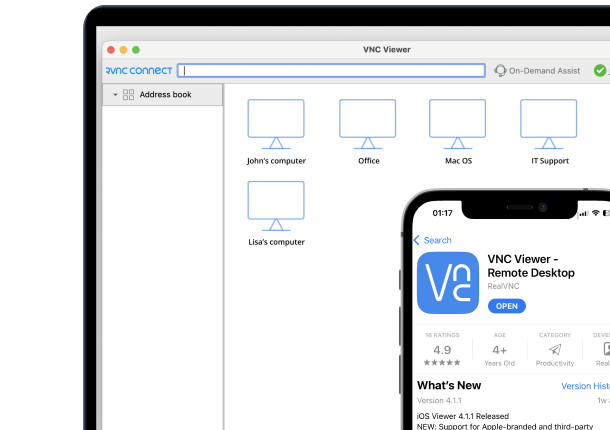
RealVNC Connect provides a controlled remote-support layer alongside industrial device operations. Multi-factor authentication (MFA) and single sign-on (SSO) with Microsoft Entra ID or Okta strengthen user authentication before a support session begins. Role-based access controls (RBAC) and granular action-based permissions restrict keyboard, mouse, and file-transfer activity to the task a role is approved to perform. Session monitoring, session recording, and detailed audit logs preserve reviewable evidence for incident review, change validation, and audit workflows. Cloud and Direct deployment options let organizations align remote-support architecture with cloud-connected or more tightly controlled environments.
This scope is deliberately bounded. RealVNC Connect does not replace a fleet-management platform, OT asset inventory, or segmentation strategy; it makes the human intervention around remote management of field equipment more attributable and reviewable. When teams investigate alerts, restore service, or coordinate maintenance, they retain a clearer operational record while the wider IIoT operating model remains accountable for lifecycle ownership and device policy.
Final Words
Build lifecycle control before the next remote-site fault, maintenance window, or equipment replacement forces your teams to reconstruct device history under pressure. The five-part framework keeps that work connected: Inventory and Identity establish what is in service and who may act; Intent records approved behavior; Intervention governs diagnosis and change; and Exit closes access and preserves retirement evidence. That gives IT, engineering, and operations a shared way to review connected assets without blurring their separate decision rights.
The payoff is a fleet that remains supportable when connectivity is limited, ownership changes, or recovery depends on fast, informed action. RealVNC Connect strengthens the intervention stage by verifying remote users through multi-factor authentication (MFA) and single sign-on (SSO), constraining session activity through role-based access controls, and retaining session recordings with detailed audit logs. Your device-lifecycle platform remains responsible for fleet policy, while remote support becomes more attributable across distributed sites. Arrange a meeting to assess how RealVNC Connect can make remote support activity more attributable within your iiot device management operating model.
FAQs
What is the lifecycle framework for industrial assets?
IIoT device management works best as a lifecycle framework rather than a set of separate provisioning, monitoring, and patching tools. The five dimensions are Inventory, Identity, Intent, Intervention, and Exit: together, they connect asset ownership, approved behavior, support activity, recovery, and retirement. NIST IR 8259r1 (2026) advises organizations to maintain a current, accurate inventory throughout the device lifecycle.
What is the difference between fleet monitoring and lifecycle control?
Fleet monitoring observes current health, connectivity, telemetry, and security signals, while lifecycle control governs what happens before, during, and after those signals trigger action. It sets rules for identity, approved configuration, authorized change, recovery, and retirement. An over-the-air update program therefore needs staged rollout, progress monitoring, and a tested rollback path rather than deployment status alone.
Which standards inform industrial connected-device governance?
NIST, NSA and CISA, and ENISA provide useful reference points for industrial connected-device governance. NIST emphasizes accurate lifecycle inventory; NSA and CISA address authentication, unknown-device detection, configuration checks, remote-access protections, updates, and device-management capabilities in their 2023 device-pillar guidance. ENISA’s 2026 playbook also covers patch intake, incident handling, end-of-support planning, and secure disposal. Organizations need to map these practices to sector obligations and their existing OT risk framework.
How should leaders compare IoT device management tools and platforms?
Leaders should compare IoT device management tools and platforms against operating conditions, integration requirements, and recovery needs. Review how each option handles device identity, provisioning, configuration control, updates, diagnostics, API access, connectivity loss, and retirement evidence. The right choice preserves clear decision rights between IT, engineering, operations, and service partners instead of forcing every site into one operating pattern.
What role does AWS IoT Core play in device operations?
AWS IoT Core is a cloud service used to connect devices and exchange device data with applications and other AWS services. In an industrial program, it needs to be assessed alongside device identity, update control, local continuity, access governance, and retirement processes. AWS IoT device management pricing and AWS documentation should be reviewed against expected device volume, message activity, support workflows, and any edge requirements before procurement.
How does RealVNC support industrial device workflows?
RealVNC Connect supports controlled remote-support workflows through multi-factor authentication, single sign-on with Microsoft Entra ID and Okta, role-based access controls, and granular permissions for keyboard, mouse, and file transfer. Session monitoring, recording, and detailed audit logs provide reviewable evidence of human activity during diagnostics or remediation. This complements the wider device-management platform; it does not replace fleet inventory, device policy, or OT segmentation.