


A traffic surge hits, a regulated system needs tighter control, and cloud invoices climb without a defined owner. Your IT team then has to decide which workloads belong where before performance, resilience, or budget suffer.
A hybrid cloud strategy combines on-premises infrastructure with public or private cloud services under a shared management approach. It lets you keep sensitive or stable workloads in the environment that suits them and use cloud capacity for changing demand, new services, and recovery options.
This article explains how to assess workload placement, build consistent security and data-protection controls, plan migration in phases, and govern cost across connected environments.
Why Hybrid Cloud Strategy Is Now an Operating Model
The architecture decision rarely arrives as a single program. A new customer service needs capacity, a data team needs a managed service, and a regulated application needs a defined location rule. Without shared decision rights, each reasonable choice leaves a harder environment to run.
A hybrid cloud strategy is the operating model that assigns workloads to on-premises, private-cloud, or public-cloud environments against agreed business criteria. It requires leaders to govern placement, identity, cost, and recovery as connected decisions. A workload can move when its requirements change.
Adoption has outpaced that operating discipline. Flexera’s State of the Cloud Report 2025 found that 70% of surveyed organizations use hybrid approaches spanning at least one public and one private cloud (Flexera, 2025). The management question is whether those environments operate through common policies or as separate technical territories.
Provider diversity does not answer that question. Pluralsight’s 2023 State of Cloud Report reported that 85% of organizations were adopting multicloud approaches (Pluralsight, 2023), yet multiple providers alone do not create common ownership, telemetry, or recovery evidence. The sections that follow set out a placement model, the evidence leaders need, and a roadmap for keeping decisions reviewable.
Why does a hybrid cloud strategy need governance?
Governance gives hybrid infrastructure a defined operating purpose: each workload has an accountable owner, an approved location, and evidence for why it belongs there. It does not prescribe public cloud, private cloud, or data center by default. It makes the trade-off visible before an application becomes expensive to move or difficult to recover.
A mixed environment becomes governed when teams apply shared decision rights across environments. Think of it as assigning production work to sites with different delivery routes, local rules, and backup capacity; choosing the newest site for every job would ignore what the job actually needs. Hybrid cloud integrates on-premises and cloud resources under a unified management approach, whereas multicloud may simply mean using more than one provider.
Placement also changes over time. Alexander Wurm, Senior Analyst at Nucleus Research, told TechTarget (2024): “Also, expect some cloud repatriation for certain workloads, especially those that perform better with specialized hardware.” That movement makes portability planning and documented exceptions part of normal governance.
Which pressures make placement decisions strategic?
Four pressures turn a platform choice into an executive decision. Each needs an owner who can explain the commercial and operational consequence.
- Regulatory exposure: Data location, retention, and audit duties must translate into documented controls and approved jurisdictions.
- Service criticality: Revenue-facing or operationally important services need explicit availability and recovery objectives.
- Economic volatility: Variable demand, storage tiers, and data-transfer charges need workload-level financial accountability.
- Data and AI locality: Data-intensive processing may require proximity to data sources, specialist infrastructure, or defined jurisdictions.
| **Model** | **Primary organizing principle** | **Executive governance implication** |
|---|---|---|
| On-premises | Direct infrastructure control | Own capacity, lifecycle, and recovery evidence internally. |
| Private cloud | Dedicated cloud operating environment | Define service ownership and control requirements. |
| Public cloud | Provider services and elastic capacity | Govern consumption, configuration, and exit conditions. |
| Hybrid cloud | Deliberate placement across environments | Apply common decision rights, identity, and evidence standards. |
Which model guides workload placement decisions?
)
A placement model works when it makes competing requirements explicit before teams commit to a migration path. Use five dimensions – business criticality, data and regulatory fit, performance and locality, economic profile, and portability and resilience – to structure a leadership decision. The model does not replace judgment; it shows where a decision depends on an assumption that must be tested.
Cache Merrill, Founder of Zibtek, told CIO.com (2025): “We’re seeing enterprises moving past the assumption that everything belongs in the cloud. Instead, they’re making deliberate decisions about workload placement based on actual business outcomes.” That is the useful shift: placement follows the work, rather than a broad migration preference.
Consider a production line that needs supplier access, local regulatory approval, reliable throughput, and a fallback site. Selecting its location requires more than comparing building rents. Workload placement follows the same logic: a lower infrastructure rate means little if data transfer, dependency changes, or recovery obligations make the operating cost larger.
- Business criticality: Identify the consequence of service interruption and the recovery commitment leadership accepts.
- Data and regulatory fit: Map data classes to location, retention, access, and evidence requirements.
- Performance and locality: Test response time, data proximity, and dependency behavior under expected demand.
- Economic profile: Compare steady-state demand, burst demand, transfer charges, and modernization effort.
- Portability and resilience: Prove that the workload and its dependencies can move or recover within the required time.
HashiCorp’s 2024 State of Cloud Strategy Survey found that 64% of respondents lacked all the staff expertise needed for their cloud infrastructure strategy (HashiCorp, 2024). Where expertise is incomplete, leaders need to reduce migration pace, narrow the first workload set, or bring in accountable specialist capacity rather than treating the gap as a later training task.
| **Placement dimension** | **Question to ask** | **Signals** | **Likely implication** | **Common misread** |
|---|---|---|---|---|
| Business criticality | What fails if this service stops? | Recovery objective and service owner | Prioritize tested continuity controls | “Important” without a measurable recovery need |
| Data and regulatory fit | Where may data reside and who may reach it? | Data class and jurisdiction | Keep defined workloads in approved locations | Treating sensitivity as a location decision by itself |
| Performance and locality | Where must processing occur? | Response-time and dependency tests | Place processing near users or data | Assuming compute capacity resolves latency |
| Economic profile | What is the full operating cost? | Consumption, transfer, and change effort | Match environment to demand pattern | Comparing only unit prices |
| Portability and resilience | Can the service move or recover? | Tested restoration and dependency map | Fund exit and recovery work early | Equating provisioning with portability |
How do business and regulatory constraints shape placement?
Business criticality and data fit set the first boundary. A regulated service may need a specific jurisdiction, retention schedule, and auditable access model; a customer-facing service with variable demand may need public-cloud capacity. Neither description determines placement until leaders define its service-level objective, data class, and recovery obligation.
Shared responsibility does not transfer accountability for application data or configuration. Your teams must define strong authentication, review resource settings, and retain evidence that controls meet the relevant obligations. “Sensitive” only becomes useful when it leads to a location rule and a testable control.
How do cost and portability alter the decision?
Infrastructure price is only one part of workload economics. Overprovisioning, configuration errors, development activity, data ingress or egress, and refactoring effort can change the total cost after migration. Financial reviews need to connect spend to service value and demand behavior.
Portability requires more than the ability to create compute in another location. It depends on synchronized data, integrated identity, mapped dependencies, and tested restoration. If a team cannot show a recent movement or recovery exercise, it has an architectural intention rather than proven exit capacity.
What controls prove hybrid operations are governed?
Governed operations produce evidence leaders can review, not dashboards that merely report activity. Five control domains show whether ownership, identity, telemetry, financial accountability, and recovery work consistently across environments. Each domain must connect a signal to a decision.
Tanuj Raja, Senior Vice President, Hyperscaler and Marketplace, North America, TD SYNNEX, told CIO.com (2025): “Organizations must consider what workloads go where and how that distribution will affect enterprise performance, reduce unnecessary costs, and help keep workloads secure.” The operating review should ask what changed, who approved it, and whether the evidence still supports the original placement.
- Workload inventory and ownership: Record the service owner, data class, approved environment, dependencies, and recovery commitment. The executive signal is a complete decision record; a list of assets without accountable owners is not enough.
- Federated identity and privileged access: Apply common identity standards to administrator and service access. The U.S. Department of Defense CIO’s Cloud Security Playbook Volume 1 calls for secure cloud identity and access-management practices, least privilege, and monitoring and logging of access requests. Separate identity rules create gaps that local teams may not see.
- Cross-environment observability: Normalize logs and operational telemetry so teams can follow a service across its dependencies. A large volume of monitoring data is not evidence if it cannot answer who changed what and when.
- FinOps accountability: FinOps – financial operations – connects cloud consumption to business ownership. Review spend by workload, demand pattern, and approved exception, rather than accepting aggregate provider invoices.
- Recovery and portability testing: Test restoration, dependency order, and alternate-location operation against agreed objectives. A backup exists only as a control when teams can restore the required service within its approved window.
| **Control domain** | **Evidence leaders review** | **Decision supported** | **Common interpretation error** |
|---|---|---|---|
| Inventory and ownership | Service record, owner, data class | Keep, move, modernize, or retire | Treating discovery as ownership |
| Identity and access | Policy coverage and access records | Approve privileged access model | Assuming provider identity rules match |
| Observability | Correlated logs and service context | Investigate change and service impact | Counting alerts instead of explaining events |
| FinOps | Workload cost and exception review | Adjust capacity or placement | Reading total spend without value context |
| Recovery testing | Restoration results and dependency evidence | Accept resilience exposure | Treating snapshots as recovery proof |
How should leaders sequence the hybrid roadmap?
The roadmap starts with decision rights and baseline evidence, not a broad migration target. First establish what leaders need to approve, what teams may decide locally, and which signals prove that controls work. That sequence prevents critical workloads from moving before the organization can govern them.
Douglas Toombs, Gartner analyst, writes in Gartner’s “Adapt IT Governance to Meet the Challenges of Cloud Computing” (2025): “Form a governance team and document operating models. Define principles and goals. Implement programmatic controls (‘guardrails’). Develop cloud usage policies (guidelines). Assess compliance, refine and optimize.” The order matters since a policy that arrives after migration often documents exceptions rather than directing decisions.
- Assess: Build a workload inventory and map business criticality, data requirements, dependencies, demand patterns, and recovery objectives. The key decision is which workloads qualify for early movement; the pitfall is using incomplete discovery as a final design.
- Set guardrails: Define identity, logging, data-location, financial, and recovery requirements that apply across environments. The success check is that teams can show an approved exception process before new services enter production.
- Mobilize priority workloads: Begin with contained workloads that test connectivity, operating procedures, and restoration without placing core operations at risk. Require performance, synchronization, and dependency tests before each subsequent wave.
- Optimize the operating model: Reassess placement as demand, regulation, service design, and provider terms change. The success check is a recurring review that produces an accountable keep, move, modernize, or retire decision.
Skills planning belongs in every stage. IDC’s Cloud Analyst Brief 2025 reported that 74% of companies believe limited in-house cloud skills have affected their ability to compete (IDC, 2025). A regulated enterprise may therefore begin with data classification and audit evidence, whereas a growth-focused enterprise may prioritize capacity economics; both need a realistic sourcing and capability plan.
| **Roadmap stage** | **Leadership decision** | **Success check** |
|---|---|---|
| Assess | Select workloads for review | Every candidate has an owner and dependency map |
| Set guardrails | Approve common control requirements | Exceptions have a named approver and expiry |
| Mobilize priority workloads | Set migration sequence and pace | Tests show expected performance and restoration |
| Optimize | Revisit placement and operating model | Reviews produce documented decisions |
Where do hybrid cloud programs lose resilience?
)
Resilience weakens when teams treat the first migration as the end of operational design. Provider availability does not prove application recovery, and a distributed service is only portable when its data, identity, dependencies, and restoration steps work together under test.
Microsoft’s Microsoft Cloud Security Benchmark – Governance and Strategy guides organizations to establish a coherent security strategy and documented governance approach, including cloud-security roles and responsibilities, a unified technical strategy, and supporting policies and standards. That guidance turns resilience into an evidence discipline: leaders need proof of recovery, access consistency, and accountable cost decisions.
- Untested recovery: Snapshots or provider features may exist, but no exercise proves the application returns in the required order.
- Fragmented identity: Local access rules drift from enterprise policy, leaving privileged activity difficult to review.
- Unowned cost: Spending rises without a workload owner who can explain demand, transfer, or capacity choices.
- Assumed portability: A service appears movable until data synchronization or a hidden dependency prevents restoration elsewhere.
Accenture’s own Cloud-First IT: Running our business in the hybrid cloud describes moving its cloud footprint from 9% to 90% of business applications over three years and tracking provisioning lead times alongside business benefits (Accenture, 2025). It is an organizational experience, not a universal benchmark. Its lesson is practical: percentage migrated says little when leaders do not also measure the operating outcomes that migration was meant to improve.
| **Resilience blind spot** | **Governance response** |
|---|---|
| Recovery assumed from infrastructure availability | Test application restoration and dependency order |
| Identity differs by environment | Review common access policies and session evidence |
| Spend lacks service context | Assign workload-level financial ownership |
| Portability is asserted, not tested | Exercise movement and alternate-location recovery |
How RealVNC Closes the Hybrid Cloud Governance Gap
Federated identity, centralized logs, and recovery testing still leave a practical evidence gap when distributed teams or third parties reach systems remotely for support, configuration review, remediation, or restoration. Those sessions sit directly inside the control domains of privileged access, observability, and recovery evidence. If the organization cannot attribute and review that activity, its broader governance record is incomplete.
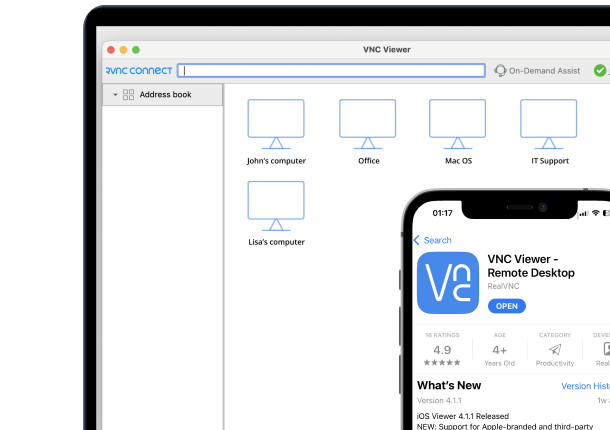
RealVNC Connect supports controlled remote operations across a cloud-and-data-center operating environment without replacing cloud management, identity, or backup controls. It maps access controls to the work teams perform:
- Single sign-on (SSO) with Microsoft Entra ID or Okta plus multi-factor authentication (MFA): Aligns remote-session authentication with enterprise identity controls.
- Role-based access controls (RBAC) and granular action-based permissions: Limits what each support role may do, with separate controls for keyboard, mouse, and file transfer.
- Session monitoring, recording, and detailed audit logs: Creates reviewable evidence of support and remediation activity.
- Cloud + Direct deployment options: Supports access requirements spanning internet-connected and more controlled network environments.
This makes remote work attributable and reviewable during the workflows that keep distributed services available. For organizations applying a hybrid cloud strategy, RealVNC Connect provides an operational control for consistent access oversight as platform, identity, and recovery teams retain responsibility for their respective domains.
Final Words
A hybrid cloud strategy works when leaders place workloads against business needs, prove recovery, and keep ownership, cost, and access decisions reviewable. RealVNC Connect adds single sign-on, multi-factor authentication, role-based permissions, and session audit evidence to remote operations.
That control keeps remediation activity attributable across environments. Arrange a meeting to discuss how RealVNC Connect can support controlled, audit-ready remote operations across your hybrid environment.
FAQs
These answers clarify workload placement, governance, operating models, and controlled remote access across mixed cloud environments.
What is the workload-placement framework?
A hybrid cloud strategy uses five dimensions to guide workload placement: business criticality, data and regulatory fit, performance and locality, economic profile, and portability and resilience. The framework supports repeatable executive decisions without turning placement into an automatic rule.
How does hybrid architecture differ from multicloud?
Hybrid architecture integrates on-premises infrastructure with public or private cloud services under coordinated management. Multicloud means using multiple cloud providers; it may not include on-premises integration or shared operating controls.
What governance model supports cross-cloud operations?
A federated model keeps policy, identity, telemetry, financial accountability, and placement reviews consistent and allows teams to execute locally. Gartner guidance calls for documented operating models, guardrails, usage policies, and continuous assessment.
What are the main advantages and disadvantages of hybrid cloud?
Hybrid cloud offers workload placement flexibility, data-location control, and access to public-cloud capacity. It also increases governance demands, as identity, cost, dependencies, and recovery must remain consistent across environments.
How does RealVNC Connect support controlled operations?
RealVNC Connect supports controlled remote access through multi-factor authentication (MFA), single sign-on (SSO) with Microsoft Entra ID and Okta, and role-based access controls (RBAC). Session monitoring, recording, and detailed audit logs make support, remediation, and recovery activity reviewable.