


When project updates arrive late and a key specialist works around the team, the impact reaches far beyond IT. Business leaders lose a reliable view of delivery, colleagues wait for answers, and skilled people start working at cross-purposes.
Knowing how to lead an IT team means giving technical professionals defined outcomes, decision boundaries, regular feedback, and room to apply their expertise. It balances autonomy with shared standards, so day-to-day work supports customer experience, cost control, and business priorities.
This guide explains how to set expectations, coach people, improve communication, use metrics as shared problem-solving tools, and remove the process friction that slows delivery. You’ll see how to sustain morale across in-house and distributed teams without turning task tracking into talent management.
Why does leading an IT team require an operating model?
Leading an IT team requires an operating model. Technical work crosses products, services, risk controls, and business functions. The leader’s role is to make priorities, authority, and trade-offs visible so specialists can act independently without fragmenting the organization’s strategy.
Task boards show activity, but they rarely show whether a team understands the business result it owns or who resolves a conflict between delivery speed and service reliability. An operating model supplies that missing structure. Think of it as air-traffic control: teams retain control of their work, and shared rules and visibility prevent conflicting movements.
The capability pressure makes this discipline urgent. McKinsey reports that 87% of companies worldwide already have a skills gap or expect one within a few years. When specialist capacity is constrained, leaders need to protect expert attention for the decisions that only those people can make.
A useful model connects four elements:
- Outcome alignment: translate business priorities into service, product, and modernization commitments.
- Decision rights: state who recommends, decides, contributes, and receives updates.
- Learning loops: turn delivery signals, retrospectives, and stakeholder feedback into changed priorities.
- Capacity protection: reserve time for maintenance, skill development, and technical debt reduction.
The U.S. Office of Personnel Management’s 2023–2026 IT Strategic Plan offers a public-sector illustration. Its Office of the Chief Information Officer reorganized to better support Agile and DevOps practices, showing that team design and delivery methods need to reinforce each other.
| Leadership dimension | Activity-led management | Outcome-led operating model |
|---|---|---|
| Priority setting | Assign work from incoming requests | Connect work to a stated business result |
| Authority | Escalate routine decisions upward | Define decision boundaries near the work |
| Performance discussion | Count completed tasks | Review service outcomes and system conditions |
| Capacity | Fill every available hour | Protect time for reliability and improvement |
The practical test is simple: if a team cannot explain its intended outcome, its decision owner, and its trade-off rules, it is managing work without a shared operating model.
Build an IT leadership framework around four systems
A durable IT leadership framework balances four systems: outcome alignment, decision rights, learning loops, and capacity protection. Together, they help leaders connect work to strategy and preserve the autonomy and technical judgment that complex IT environments require.
These systems are connected. A roadmap without named decision owners creates delay; autonomy without learning loops repeats avoidable mistakes; protected capacity without outcome alignment becomes work with no agreed business purpose. The framework gives leaders a way to inspect the conditions around delivery before judging the people doing it.
- Outcome alignment: links technical roadmaps and service commitments to customer experience, cost control, risk reduction, growth, or resilience.
- Decision rights: assigns authority close to the technical context and retains executive ownership of material commitments.
- Learning loops: use retrospectives, incident reviews, and stakeholder input to change how work is planned.
- Capacity protection: preserves time for maintenance, documentation, training, and debt reduction before urgent work consumes it.
| Framework system | Leadership question | Evidence source | Decision supported | Common misread |
|---|---|---|---|---|
| Outcome alignment | Which business result does this work change? | Roadmap and service commitments | Prioritization | Treating every request as equally urgent |
| Decision rights | Who has authority to decide? | RACI responsibility matrix | Escalation design | Adding approval layers |
| Learning loops | What did delivery teach us? | Retrospectives and incident reviews | Process change | Treating review meetings as reporting rituals |
| Capacity protection | What work is being deferred repeatedly? | Demand and maintenance patterns | Staffing and sequencing | Filling all available time with planned delivery |
Outcome alignment and decision rights
Outcome alignment turns enterprise priorities into work a technical team can act on. A modernization program, for example, should state whether it aims to improve customer response time, reduce operating cost, address a stated control requirement, or increase service resilience. That statement gives engineers a basis for making sound local choices.
A RACI responsibility matrix makes ownership visible without placing every decision in a committee. For a legacy-system modernization decision, IT operations may be responsible for implementation, security contributes control requirements, finance approves material spend, and product leadership is accountable for the customer and roadmap outcome. The team then knows where technical discretion begins and where escalation is required.
Clear roles reduce the “hero coder” pattern, where one specialist becomes the informal owner of difficult work when nobody has defined a durable route for decisions. Expertise still matters. It simply becomes part of a repeatable team system.
Learning loops and capacity protection
Learning loops turn operational events into changes in planning. Google re:Work’s guidance on psychological safety describes the conditions in which people speak up, ask questions, and take interpersonal risks; leaders need those conditions if an incident review is to reveal the real constraint rather than the safest answer.
Consider a postmortem that finds recurring service disruption during a routine dependency update. The useful response is not to single out the engineer who ran the change. It is to move dependency testing and runbook updates into the next roadmap cycle, then protect capacity to complete them.
Capacity reviews serve the same purpose. When urgent maintenance repeatedly consumes planned improvement work, leaders need to adjust scope, sequencing, or staffing. Otherwise, the team spends every quarter responding to the same operational pressure.
Which measures show whether IT leadership is working?
)
IT leadership works when teams deliver meaningful outcomes with reliable services, sustainable workloads, and increasing capability. Leaders should review a balanced set of delivery, reliability, collaboration, and team-health signals, then use the data to investigate system conditions rather than judge individuals.
Measurement needs context before it needs detail. “Measuring, tracking, and benchmarking developer productivity has long been considered a black box. It doesn’t have to be that way,” Chandra Gnanasambandam, Martin Harrysson, Alharith Hussin, Shivam Srivastava, and Jason Keovichit wrote for McKinsey & Company in 2023. The point is to create better management conversations, not a scoreboard for surveillance.
- Business outcome progress: Review whether work changes the customer, cost, resilience, or control result it was meant to change. This informs roadmap choices; the pitfall is treating delivery of a feature as proof of value.
- Service reliability: Review service commitments, incident patterns, and recovery performance. This informs investment in reliability; the pitfall is assuming one incident defines the whole service.
- Flow and friction: Review waiting time, handoffs, approval delays, and recurring rework. This informs process redesign; the pitfall is equating busy teams with effective teams.
- Team health and capability: Review workload patterns, skill development, feedback themes, and internal mobility. This informs coaching and capacity decisions; the pitfall is treating engagement as an individual attitude alone.
- Stakeholder confidence: Review whether business partners understand priorities, trade-offs, and service commitments. This informs communication design; the pitfall is mistaking frequent updates for shared understanding.
| Leadership measure | Signal to review | Decision it informs | Common error |
|---|---|---|---|
| Business progress | Outcome against stated commitment | Roadmap priorities | Counting features instead of results |
| Reliability | Repeat incidents and recovery patterns | Resilience investment | Blaming the final responder |
| Flow | Delays, handoffs, and rework | Process redesign | Treating utilization as flow |
| Capability | Skill needs and growth evidence | Development planning | Limiting growth to management roles |
| Confidence | Stakeholder understanding of trade-offs | Communication cadence | Reporting without dialogue |
The SPACE framework authors in ACM Queue argue for a broader view of developer productivity that includes satisfaction and well-being, performance, activity, communication and collaboration, and efficiency and flow. Google Cloud’s State of DevOps guidance similarly frames delivery measures as system-level signals. Review trends alongside team narratives; a dashboard can show where to look but cannot explain why conditions changed.
The four leadership trade-offs in technical teams
Technical teams need both room to exercise judgment and enough structure to work toward the same outcome. The leadership task is to set visible guardrails, then avoid becoming the decision bottleneck for every technical choice.
The right balance varies with the operating context. A smaller internal team may need broad roles and short feedback cycles; a regulated organization may need more formal evidence and escalation routes. The underlying questions remain the same: where does authority sit, what must be documented, and how does the team learn?
Balance autonomy with visible guardrails
Autonomy works when the leader states the outcome, decision boundaries, escalation path, and architecture decision record requirements. A platform team might own implementation choices within agreed reliability and cost boundaries. An executive steering group retains decisions involving material regulatory exposure or capital commitments.
Purposeful delegation develops capability. Assign work based on a person’s strengths and growth goals, then provide the context needed to make decisions well. Passing along a task without decision rights only moves the queue.
Balance coaching with performance accountability
Regular one-on-ones need to be coaching conversations, not miniature status meetings. Google re:Work’s one-on-one guidance recommends using these meetings as recurring support mechanisms, which gives leaders a regular route to surface blockers before they become delivery problems.
Use a consistent six-prompt agenda:
- What outcome changed since the previous meeting?
- Which blocker needs a decision or escalation?
- Is workload sustainable for the commitments ahead?
- Which skill or experience needs deliberate development?
- What support is needed from the leader?
- What commitments will each person carry into the next meeting?
Developmental coaching and formal performance intervention serve different purposes. Coaching builds skill, judgment, and confidence over time. Formal intervention addresses a defined gap against stated expectations and requires clear evidence, a timeline, and documented follow-through.
A monthly leadership rhythm keeps these trade-offs visible:
- Review roadmap commitments against business outcomes.
- Examine capacity, maintenance demand, and upcoming service pressure.
- Identify recurring themes from one-on-ones and career discussions.
- Review incidents and retrospectives for changes to ownership, process, or investment.
This rhythm turns management from a series of urgent conversations into a repeatable leadership practice.
Where do leadership gaps create operational risk?
Leadership gaps become operational risk when teams compensate for unclear norms with personal effort. People stay available after hours, informal experts become permanent escalation points, and routine support activity proceeds without a consistent record of who approved or performed it.
Remote-work pressure makes these patterns easier to miss. Zippia’s 2026 remote-work burnout statistics report that 67% of remote workers feel compelled to remain constantly available. That figure does not describe every IT team, but it is a useful prompt for leaders to define incident escalation separately from routine after-hours expectations.
- Coordination debt: unclear handoffs and undocumented dependencies create repeated waiting, duplicate work, and fragile escalation routes.
- Burnout normalization: persistent urgency makes unsustainable availability appear like commitment rather than a capacity signal.
- Measurement distortion: individual scoreboards encourage work that improves a metric at the expense of collaboration or service quality.
- Ownership ambiguity: unclear authority delays changes, weakens accountability, and leaves critical maintenance dependent on informal knowledge.
The cost of measurement misuse deserves particular care. Gergely Orosz, author of The Pragmatic Engineer’s analysis of developer productivity measurement, wrote in 2023: “The consultancy giant has devised a methodology they claim can measure software developer productivity. But that measurement comes at a high price.” Leaders need measures that reveal system constraints without turning professional judgment into a compliance exercise.
Quarterly operating reviews should examine these risks alongside delivery and financial commitments. Where ISO/IEC 27001:2022, SOC 2, HIPAA, PCI DSS, GDPR, or NIS2 applies, access governance and evidence retention require named owners and documented procedures. The control question is practical: can the organization show who had authority, what occurred, and how lessons changed the next decision?
How RealVNC Closes the IT Team Leadership Gap
)
Distributed support work tests the leadership systems described above. When an incident needs specialist help, a vendor needs temporary access, or a remote technician supports an unmanaged device, leaders need defined escalation paths and evidence that the session followed assigned decision rights. Informal remote access arrangements create uncertainty precisely when the team needs a reliable record.
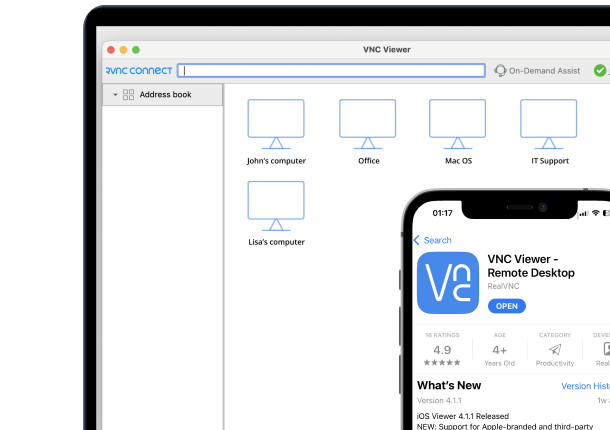
RealVNC Connect maps controlled remote access to those operating needs:
- Multi-factor authentication (MFA) and single sign-on (SSO): Microsoft Entra ID or Okta integration reinforces identity assurance for distributed support workflows.
- Role-based access controls (RBAC) and granular action-based permissions: leaders can limit keyboard, mouse, and file-transfer rights according to assigned responsibilities.
- Session monitoring, recording, and detailed audit logs: authorized administrators have reviewable evidence for incident postmortems, support oversight, and audit preparation.
- Code Connect: single-use 9-digit session codes provide time-bound, revocable access for third-party or ad hoc support without issuing standing credentials.
These controls do not replace a leadership operating model, an identity provider, or a service-management process. They reinforce the decision rights and learning loops that those practices depend on. MFA and SSO establish who is connecting; RBAC narrows what that person can do; session evidence gives leaders a factual basis for reviewing support activity after the work is complete.
For leaders managing distributed IT operations, that connection matters. Controlled sessions reduce ad hoc coordination during remediation. Monitoring, recording, and audit logs preserve evidence for operational review. The result is a remote-support workflow that matches the accountability standards the team uses everywhere else.
Final Words
How to lead an IT team means connecting outcomes, decision rights, learning loops, and protected capacity so people deliver reliable work without becoming the escalation system.
RealVNC Connect reinforces that discipline through multi-factor authentication, role-based access controls, and session evidence. Book a meeting with RealVNC Connect to see controlled, audit-ready remote operations for the IT team you lead.
FAQs
What is an IT leadership operating model?
How to lead an IT team starts with an operating model that defines priorities, responsibilities, decisions, feedback, and capacity. It connects outcome alignment, decision rights, learning loops, and capacity protection so technical judgment supports business goals.
What is the difference between IT management and IT leadership?
IT management coordinates budgets, work, systems, and service commitments. IT leadership creates strategic context, develops people, assigns decision rights, and manages trade-offs across the organization. Both are needed for reliable operations and sustained capability.
How can a first-time manager lead an IT team?
A first-time manager leads effectively by setting defined outcomes, holding regular one-to-ones, and making decision boundaries visible. You don’t need every technical answer; you need to create the conditions for sound decisions, useful feedback, and shared accountability.
Which governance practices support distributed IT teams?
Distributed teams need explicit decision rights, documented escalation paths, shared knowledge practices, and consistent access controls. RACI matrices, architecture decision records, postmortem reviews, and capacity planning make remote coordination easier to review and govern.
How does RealVNC support IT leadership workflows?
When an IT leader approves temporary vendor access, RealVNC Connect supports the workflow through multi-factor authentication (MFA), single sign-on (SSO), role-based access controls, and granular permissions. Session monitoring, recording, and detailed audit logs provide reviewable evidence for reviewing the session after an incident. Code Connect provides time-bound third-party access.