


A service slows after a routine change, but the application dashboard, cloud console, and infrastructure alerts each tell part of a different story. Fragmented investigation makes customers wait and causes business teams to lose confidence in the service.
The future of IT operations is a shared, continuously updated view of applications, infrastructure, dependencies, and operational signals. It connects what the software is doing with the resources and services beneath it. Teams can identify the source of an incident, judge downstream effects, and take informed action.
This article examines why fragmented monitoring and separate operating teams fall short in hybrid environments, what a unified operational model requires, and where artificial intelligence for IT operations (AIOps) supports safer automation. The article sets out the leadership decisions that turn disconnected telemetry into stronger digital resilience.
Why are operations now a resilience issue?
Digital resilience depends on whether teams can see how a service, its dependencies, and its supporting infrastructure behave together. A cloud-native operations model turns telemetry into shared operational context, so leaders can connect a degraded customer service to a change, an owner, and an accountable response.
Cloud adoption has made that context harder to maintain. Cloud Native Computing Foundation’s 2026 survey found that 82% of container users run Kubernetes in production. More services now depend on containers, application programming interfaces (APIs), managed platforms, and data services that teams do not operate in one place.
More dashboards do not solve this problem. Think of separate telemetry tools as separate maps of the same city: each shows streets, utilities, or public transport, yet none shows the route between them when traffic stops. Leaders need observability telemetry frameworks that connect signals to service impact, rather than asking engineers to assemble the route during an outage.
| Legacy Operations Assumption | Emerging Operating Reality | Executive Consequence |
|---|---|---|
| Infrastructure issues sit below application issues | Service failures often cross code, platforms, and dependencies | Ownership must follow the service path |
| Alerts indicate what needs attention | Alerts require change and dependency context | Teams need decision-ready incident views |
| Automation handles isolated tasks | Automation affects connected services | Approval boundaries require clear policy |
Which pressures are reshaping operations?
The pressure comes from interacting changes, rather than one technology trend. John Capobianco, Head of DevRel at Selector, told APMdigest: “In 2026, observability will shift from reactive troubleshooting to continuous system guidance.” Paul Delory, VP Analyst at Gartner, said in Gartner ThinkCast: “What we need here is what Gartner calls continuous operations.”
- Dependency density: Each new service relationship increases the number of paths an incident can follow.
- Change velocity: Infrastructure as code (IaC) makes change repeatable, but every change still needs service context.
- Threat exposure: Distributed access and data paths require security teams to see who acted, where, and under which authority.
- Human coordination limits: Engineers lose time when they must reconcile signals and ownership across separate teams.
The executive task is to make operational understanding shared, current, and actionable.
Which operating model fits an AI-driven enterprise?
An AI-driven operating model gives automation the context, authority, and human oversight required to act responsibly. It joins artificial intelligence for IT operations (AIOps), site reliability engineering (SRE), platform engineering, and service management around clear decisions instead of treating each discipline as a separate program.
AI pilots rarely fail for lack of interest. DevOps Community’s 2026 Kubernetes and Cloud-Native Ecosystem Report found that 94% of organizations view AI as critical to the future of platform engineering. Yet IBM’s 2026 analysis of AI adoption challenges stresses that enterprise scale depends on data readiness, governance, skills, workflow integration, and return on investment.
- Context – Maintain a unified view of services, dependencies, changes, and telemetry so teams understand what a signal means.
- Control – Define policy boundaries, approval rights, identity controls, and auditability before automated actions reach consequential systems.
- Coordination – Set incident workflows, escalation paths, shared ownership, and decision rights across teams.
- Capability – Build the skills, platform practices, and learning routines that keep the model effective as services change.
| Framework Dimension | Executive Question | Observable Signal | Primary Data Source | Common Misread |
|---|---|---|---|---|
| Context | Can teams trace a service issue across dependencies? | Mapped service ownership | Telemetry and service maps | More data equals more understanding |
| Control | Who approves consequential action? | Documented policy boundaries | Identity and audit records | Automation removes accountability |
| Coordination | Can teams decide quickly during disruption? | Clear escalation paths | Incident workflow data | A ticket queue is coordination |
| Capability | Are roles evolving with the operating model? | Skills and workflow adoption | Workforce planning | Tools alone change behavior |
Maturity requires balance across all four dimensions. Strong telemetry without control creates uncertain automation. Clear policies without shared context leave teams waiting for manual interpretation.
What capabilities signal an operations maturity shift?
)
Operations maturity appears in the quality of decisions made under service pressure, not in the number of tools deployed. Leaders should measure whether teams understand service context, reduce noise, shorten the route from detection to accountable action, and keep automation within documented limits.
Case studies illustrate the direction of travel, rather than a universal benchmark. A global financial-services enterprise using ScienceLogic SL1 reported in a 2023 ScienceLogic case study lower incident noise and fewer major incidents after automating ticketing and routing. Kanerika’s 2026 AIOps review reports that TD Bank improved transaction reliability and earlier incident detection after placing Dynatrace at the center of operations. Service design, data quality, and ownership determine whether similar changes translate to another organization.
- Service-context coverage – Track the share of critical services with mapped dependencies and named owners.
- Signal-to-incident ratio – Compare meaningful incidents with raw alerts to reveal whether telemetry supports judgment.
- Detection-to-decision time – Measure how long it takes to move from anomaly detection to an accountable decision.
- Bounded automation rate – Track repeatable actions performed within documented policy and approval limits.
- Reactive-work share – Measure engineering capacity spent on recurring triage and remediation.
| Capability | Leadership Signal | Decision Supported | Interpretation Risk |
|---|---|---|---|
| Service-context coverage | Services have owners and dependency maps | Prioritize mapping investment | Mapping alone proves readiness |
| Signal-to-incident ratio | Noise falls as service insight improves | Consolidate monitoring workflows | Fewer alerts always means better coverage |
| Detection-to-decision time | Accountable choices happen sooner | Improve incident governance | Speed outweighs sound judgment |
| Bounded automation rate | Repeatable work stays within policy | Expand automation scope | Volume proves safe automation |
| Reactive-work share | Teams spend less time correlating signals | Redesign capacity and skills | Lower effort means less oversight |
Review these trends quarterly by service criticality. A lower alert count means little if teams still cannot explain customer impact or identify the person who owns the next decision.
Where does governance break as automation scales?
Automation breaks down when decision rights arrive after workflows are already running. Teams need to classify actions by reversibility, service criticality, data sensitivity, and blast radius before an automated response changes a production environment.
The governance case is practical. AInformat’s 2026 account of BDO Canada reports an 84% auto-resolution rate for service requests and incidents through an autonomous service desk. That result does not remove the need for control: NIST’s Artificial Intelligence Risk Management Framework Generative AI Profile states that trustworthy-AI characteristics must be integrated into organizational policies, processes, procedures, and practices.
| Automation Category | Appropriate Governance Pattern | Implication |
|---|---|---|
| Repeatable service request | Pre-approved workflow with logging | Automate within a defined service boundary |
| Low-consequence remediation | Reversible action with supervision | Review exceptions and outcome patterns |
| Production configuration change | Named approver and staged validation | Retain human decision authority |
| Sensitive-data access | Identity verification and audit evidence | Limit access to the task and session |
Which actions deserve bounded automation?
Bounded automation means an action has a stated purpose, a defined limit, and a way to stop or reverse it. ISACA’s 2026 guidance on managing AI risk advises leaders to identify AI benefits and risks, then use continuous risk management with effective guardrails.
- Reversibility: Teams must be able to return the service to a known state.
- Service criticality: Customer-facing and regulated services need tighter approval paths.
- Data sensitivity: Actions involving sensitive information require stricter access controls.
- Blast radius: A change affecting multiple dependencies needs staged validation.
Who owns decisions when AI acts?
AI changes how work is assigned; it does not remove human responsibility. Platform engineering defines control patterns, service owners accept service risk, security governance sets policy boundaries, and operations excellence supervises exceptions and improves workflows.
This model protects institutional knowledge as routine triage declines. Teams can then focus on architecture protection, complex decisions, continuous modernization, and the feedback loops that make automated actions more reliable over time.
The 2030 operations roadmap: people, platforms, controls
A practical roadmap modernizes operations in stages, preserving the knowledge embedded in legacy services and improving control around newer platforms. Security must be part of the design from the start, since Red Hat’s State of Cloud-Native Security Report: 2026 Edition found that 97% of organizations reported at least one cloud-native security incident in the past year.
- Establish the baseline – Inventory critical services, telemetry gaps, ownership, and legacy constraints.
- Create shared context – Normalize operational data and map dependencies across hybrid environments.
- Govern and automate selectively – Define control boundaries, approval paths, and audit evidence before expanding automation.
- Redesign capability – Develop platform, SRE, data, security, and AI-supervision skills.
| Roadmap Risk | Governance Response | Executive Review Signal |
|---|---|---|
| Incomplete service ownership | Assign accountable service owners | Ownership gaps shrink over time |
| Fragmented telemetry | Set common data and context standards | Critical-service maps remain current |
| Uncontrolled automated actions | Use staged approvals and audit evidence | Exceptions receive timely review |
| Skills gaps | Fund role-based learning and workflow redesign | Teams adopt the agreed operating model |
Autumn Stanish, Senior Director Analyst at Gartner, said in Gartner ThinkCast: “Agent sprawl is very real and it’s a growing concern.” Victoria Medina, Chief Technology and Data Officer at Allianz Spain, told the IBM Newsroom: “AI has both a light side and a dark side. While most focus on the opportunities, it also introduces new vulnerabilities, and many organizations are more exposed than they realize.” The roadmap keeps identity, auditability, and oversight connected to every stage.
How RealVNC Closes the Future IT Operations Gap
)
Even a well-run AI-driven operating model still requires controlled human intervention. When a team investigates a service issue, supports a distributed endpoint, or brings in a third party, it needs to connect, act, and retain evidence. It must do so without bypassing the decision rights, service criticality rules, and audit expectations defined elsewhere in the operating discipline for hybrid infrastructure.
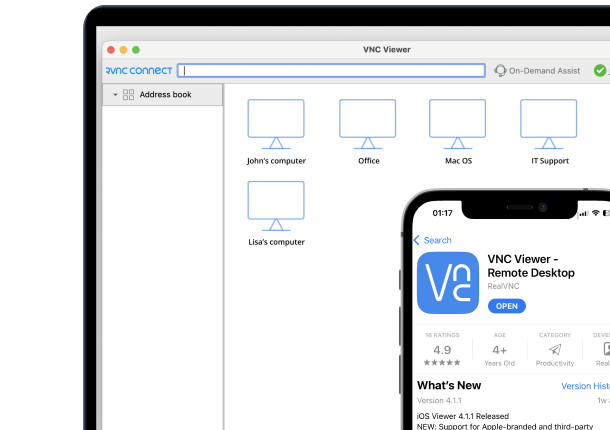
RealVNC Connect supports this governed access layer through multi-factor authentication (MFA) and single sign-on (SSO) with Microsoft Entra ID or Okta, helping organizations verify who is requesting remote access. Role-based access controls (RBAC) and granular action-based permissions let administrators limit keyboard, mouse, and file-transfer actions separately, aligning a session with the task at hand. Session monitoring gives supervisors real-time visibility into active remote-control sessions, and session recording and detailed audit logs preserve evidence of who connected, which device they accessed, when they connected, and which permissions applied. These controls support accountable support and remediation workflows when automated detection requires a person to investigate or intervene.
This is where controlled remote access fits into the future of it operations: alongside shared telemetry, bounded automation, and clear ownership. RealVNC Connect does not replace observability or incident coordination. It provides the governed access and audit-ready evidence needed when people must take action inside a resilient digital-service management model.
Final Words
The future of it operations depends on shared context, clear control, coordinated decisions, and capable teams. AI creates value when automation stays within defined boundaries and people retain accountable oversight.
RealVNC Connect adds governed remote access through MFA, role-based permissions, and audit evidence. Start a free trial of RealVNC Connect to evaluate controlled, auditable remote access for the teams responsible for resilient IT operations.
FAQs
How should leaders assess the future of IT operations?
The future of IT operations depends on four capabilities: Context, Control, Coordination, and Capability. Leaders should review service-context coverage, detection-to-decision time, bounded automation, and the share of recurring reactive work.
What is the difference between AIOps and automation?
AIOps analyzes operational data to correlate signals, detect anomalies, and support decisions; automation executes defined actions. Safe automation requires context, policy boundaries, reversibility, and clear approval rights.
Which governance frameworks apply to AI operations?
AI operations commonly combines AI-specific governance with security, risk, and service-management controls. The NIST AI Risk Management Framework Generative AI Profile (2024) calls for trustworthy-AI practices to be integrated into organizational policies and workflows.
What 5 jobs will remain after 2030?
Five job families likely to remain central are service ownership, platform engineering, security governance, site reliability engineering, and operations leadership. Their work will focus more on architecture, risk decisions, exception handling, and service improvement.
What is the future of the IT industry?
The IT industry is moving toward cloud-native services, AI-assisted operations, and stronger governance of automated decisions. Organizations will need operating models that connect technology, workforce capability, and accountable action.
How does RealVNC support governed operations workflows?
RealVNC Connect supports governed remote access with multi-factor authentication, single sign-on, role-based access controls, and granular action-based permissions. Session monitoring, recording, and detailed audit logs provide evidence for controlled support and remediation workflows.