



A line fault can leave operators waiting beside idle equipment as production leaders decide whether to pause, dispatch a specialist, or risk a hurried intervention. The delay reaches planning, maintenance, and customer commitments long before it appears in an IT queue.
Supporting remote engineers in manufacturing means giving approved specialists controlled, task-specific access to the industrial systems they need from another location. It requires access rules that reflect asset criticality, named authorization, and bounded session permissions. Local authority over physical safety and restart decisions keeps remote support focused on improving response times without creating open-ended routes into production systems.
That distinction matters: a programmable logic controller (PLC), human-machine interface (HMI), or engineering workstation does not carry the same operational consequence. A remote diagnostic session for a repeatable equipment issue may fit a defined maintenance window. A configuration change or PLC programming task needs stronger approval, a recovery owner, and coordination with the people at the plant.
This article sets out how leaders can decide where remote work fits, where onsite control must remain, and how hybrid engineering workflows should operate. It covers OT and IT boundaries, access controls for PLC and HMI work, a staged rollout model, and the governance failures that leave vendor routes, shared accounts, or session evidence without clear ownership.
Why Is Enabling Remote Engineers in Manufacturing Urgent?
A specialist may be needed at a plant hours away. Onsite staff need a direct answer now: diagnose remotely, wait for a visit, or bring in the equipment supplier. The decision affects production continuity, but it also determines who may reach a programmable logic controller (PLC), human-machine interface (HMI), supervisory control and data acquisition (SCADA) system, or engineering workstation.
Remote engineers need governed, OT-aware workflows that extend specialist reach without weakening production safety, reliability, or accountability. The program must define which assets are suitable for off-site work, who approves each session, and what evidence remains after the work ends.
The security context makes informal access difficult to defend. Manufacturing accounted for 26% of incidents across IBM X-Force’s ten most-targeted industries in 2024, marking its fourth consecutive year as the most-targeted sector (IBM X-Force 2025 Threat Intelligence Index, 2025). A plant cannot treat a support connection as ordinary employee flexibility when it reaches systems that influence physical operations.
NIST’s OT guidance states that; copying enterprise IT controls into production environments is insufficient (NIST SP 800-82 Rev. 3, 2024). The sections below set out the decision model, operating controls, rollout sequence, and governance review needed to make that distinction workable.
Why Do Remote Engineers Change the Factory Risk Model?
A remote engineering connection changes the factory risk model: it may cross from business systems into equipment control, rather than simply opening a corporate application. Each session needs a defined purpose, a bounded asset scope, and an owner who can stop work when plant conditions change.
This is where legacy routes create pressure. Dragos’ 8th Annual OT Cybersecurity Year in Review found insecure remote-access conditions, including default credentials and unpatched virtual private networks, at 65% of assessed OT sites (2025). These paths often began as practical maintenance arrangements, then remained after the original task or supplier relationship changed.
Think of broad network access as handing a contractor a master key. A governed engineering workflow is closer to issuing a time-bounded work order that names the room, task, supervisor, and return time. CISA identifies removing OT connections from the public internet and securing remote OT access as primary mitigations (CISA, 2024).
The Four Pressures Behind Governed OT Access
Local workarounds become an enterprise concern when plants, original equipment manufacturers (OEMs), and central engineering each adopt separate access methods. Cybersecurity Dive reported that more than half of OT environments contained at least four remote-access tools in an analysis of over 50,000 devices (2024). More tools mean more owners, approval paths, and evidence gaps to reconcile.
- Skills availability: Scarce controls expertise must reach the site that needs it without granting standing access everywhere.
- Service criticality: A diagnostic view of a noncritical node differs from authority to alter a production controller.
- Tool sprawl: Separate OEM and plant tools make it harder to identify the approved route for a session.
- Audit exposure: Leaders need to show who connected, what they could do, and who accepted the change.
| Legacy Remote Path | Governed Engineering Workflow | Executive Consequence |
|---|---|---|
| Shared supplier account | Named, approved individual | Clear accountability |
| Broad network route | Asset-specific conduit | Reduced reach into production systems |
| Permanent entitlement | Task-bounded authorization | Fewer stale permissions |
| Informal support record | Reviewable session evidence | Defensible change history |
The aim is not to remove needed maintenance access. It is to make each route explainable before the next urgent fault forces a hurried decision.
Which OT/IT Boundaries Enable Secure Engineering?
)
OT/IT boundaries support secure engineering when they make access follow the asset, task, and operating condition rather than the engineer’s job title. Leaders need a repeatable way to decide whether a person requires observation, diagnostics, configuration authority, or PLC programming capability.
That distinction deserves attention. Dragos’ 2025 OT/ICS Cybersecurity Report stated that 20% of OT incidents observed in 2024 involved remote-access exploitation. The reported exploitation included virtual private network exploits, remote-access applications, and Remote Desktop Protocol (RDP) paths from corporate networks. The finding does not make every remote session unsuitable; it makes broad, poorly bounded access harder to justify.
A five-part model gives OT, IT, engineering, and plant operations a shared review method:
- Asset criticality: Classify the operational consequence if the system is unavailable or changed incorrectly.
- Access path: Define the approved route from the engineer to the relevant system.
- Identity and authorization: Confirm the person, role, task, and approval behind the session.
- Session control: Set allowed actions, oversight, time limits, and evidence requirements.
- Recovery readiness: Name rollback ownership and the local authority that controls restart decisions.
Map Access to Asset Criticality
Access scope must follow service criticality, not job title alone. NIST SP 800-82 Rev. 3 identifies safety, reliability, and performance as central OT security considerations (2024), so an HMI supporting a live line warrants different controls from an edge node used for noncritical reporting.
Observation provides visibility without changes. Diagnostics permit approved investigation. Configuration changes settings within a defined boundary. Programming authority alters controller logic and requires the strongest approval, recovery planning, and local coordination. NIST’s manufacturing profile offers an illustrative one-time access policy model, but leaders must validate it against their own environment before relying on it (NISTIR 8183A-2, 2019).
| Decision Dimension | Leadership Question | Evidence to Review | Risk Signal | Design Response |
|---|---|---|---|---|
| Asset criticality | What fails if access goes wrong? | Process dependency | Live production impact | Narrow authority |
| Access path | Which route reaches the asset? | Network diagram | Broad route | Approved conduit |
| Identity | Who is requesting access? | Role and approval | Shared account | Named authentication |
| Session control | What actions are needed? | Work order | Open-ended task | Defined permissions |
| Recovery readiness | Who owns reversal and restart? | Change plan | No local owner | Stop and escalation path |
Treat the Conduit as a Controlled Work Zone
A controlled conduit is the mediated route between an approved engineer and a specific OT resource. It keeps the connection purpose-bound and reviewable instead of giving a remote user general reach across a plant network. The joint CISA, NSA, FBI, and international-partner advisory states: “All connections to OT networks are denied by default unless explicitly allowed” (Modern Approaches to Network Access Security, 2024).
Some restricted settings need an onsite handoff, especially where local staff must retain physical safety or restart authority. Others can use a segmented path with defined conditions. The FBI IC3 and partner agencies advise: “When possible, employ zero trust solutions – or least-privilege-use configuration – which can be endpoint- or identity-based” (Guide to Securing Remote Access Software, 2023).
- Approved conduit: The route is known, documented, and limited to its intended systems.
- Authenticated identity: Every session maps to a named person and approved role.
- Defined session purpose: The request names the asset, task, maintenance window, and accountable owner.
What Controls Govern Remote PLC and HMI Work?
Controls govern remote PLC and HMI work when they prove that the right person received the right authority for the right task. A policy alone is insufficient; leaders need evidence that operating teams can use the controls during planned maintenance and urgent diagnosis.
Multi-factor authentication (MFA) is the baseline for OT network access. CISA, NSA, FBI, and international partners state: “Implement multifactor authentication for all access to the OT network” (Defending OT Operations Against Ongoing Pro-Russia Hacktivist Activity, 2024). NIST SP 800-53 Rev. 5 control AC-17 requires documented restrictions and connection requirements for each permitted remote-access type (NIST SP 800-53 Rev. 5, 2020).
- Identity assurance: Confirm the individual behind every employee, contractor, and OEM connection.
- Role and action scope: Separate observation, diagnostics, configuration, keyboard and mouse control, and file transfer according to operational need.
- Just-in-time authorization: Link elevated authority to an approved maintenance window, asset, and task.
- Session oversight: Retain monitoring, recording, and audit evidence in line with service criticality.
- Exception and recovery control: Record approval, rollback ownership, and post-session review for sensitive changes.
| Control Component | Evidence or Signal | Leadership Decision Supported | Common Misread |
|---|---|---|---|
| Identity assurance | Named session identity | Who may connect | Login equals authorization |
| Role scope | Permission record | What actions are allowed | Role grants every action |
| Time-bounded access | Start and end record | When authority ends | Approval has no expiry |
| Session oversight | Reviewable session record | Whether work matched intent | Evidence is collected but unread |
| Recovery control | Change and rollback owner | Who acts after an issue | Central IT owns plant restart |
Review trends in rejected requests, elevated permissions, approved exceptions, and session evidence. Those signals show whether the program is usable and controlled. A single maturity score often hides the work that needs attention.
How Should Leaders Roll Out Remote Engineering?
Leaders should begin with bounded workflows where the plant can define the task, asset, approval owner, and safe stopping point. Remote diagnostics for a repeatable conveyor issue is a stronger first pilot than unrestricted controller programming across several sites.
External access requires particular discipline. Verizon recorded 2,305 manufacturing security incidents in its 2024 report, including 849 confirmed data-disclosure incidents, and stated that external actors were involved in 73% of manufacturing breaches (2024 Data Breach Investigations Report: Executive Summary, 2024). The point is practical: third-party identity, session purpose, and withdrawal of access need the same ownership as technical connectivity.
- Select bounded workflows: Start with diagnosable, repeatable support tasks.
- Define decision rights: Assign approval, safety, session ownership, and escalation across OT, IT, engineering, and vendors.
- Pilot one service-criticality tier: Limit the first scope to an asset class, site, or support group.
- Validate operational evidence: Review requests, session records, exceptions, and plant feedback after each maintenance cycle.
- Scale by policy: Extend only when access criteria and incident responsibilities are repeatable.
| Program Stage | Leadership Decision | Success Check |
|---|---|---|
| Workflow selection | Which task starts first? | Scope is bounded |
| Pilot | Which asset tier applies? | Local authority is clear |
| Standardization | What becomes policy? | Approval path is repeatable |
| Evidence review | What must be reviewed? | Exceptions have owners |
| Expansion | Where does scope grow? | Controls work across plants |
Consider a conveyor fault during a planned maintenance window. A remote controls engineer enters an approved diagnostic session. Local personnel retain physical safety and restart authority; the session record then links investigation activity to the maintenance request. The UK National Cyber Security Centre advises organizations to document third-party OT risk and answer key questions about parties connecting to the network (NCSC, 2024). That review determines whether the pilot is ready to expand.
Four Governance Failures in Remote Factory Access
)
Governance fails when written policy and plant practice no longer match. ISA/IEC 62443-2-1:2024 sets security-program policy and procedure requirements for asset owners operating industrial automation and control systems (International Electrotechnical Commission, 2024). Leaders need to connect those program responsibilities to the actual access paths used during maintenance and support.
- Persistent vendor access: Treat third-party connectivity as a reviewed, task-bounded exception rather than standing convenience.
- Unowned legacy pathways: Assign an accountable owner to historic modem, virtual private network, remote-desktop, and gateway routes.
- Policy-to-practice drift: Specify what rules apply to PLC programming, HMI support, engineering workstations, and emergency troubleshooting.
- Evidence without review: Set a review cadence and connect session records to change-management decisions.
NIST AC-17 requires documented usage restrictions, connection requirements, and implementation guidance for each allowed remote-access type (NIST SP 800-53 Rev. 5, 2020). If leadership cannot name the owner, approved purpose, asset scope, and review process for a route, that route needs escalation rather than another local exception.
How RealVNC Closes the Remote Engineering Gap
The gap between policy and practice appears when an approved engineer or OEM needs to reach one engineering workstation or HMI, yet the available option is a broad, persistent connection. That gap affects identity assurance, action limits, and the evidence available after a maintenance task. CISA’s OT guidance places securing remote access among its primary mitigations (CISA, 2024).
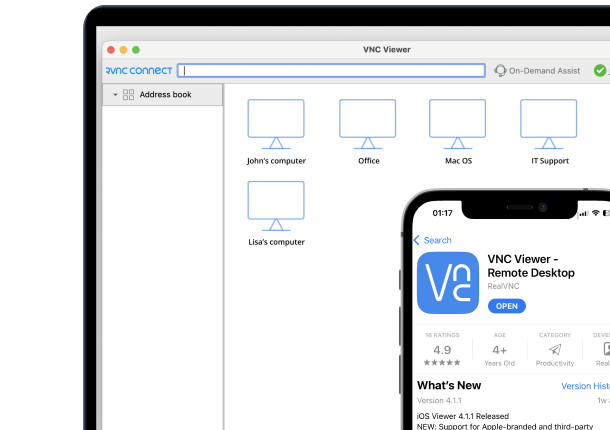
RealVNC Connect provides controls that map to governed factory-system access rather than replacing OT segmentation, asset classification, or local operating authority:
- MFA and single sign-on (SSO): Microsoft Entra ID or Okta SSO strengthens identity assurance for employees, contractors, and approved vendors.
- Role-based access controls (RBAC): Granular action-based permissions scope a session by role and task.
- Session monitoring and recording: Detailed audit logs support review, change accountability, and audit evidence.
- Code Connect: Single-use nine-digit session codes provide time-bounded third-party access without persistent credentials.
These capabilities give teams an enforceable session layer around the workflow defined by plant operations and OT governance. They align with the default-deny approach stated in the joint CISA, NSA, FBI, and partner advisory (Modern Approaches to Network Access Security, 2024): access is explicitly allowed for a defined need, rather than assumed solely from a person’s support role. The result is a clearer record of who connected, what authority applied, and when the session ended.
Final Words
Supporting remote engineers in manufacturing works when every connection follows the operational conditions around it. Start with asset criticality, then define the approved access path, named identity, session authority, and recovery owner before work begins. That approach separates remote observation and diagnostics from configuration or PLC programming that needs stronger approval and local coordination. It also gives plant leaders a practical way to move beyond inherited vendor routes, shared accounts, and open-ended access that no one can fully explain.
The payoff is controlled specialist reach without losing sight of safety, reliability, or accountability. RealVNC Connect supports that operating model with multi-factor authentication and single sign-on (SSO), role-based access controls with granular permissions, and session recording with detailed audit logs. Used alongside OT segmentation, plant decision rights, and documented review processes, those controls make each engineering session easier to authorize, oversee, and assess after the work ends. Start a free trial of RealVNC Connect to evaluate governed remote engineering workflows with the identity, authorization, and session evidence your manufacturing environment requires.
FAQs
What framework governs remote industrial engineering?
Supporting remote engineers in manufacturing requires a governance framework that maps asset criticality, access path, identity and authorization, session control, and recovery readiness. This model determines whether observation, diagnostics, configuration, or programming may take place remotely, and when onsite authority must remain. NIST SP 800-82 Rev. 3 (2024) requires security decisions to account for operational performance, reliability, and safety.
What is the difference between IT and OT remote access?
IT remote access usually reaches business applications and information systems. OT remote access may influence physical processes, equipment availability, or safe plant operation. That distinction changes approval ownership, segmentation, session permissions, and recovery procedures. CISA and its partners (2024) recommend denying OT network connections by default unless they are explicitly allowed.
What are practical examples of remote industrial engineering?
Practical examples include remote PLC diagnostics, HMI troubleshooting, engineering-workstation support, and equipment commissioning assistance. A suitable workflow names the asset, task, approval owner, maintenance window, and local person responsible for physical safety and restart decisions. Remote observation may need fewer permissions than a configuration change or PLC programming session.
What does a remote engineer do in a manufacturing environment?
A remote engineer diagnoses equipment conditions, reviews system behavior, and provides approved technical support from outside the plant. Depending on the task, the engineer may observe an HMI, investigate a PLC condition, or apply an authorized configuration change through a controlled session. Local personnel retain authority over physical interventions and production restart decisions.
Which standards inform controlled OT connectivity?
ISA/IEC 62443-2-1:2024 provides security-program policy and procedure requirements for asset owners operating industrial automation and control systems (International Electrotechnical Commission, 2024). NIST SP 800-53 Rev. 5 control AC-17 requires documented restrictions and connection requirements for each permitted remote-access type (NIST, 2020). These references structure accountability and evidence, but leaders still need asset-specific decisions.
How does RealVNC support governed factory access?
RealVNC Connect supports governed factory access with multi-factor authentication (MFA), single sign-on (SSO), role-based access controls, granular action-based permissions, session recording, and detailed audit logs. Code Connect provides single-use nine-digit session codes for time-bounded third-party support without standing credentials. These features support identity checks, task-specific authority, and reviewable remote sessions within the wider OT governance model.