



A production line can pause while an inspection system waits for a distant service to interpret a camera feed. Operators lose time, supervisors lose visibility, and a delay that looks minor in a dashboard can hold up the next decision on quality, equipment condition, or worker safety.
Edge computing in manufacturing means processing time-sensitive machine, sensor, and vision data close to the production asset instead of sending every event to a central data center. It gives local systems a defined role in immediate decisions, while cloud systems retain selected information for cross-site analysis, historical records, and model development.
That split matters because factories generate continuous images, vibration signals, machine states, and control data. Moving every raw signal away from the plant adds dependence on network availability and may place remote processing in the path of a decision that needs to happen during the production cycle. Local processing also creates more systems to maintain, secure, update, and govern across sites.
The leadership decision is therefore about workload placement, not simply buying more compute. You need to know which decisions require a local response, which data merits central retention, and who owns the operating responsibilities when connectivity changes or a system needs maintenance.
This guide explains where local processing earns its place in quality inspection, predictive maintenance, and production monitoring. It compares machine, plant, and cloud responsibilities; sets out the metrics behind a credible business case; and identifies the governance, lifecycle, and remote-access controls that keep a multi-site program repeatable.
Why does edge computing in manufacturing matter now?
Manufacturers are moving from collecting production data to deciding where it must be interpreted and acted on. Edge computing in manufacturing places immediate decisions near production assets, while centralized systems coordinate learning and analysis across sites. This is a workload-placement decision with consequences for output, continuity, and operating ownership.
A quality camera that waits for a remote response may identify a defect after the item has moved into the next production stage. When the same inspection decision happens beside the line, operators receive the result within the production cycle and can respond before more material enters the process. The question is not whether cloud processing has value; it is whether delay changes the outcome.
Adoption makes that question harder to leave implicit. The OECD’s manufacturing IoT case study found adoption among 31% of manufacturing enterprises in surveyed European countries and 22% in Canada (OECD, 2023). As connected assets multiply, data placement becomes an architectural decision rather than a series of local exceptions.
Which pressures are moving data decisions onto the factory floor?
These pressures interact. A site with heavy data flows may also have intermittent connectivity and limited specialist support, so leaders need one placement model that accounts for the full operating context. Omdia’s Industrial Edge report reported that 46% of surveyed manufacturers planned to increase edge investment over the following 18 months (Omdia, 2025).
- Decision latency: Some inspection, control, and alert decisions lose value when network delay enters the loop.
- Data gravity: Images and sensor streams are costly to move and retain when most raw data has no long-term value.
- Operational continuity: Critical workflows need defined behavior when external connectivity is unavailable.
- Workforce constraints: More local nodes create patching, support, and ownership work that each plant must absorb.
| Legacy cloud-first assumption | Modern workload-placement approach | Executive implication |
|---|---|---|
| Every event belongs in one central environment | Process locally when delay changes the production result | Fund compute where it protects a defined decision |
| More data always produces more insight | Filter raw signals and retain useful context | Set retention rules before storage costs accumulate |
| Connectivity is always available | Define local behavior during interruption | Make continuity a design requirement |
| A pilot proves the model | Test support and ownership across sites | Scale only after operating evidence is repeatable |
Cloud-first aggregation remains appropriate for many workloads. It becomes a poor default when a plant cannot explain which decisions tolerate delay, who owns local systems, and what happens during a connection interruption.
How should manufacturers divide work across edge, cloud, and fog?
Edge, fog, and cloud are complementary tiers that serve different decision horizons. Machine-edge systems act beside an asset; fog computing pools local processing at plant level; cloud systems coordinate retained data and analysis across a wider estate. A sound industrial edge architecture assigns work according to consequence, rather than treating location as a technology preference.
Think of the model as a factory receiving area: urgent items go straight to the line, shared supplies move to a local store, and long-term records go to central archives. The IEEE P2805.6 edge/cloud reference-architecture effort distinguishes cloud, edge, and network-device roles in industrial automation (IEEE Standards Association, 2026). That distinction gives IT and operational technology (OT) teams a common language for deciding where a workload belongs.
- Decision latency: Identify how quickly a validated action must occur and whether network delay changes production, quality, or safety outcomes.
- Data gravity: Assess the volume, movement cost, and sensitivity of raw machine data before deciding what leaves the site.
- Continuity requirement: Define which workflows continue through a connectivity interruption and under what approved limits.
- Coordination scope: Separate plant decisions from fleet-wide learning, benchmarking, and model development.
| Framework dimension | Machine edge | Plant/fog tier | Cloud tier | Common misread |
|---|---|---|---|---|
| Decision latency | Immediate sensing or control | Local shared response | Longer-horizon analysis | Every workload needs the fastest tier |
| Data gravity | Filter raw signals at source | Aggregate plant context | Retain selected data | Raw data must always move centrally |
| Continuity requirement | Keep defined local functions running | Coordinate site workflows | Support recovery and analysis | Local autonomy needs no controls |
| Coordination scope | One asset or line | One plant | Multiple plants and enterprise teams | Cloud and edge perform identical work |
What belongs at the machine and plant edge?
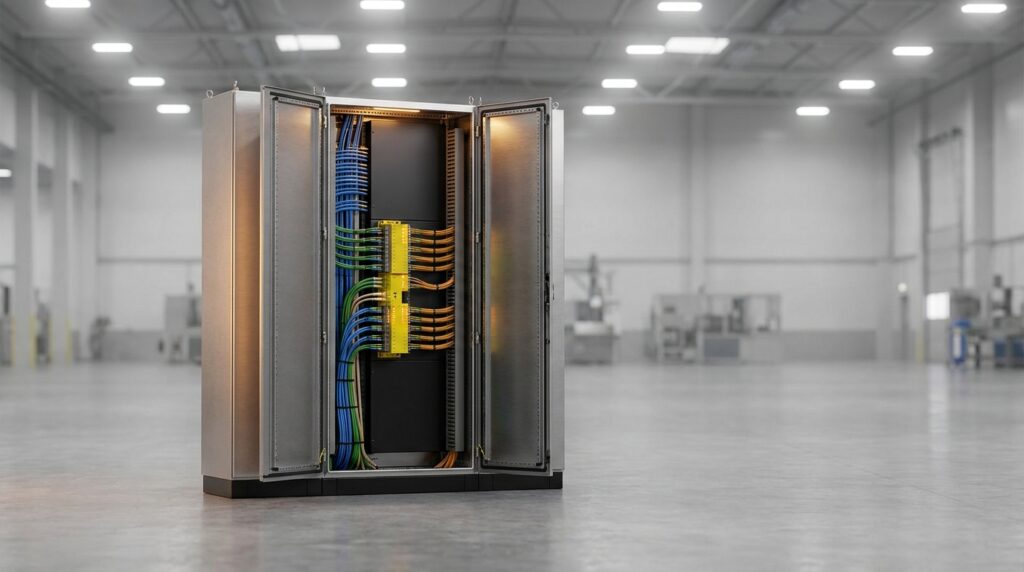
Machine-adjacent compute fits decisions where a sensor, camera, or controller needs an immediate response. It reduces travel time for data, but it also increases the number of systems that require asset records, approved updates, and support coverage.
A plant-level fog tier fits shared local workloads that do not need compute beside every machine. It pools capacity for several lines and gives teams fewer nodes to maintain, while preserving a local response path for processes that cannot depend on external connectivity. Choose this tier when shared processing meets the latency budget without adding unnecessary device management.
Which decisions still benefit from cloud-scale analysis?
Cloud capacity remains the right home for historical retention, cross-site benchmarking, broader optimization, and machine-learning model development. These workloads gain value from comparing data across facilities and retaining it long enough to identify patterns that one line cannot reveal.
The scale of connected-production investment reinforces the need for this division. Politecnico di Milano’s 2024 Industry 5.0 analysis put Italy’s Smart Factory segment at €1.04 billion in 2024, a 15% year-over-year increase (Politecnico di Milano, 2024). Central analysis turns local observations into portfolio-level learning, but it does not need to sit in the path of every immediate production decision.
What metrics make an industrial edge business case credible?
)
A credible business case measures avoided production loss and better decisions, rather than hardware cost or data throughput alone. Leaders need a baseline that connects local compute to total cost of ownership across devices, connectivity, software, support, and security controls. Otherwise, a fast pilot can look compelling without proving it will travel across plants.
The relevant measures show whether the operating model changes an outcome that matters. Microsoft’s manufacturing IIoT guidance reported a median break-even period of 20 months among surveyed organizations executing an industrial Internet of Things (IIoT) strategy (Microsoft, 2023). Treat that as context for disciplined baselining, not a payback promise.
- Time-to-detect and time-to-decide: Measure elapsed time from a machine event to validated action. This reveals whether a claimed latency requirement changes a business decision or merely makes a dashboard update faster. Compare equivalent lines and production conditions.
- Avoided quality loss: Track defects intercepted before downstream processing, rework, recall exposure, or material waste. The leadership signal is the point in the process where inspection changes the result; do not assign every quality gain to local processing.
- Continuity coverage: Measure the share of critical workflows that continue safely through a defined connectivity interruption. This separates approved local autonomy from an uncontrolled system that simply continues operating.
- Cost per actionable event: Compare transmission, storage, processing, and support costs for raw data with costs for retained insights. This prevents a narrow bandwidth case from hiding device-lifecycle expense.
| Metric | Calculation or evidence | Decision it informs | Common error |
|---|---|---|---|
| Time-to-detect | Event timestamp to validated action | Machine versus plant processing | Measuring network speed alone |
| Avoided quality loss | Defects intercepted before next stage | Inspection investment priority | Claiming all gains for one component |
| Continuity coverage | Critical workflows operating through a defined interruption | Local autonomy requirements | Treating continued operation as approved operation |
| Cost per actionable event | Full lifecycle cost divided by useful outcomes | Multi-site economic case | Ignoring support and update effort |
Inspection evidence needs the same discipline. A USA Journals account of a Siemens electronics-assembly deployment described defect identification at 60 frames per second with more than 98% inspection accuracy (USA Journals, 2026). That illustrates the measurements to test – speed, accuracy, and production context – not a result every facility should expect.
Use the metrics to decide whether to extend, redesign, or stop a program. A business case becomes credible when every plant can apply the same definitions and leadership can see where local processing changes a material operating result.
Which four steps de-risk an edge program across plants?
A multi-site program needs governance gates before it needs more devices. Start with the production decision, document the data path, assign ownership, and test whether the model works outside the pilot environment. This sequence keeps a technically sound demonstration from becoming a difficult-to-run estate.
- Step #1: Prioritize decisions, not devices. Goal: Select one or two decisions where latency, continuity, or data volume has a measurable consequence. Inputs: Process maps, production-loss data, quality requirements, and safety constraints. Decision: Choose the workflow for a pilot. Pitfall: Starting with available hardware. Success check: A baseline exists for the selected metric.
- Step #2: Define the workload-placement boundary. Goal: Record what stays machine-local, what is shared at plant level, and what moves to cloud analysis. Inputs: Latency budget, data classification, connectivity profile, and model lifecycle. Decision: Select distributed, central, or hybrid processing. Pitfall: Assuming every sensor stream needs permanent retention. Success check: Teams approve a data-flow and ownership map.
- Step #3: Establish IT-OT operating ownership. Goal: Assign accountability for updates, model changes, incident escalation, and change windows. Inputs: Asset inventory, responsibility matrix, maintenance schedules, and risk tolerance. Decision: Name owners for runtime, network, and security controls. Pitfall: Leaving support between IT and engineering teams. Success check: Every site has named owners and escalation paths.
- Step #4: Prove repeatability before scale. Goal: Test deployment, monitoring, recovery, and support across different lines or plants. Inputs: Pilot evidence, site constraints, network design, and lifecycle costs. Decision: Scale, redesign, or stop. Pitfall: Extending a heavily supported pilot without testing normal site conditions. Success check: Teams retain a standard deployment and evidence package.
Hybrid patterns often provide the clearest first test. The Connected Systems Institute at the University of Wisconsin–Milwaukee combined NVIDIA Jetson edge AI with Azure analytics for quality monitoring in an advanced-manufacturing testbed (Connected Systems Institute / University of Wisconsin–Milwaukee, 2025). The lesson is architectural: local and centralized systems can share one workflow when their responsibilities are explicit.
Lifecycle ownership needs the same attention. The U.S. Department of Defense edge-device guidance requires operators to follow hardening guidance, monitor vendor security notifications, and install security patches (U.S. Department of Defense, 2025). A repeatable program has evidence that those duties occur at every site.
The four industrial-edge risks leaders cannot outsource
Distributed compute gives plants more local decision capacity, but it also creates more assets, access paths, and change decisions to govern. Leaders cannot delegate the accountability for these choices to a device supplier or a pilot team. They need evidence that each exception has an owner, an approval path, and a defined operational boundary.
Daniel Bar, Director of OT Security Strategy at Unit 42, writes in Turning Time Into an Advantage in OT Security: “The edge is best understood as a strategic control point: the network and security layer where external connectivity, IT systems and OT environments converge.” His point is practical: local compute concentrates the need for disciplined access and asset control at the point where plant and enterprise systems meet.
- Device lifecycle drift: Hardware records, software versions, and support status diverge across sites unless ownership is explicit.
- Remote access exposure: Support sessions need approved identity, limited authority, and retained evidence.
- Unclear data and model ownership: Teams need to know who approves model changes, retained data, and rollback decisions.
- Continuity-versus-change tension: A deferred update needs documented reasoning, compensating controls, and a review date.
| Risk category | Decision-right or control | Evidence to retain |
|---|---|---|
| Device lifecycle drift | Asset owner and update process | Asset record and update status |
| Remote access exposure | Identity, authorization, and session review | Access approval and session evidence |
| Data and model ownership | Named approval authority | Change record and data classification |
| Continuity-versus-change tension | Approved exception process | Risk decision and review schedule |
The NIST Cybersecurity Framework 2.0 Manufacturing Profile states that operational continuity and product integrity must shape cybersecurity decisions, including patch deferrals and remote-access policies (NIST, 2025). The right question is whether a plant can document, approve, isolate, and compensate for an exception according to service criticality. That preserves production choice while giving auditors a clear record of why the choice was made.
RealVNC and the Factory Edge Access Problem
)
Machine-edge nodes, plant servers, vision systems, and engineering workstations all need specialist support over their lifecycle. When remote maintenance bypasses the operating model, teams lose sight of who connected, what authority they had, and whether the work aligned with an approved change window. That weakens the continuity and product-integrity expectations identified in the NIST Manufacturing Profile (NIST, 2025).
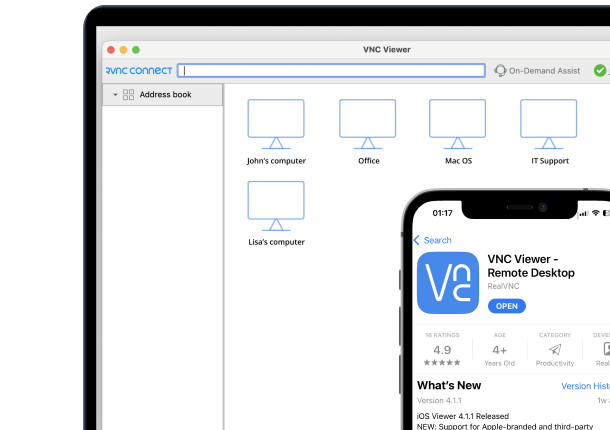
RealVNC Connect provides a controlled access layer for these production-support workflows. It does not replace industrial edge architecture or IT-OT governance; it gives teams a way to apply those decisions when support reaches a distributed system.
- Role-based access controls and granular action-based permissions: Limit support roles and separately control keyboard, mouse, and file-transfer actions for the maintenance task.
- Multi-factor authentication and single sign-on (SSO): Connect access decisions to enterprise identity practices through Microsoft Entra ID or Okta.
- Session monitoring, recording, and detailed audit logs: Retain evidence for incident review, maintenance accountability, and audit preparation.
- Cloud + Direct deployment options: Fit different connectivity and deployment models across manufacturing environments.
This matters when an engineering specialist needs access to a system outside normal on-site coverage. The U.S. Department of Defense guidance links edge-device operation to hardening guidance, security notifications, and patch activity (U.S. Department of Defense, 2025). RealVNC Connect helps IT and OT teams make remote remediation accountable: access is tied to a role, session activity is visible, and evidence remains available for review. That keeps decision rights and operational continuity visible as factory systems become more distributed.
Final Words
Start with the production decision, then place the workload where it can meet that decision’s latency, data, continuity, and coordination needs. Edge computing in manufacturing earns its place when local processing changes the outcome on the line, while cloud systems retain their role in cross-site analysis, historical data, and model development. The business case must measure time to validated action, avoided quality loss, continuity coverage, and full lifecycle cost. That gives leaders a common basis for extending a pilot, redesigning it, or stopping it before local exceptions spread across plants.
Scale also depends on operating discipline. IT and OT teams need named owners for updates, model changes, remote maintenance, and approved exceptions, with evidence that those decisions hold up across different sites. RealVNC Connect supports that controlled-access layer through role-based access controls, multi-factor authentication and single sign-on, plus session recording and detailed audit logs for maintenance accountability. When distributed production systems need specialist attention, those controls keep access aligned with change windows and make session activity reviewable. Arrange a meeting to assess how RealVNC Connect can support controlled remote access across your distributed manufacturing environment.
FAQs
What is the workload-placement framework for factory data?
Edge computing in manufacturing places workloads according to decision latency, data gravity, continuity requirements, and coordination scope. Immediate machine decisions stay close to production assets, while plant-level systems handle shared local processing and cloud platforms retain selected data for broader analysis. The IEEE P2805.6 reference-architecture effort distinguishes the roles of cloud, edge, and network devices in industrial automation (IEEE Standards Association, 2026).
What is the difference between machine edge and fog computing?
Machine edge processing runs beside an individual machine, sensor, or production line, while fog computing provides a shared processing tier at plant level. The machine tier suits immediate sensing, inspection, or control; the fog tier pools local capacity for several lines without placing compute beside every asset. This division reduces unnecessary duplication while preserving local processing for workflows that cannot depend on an external connection.
What are examples of edge computing in manufacturing?
Examples include camera-based quality inspection, machine-condition monitoring, local production alerts, and processing vibration data near equipment. A vision system might assess a product during its passage through the line, while a plant-level system aggregates results for supervisors and a cloud platform compares patterns across facilities. The right example depends on whether delay, data volume, or connectivity changes the production decision.
What skills are needed for edge computing?
Edge programs require skills across industrial networking, operational technology (OT), cloud architecture, cybersecurity, data engineering, and lifecycle management. Leaders also need people who understand production processes well enough to connect technical measures with quality, continuity, and maintenance outcomes. The strongest teams combine IT and engineering expertise, assign ownership for updates and access, and know when a workload belongs locally or centrally.
How does RealVNC evidence activity on production-support systems?
RealVNC Connect provides role-based access controls, multi-factor authentication (MFA), single sign-on (SSO), session monitoring, session recording, and detailed audit logs for controlled support workflows. These features help teams limit authority, review maintenance activity, and retain evidence about access to distributed production systems. That evidence supports accountability when remote work must align with site procedures and operational-continuity requirements.