



Managing a handful of digital signs is relatively straightforward. Managing hundreds or thousands across multiple locations is a different challenge entirely.
With digital signage remote access, IT and AV teams can monitor and troubleshoot signage players from anywhere. This helps reduce downtime while keeping deployments secure and scalable.
In this article, we’ll explain how digital signage remote access works, its core components, and the best practices for managing large-scale signage networks securely.
What is digital signage remote access?
A retail chain with screens in 200 stores has 200 different ways for something to go wrong, like offline displays in one location and a kiosk stuck on a loading screen in another.
Digital signage remote access is the ability to connect securely to a signage player or kiosk from a different location to monitor, troubleshoot, reboot, update, or directly control it, whether it’s a hospital wayfinding display or a digital sign for retail. Its primary purpose is operational support, allowing teams to use digital signage remote management to diagnose and fix issues affecting displays without needing physical access to the site.
A common misconception is that it exists solely to push content changes. In reality, content scheduling and creation are usually handled by a content management system (CMS), as defined by the U.S. Chamber of Commerce. Remote access focuses on the underlying device, operating system, network connection, applications, and hardware performance.
Modern digital signage networks often span multiple locations with different network environments. Some screens operate behind retail firewalls, while others rely on guest Wi-Fi or segmented branch networks. In these situations, secure remote access helps support teams reach devices without exposing them directly to the public internet.
Security expectations have also changed. Organizations frequently require multi-factor authentication (MFA), role-based access controls (RBAC), audit logs, and session recording capabilities to help manage access to customer-facing systems. Per a Vanta report, the organizations surveyed believe that 17% of their IT budget should be allocated to security and compliance to help address rising security expectations and tightening regulatory environments.
Key components of digital signage remote access
A remote signage environment contains several layers that work together.
The display presents content to viewers, while a media player or controller drives the screen. A CMS manages content publishing and scheduling. The remote access layer enables authorized users to inspect and control devices, and security and identity controls determine who can perform specific actions.
Separating these functions helps organizations maintain both operational efficiency and governance.
Endpoint agents and screen controller hardware
Endpoint agents are lightweight services installed on signage players that report health, online status, CPU load, storage, and software version. They enable unattended actions like remote reboots, cache cleanup, app restarts, and kiosk-mode recovery.
Controller hardware can be a Windows mini PC, a Linux appliance, an Android player, or a Raspberry Pi running a single digital sign in a hallway. The best options support over-the-air (OTA) firmware updates, thermal monitoring, and compatibility with existing tools. Remote screenshots let teams confirm the right content is actually playing, while basic AV controls like HDMI-CEC or RS-232 can check input source, brightness, schedules, and power state without a visit.
Connectivity, identity, and management layers
The connectivity layer allows support teams to access devices operating across different locations and network environments.
Many signage deployments rely on encrypted outbound connections that help maintain access to devices located behind Network Address Translation (NAT), retail firewalls, or cellular networks. This approach avoids exposing devices directly to inbound internet traffic while still enabling remote management capabilities.
Identity controls are equally important. Role-based access controls help separate responsibilities between administrators, content operators, technicians, MSP personnel, and auditors. This limits access to only the systems and functions required for each role.
Organizations increasingly use SAML-based single sign-on (SSO) and MFA to reduce credential sprawl and strengthen account security. And while 89% of organizations already use SSO, 57% still use applications that don’t support it, Bitwarden reported. Per the same report, 62% of respondents believe that SSO alone isn’t enough for secure authentication.
Audit logs and session recording provide accountability by documenting who accessed a device, when access occurred, and what actions were performed during a session.
How signage remote access differs from CMS management
A CMS and remote access tools solve different problems and usually work together rather than compete. The CMS manages playlists, campaign timing, emergency messages, and location targeting, with smaller deployments being able to operate with CMS-only management. Remote access handles device-level diagnosis, recovery, and maintenance, the parts of digital signage remote management that a CMS was never built to cover.
Core differences in day-to-day workflows
Content and marketing teams use the CMS to publish and report on what’s playing. Support teams use remote access to check the desktop, restart the player app, review logs, apply OS updates, and clear storage.
Direct device access is especially useful for unattended players spread across multiple screens in a multi-site fleet, where a technician dispatch is expensive for what’s often a five-minute fix.
Where CMS and remote access overlap
Both categories can show device status, online and offline alerts, screenshots, and device grouping.
But that overlap doesn’t mean equal depth. Remote access usually provides the deeper control needed when a player needs hands-on troubleshooting, such as diagnosing a black screen or the wrong display input. It’s worth checking how alerts, APIs, and ticketing integrations connect the two so support work stays documented.
Real-world examples of remote signage support
A retail chain with a Windows media player that freezes the morning of a promotion can have support restart the app remotely, even before doors open, instead of losing the display for a day over a problem with one screen.
A hospital can verify that wayfinding screens are showing the right routes and fix a kiosk lockup after visiting hours without disturbing patients.
A quick-service or hospitality chain running Android or Linux menu boards can schedule reboots and content pushes for off-hours so updates never interrupt service.
Managed service providers handling several customers’ signage at once across different locations rely on multi-tenant isolation and role-based access to keep each client’s fleet, and each technician’s access, properly separated. Audit logs document what changed during any of these fixes, which matters when a client asks what happened.
Where remote display access is used
Different sectors need different things from the same underlying capability. For instance, public-facing networks care most about uptime and speed of response, while enterprise and regulated environments care more about access governance and accountability.
Commercial and public-facing signage networks
Retail and franchise networks use remote access to validate promotions, fix media players, and manage regional pricing displays without leaning on local IT for every issue. Transport hubs and venues depend on reliable arrival boards, wayfinding, and event schedules, where downtime is visible to the public immediately. Sites running on cellular or shared bandwidth need scheduled content pushes and caching so updates don’t compete with daytime traffic.
Enterprise, healthcare, and managed service environments
Corporate campuses and universities use signage for dashboards, visitor messaging, safety alerts, and room information, often across buildings with their own network quirks. Healthcare settings need careful handling of access to displays that show clinic routes or patient-adjacent information. MSPs running fleets across multiple clients need multi-tenant isolation, delegated roles, and consistent enrollment.
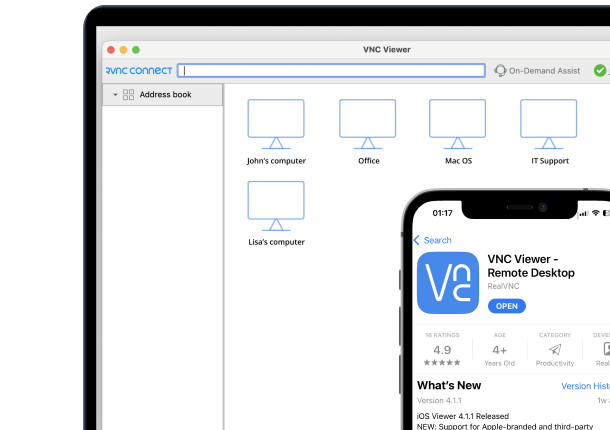
RealVNC Connect, for example, is built around this kind of cross-platform, cloud-brokered access rather than running on the cloud itself, which is one reason it shows up as a remote-session layer in MSP and enterprise signage stacks.
Future trends in connected signage networks
Fleets are growing faster than the teams managing them, which is pushing a few changes. Zero-touch provisioning and bulk enrollment matter more once a deployment reaches hundreds or thousands of screens since configuring each device by hand stops being realistic.
Edge caching is becoming standard for 4K video and low-bandwidth branches, so playback doesn’t depend on a constant connection. APIs, webhooks, and ticketing integrations are turning device alerts into actual support workflows instead of inboxes full of notifications nobody acts on.
Zero Trust principles, including MFA, SSO, least-privilege roles, and device posture check, are showing up in signage access the same way they have across broader IT security.
RealVNC Connect can support the remote-session layer in this stack, while the CMS, identity provider, and monitoring tools remain separate categories doing separate jobs.
What are the risks of remote signage access?
Remote access improves operational efficiency, but it also introduces risks that organizations must manage carefully.
Credential sprawl is the most common risk. Separate logins for local signage accounts, the CMS, MSP tools, and remote access software pile up until nobody can account for who has access to what. Weak role-based access also compounds it because it’s letting a content user perform admin tasks or a technician reach sites outside their assignment.
Unsafe port forwarding, set up to work around NAT, creates exposure that outbound encrypted connections are specifically meant to avoid.
Without audit logs, teams can’t prove who accessed a device, what changed, or whether a session was recorded, which becomes a real problem during compliance reviews. Failed OTA updates and reboot loops are operational risks worth planning for, too, with staged rollouts and rollback plans rather than pushing changes to an entire fleet at once.
RealVNC Connect addresses several of these directly, with encryption, role-based access, MFA, audit logging, and session recording built into how it governs access.
Best practices for digital signage remote access
Organizations evaluating a digital signage remote access platform should begin by understanding their current environment. A practical deployment framework includes:
- Inventory the signage estate. Document displays, media players, operating systems, locations, network segments, owners, and support contacts.
- Define user roles early. Separate responsibilities for administrators, technicians, content operators, auditors, and external service providers.
- Use secure connection methods. Favor encrypted connections, MFA, and SSO where available. Avoid unnecessary inbound exposure.
- Standardize device management. Create consistent naming conventions, site groups, ownership records, and deployment procedures.
- Plan maintenance windows. Schedule updates and reboots during periods that minimize disruption to customers and staff.
- Enable auditing and monitoring. Capture logs, alerts, and session records that support troubleshooting and compliance efforts.
- Test recovery workflows. Validate reboot procedures, update processes, access controls, and alert routing before expanding deployment.
- Run a pilot first. Testing with representative devices and locations can identify gaps before a full rollout.
A structured approach helps teams scale remote management capabilities while maintaining security and operational consistency.
Managing digital signage remote access
Managing screens across more than one site eventually turns into managing devices, not just content. The CMS handles what’s playing while remote access covers everything else, including whether a player is online, if it needs a reboot, or if the team can prove who touched it and when. Choosing the right architecture, securing access, and automating routine maintenance helps keep large deployments manageable. Anyone running signage past a handful of locations should compare how their current setup handles that layer against a signage solution built for it, whether through a trial or straightforward deployment checklist.
Frequently asked questions
How does digital signage remote access work?
It typically combines endpoint agent software on the player, a CMS or RMM platform, and a secure outbound connection such as a TLS tunnel or delay. That combination lets a team check device health, push content, reboot a player, and troubleshoot a screen without visiting it.
Can digital signage remote access work without a VPN?
Yes. Most platforms avoid traditional VPNs in favor of outbound encrypted connections or relay-based access, which reach devices without exposing them on the public internet. MFA, SSO, RBAC, and session logging cover the access-control side of that setup.
What ports are needed for remote display management?
It depends on the CMS, the player’s operating system, and the network. Most setups rely on outbound HTTPS or TLS traffic, while on-premise or direct-access models can require additional firewall rules specific to the deployment.
How do you secure remote access to signage players?
Encryption, least-privilege RBAC, SSO, MFA, and session logging cover most of it. Credential sprawl and inconsistent technician access tend to be the more common failure points and not necessarily the connection method itself.
What features matter for managing signage at scale?
Fleet-wide visibility, health alerts, OTA updates, scheduled reboots, and bandwidth-aware content delivery matter most. MSPs and enterprise teams should also check tenant separation, APIs, reporting, and support terms before committing to a platform.