


A customer question lands, but the answer sits across disconnected systems and conflicting reports. Teams spend the week reconciling numbers instead of deciding what to do next.
A data and analytics strategy is a business-aligned plan for collecting, managing, governing, and applying trusted information so leaders can act on evidence. Think of it as a shared map: every team can see which data matters, who owns it, and how it supports the destination.
This article explains how to assess your current capabilities, set measurable priorities, build governance and data literacy, and connect analytics investments to operational and strategic outcomes. It describes an iterative approach for adapting as artificial intelligence and business requirements change.
What Changes When Data Becomes a Strategic Asset?
A strategic asset is data that teams can define consistently, trust in context, and use to make accountable decisions. The change is practical: instead of producing separate reports for each function, leaders create a shared capability that connects business questions to governed information and measurable action.
The pressure is visible in everyday reporting. Strategy&’s 2026 research found that 99% of leaders struggle to define consistent business metrics across tools and departments. A common metric definition works like a financial chart of accounts: every team may analyze its own activity, yet revenue, cost, and performance still mean the same thing when leaders compare results.
A fragmented approach treats reporting as a service request. An enterprise capability assigns ownership for definitions, access, quality, and the decisions each insight informs. Gartner’s Data Governance guidance (2026) recommends adaptive, trust-based governance that aligns effort with business value rather than applying control for its own sake.
Which pressures make fragmented analytics unsustainable?
Four pressures compound the cost of a tool-by-tool response:
- AI ambition: New models need trusted inputs and accountable owners before they enter operational decisions.
- Metric inconsistency: Different definitions turn performance reviews into reconciliation exercises instead of decision forums.
- Regulatory exposure: Privacy, retention, and access obligations require defined responsibility for data use.
- Legacy integration debt: Older systems and merger-related platforms create delays when teams must join information across functions.
| Strategic dimension | Fragmented approach | Enterprise capability approach |
|---|---|---|
| Metric definitions | Teams define measures locally | Business terms have named owners |
| Data access | Requests move through separate channels | Access follows shared policy and purpose |
| Decision evidence | Dashboards show activity | Measures connect to a business decision |
| Governance | Reviews occur after disputes arise | Controls guide work before reporting spreads |
The next decision is to define the operating framework that keeps these elements connected.
Which Framework Aligns Data, Decisions, and Value?
A data and analytics strategy needs a repeatable route from a business question to a trusted decision, followed by evidence that the decision improved an outcome. Maturity is not the number of dashboards, models, or platforms in use. It is the organization’s ability to repeat that route across priorities without rebuilding the rules each time.
People remain part of that capability. Drexel University LeBow College of Business and Precisely’s 2026 report found that 51% of leaders identify skills as their leading AI-readiness need. The report found that 38% feel prepared with suitable staff skills and training. A framework gives training a practical destination: better decisions in defined workflows.
- Business Outcomes: Set the decision, owner, and result that justify investment.
- Trusted Data: Establish reliable sources, definitions, quality expectations, and stewardship.
- Decision Architecture: Design how information reaches the people and systems making decisions.
- Operating Model: Allocate decision rights across enterprise leaders and business domains.
- Value Realization: Track whether the initiative changed performance, speed, or capability.
| Framework dimension | Executive question | Evidence signal | Primary owner | Common misread |
|---|---|---|---|---|
| Business Outcomes | Which decision improves? | Named KPI and decision owner | Business leader | Treating interest as value |
| Trusted Data | Is the source fit for purpose? | Quality and stewardship evidence | Data owner | Assuming availability equals trust |
| Decision Architecture | How does insight enter work? | Defined workflow or product | CIO and product leaders | Counting dashboards alone |
| Operating Model | Who decides and escalates? | Documented decision rights | CDO and executives | Equating coordination with authority |
| Value Realization | What changed after use? | Baseline and outcome trend | Business sponsor | Reporting activity as return |
How do business outcomes set investment priorities?
Business Outcomes turns a wish for better insight into a portfolio decision. Patrick Jacolenne, Chief Data Officer and data-governance leader, wrote in LinkedIn practitioner guidance (2025): “Every pipeline, model, or dashboard should tie back to a measurable goal. If it doesn’t drive a decision, it’s just data, not insight.”
- Decision impact: Identify the business choice the work improves.
- Feasibility: Test whether teams can deliver the change within available capacity.
- Data readiness: Confirm source quality, ownership, and access.
- Risk exposure: Assess consequences when an insight is wrong or delayed.
- Time to evidence: Set when leadership expects to see an attributable result.
How does the operating model sustain the framework?
The operating model separates enterprise coordination from local accountability. The Chief Data Officer (CDO), Chief Information Officer (CIO), and risk leaders need shared authority over definitions, policy, architecture, and escalation. Domain leaders remain accountable for applying governed information to their decisions and for explaining the resulting business outcome.
The Federal CDO Council Analytics Working Group stated in The Progress and Promise of Federal Enterprise Analytics (2023): “Enterprise Analytics programs include … Align with the agency strategy and performance plan … Invest in workforce capabilities … Centralize and curate data and data products.” A federated model works when enterprise standards are firm and domain accountability is visible.
How Should Leaders Measure Analytics Value?
)
Leaders should measure whether insight changes a business decision and whether that decision improves performance over time. Activity measures still matter, but training completion, report delivery, and model deployment are leading indicators. They do not prove value on their own.
This distinction matters as AI spending grows. Deloitte’s State of AI in the Enterprise (2026) reports that 66% of organizations see productivity and efficiency gains from enterprise AI adoption. Separately, 53% report better insights and decision-making. Those outcomes need baselines, a named business owner, and a record of the decision affected.
- Business Outcomes: Measure the operational or commercial result tied to a decision.
- Trusted Data: Track whether critical sources meet agreed quality and ownership expectations.
- Decision Architecture: Measure the time from question to usable decision evidence.
- Operating Model: Review adoption within the workflow and unresolved ownership escalations.
- Value Realization: Compare attributable results with the investment and ongoing operating cost.
| Metric family | Example measure | Leadership decision supported | Common error |
|---|---|---|---|
| Business Outcomes | Change in a business KPI | Continue, adjust, or stop a use case | Measuring output without outcome |
| Trusted Data | Certified-source coverage | Fund quality improvement | Treating all data as equally material |
| Decision Architecture | Decision-cycle time | Redesign workflow | Counting reports delivered |
| Operating Model | Resolved stewardship issues | Clarify accountability | Treating attendance as adoption |
| Value Realization | Attributed performance trend | Scale the portfolio | Claiming correlation as return |
Race Reva, Chief Data Officer advisor and former CDO, wrote in “The Rise of the Real-Time CDO” (2026): “I simplify ROI into three buckets: Business impact … Decision velocity … Strategic capability.” Use those categories as prompts for evidence, rather than as a universal formula.
A scoped example shows the discipline. LeadingAge’s case study (2023) reports that Beacon Health Management automated turnover analytics and benchmarking, saving 8–10 hours per month and supporting earlier identification of turnover trends. The result supports a narrow operational decision; it does not establish a universal savings expectation.
Where Do Governance and Speed Need Balancing?
Fast access earns trust only when people understand what they are using, who owns it, and whether it fits the decision. Centralized models create consistent enterprise rules. Federated models place more responsibility with business domains. Hybrid arrangements combine shared standards with local delivery, but they require leaders to define where enterprise authority ends.
Talent capacity affects that choice. CIO Dive reported in 2023 that 19% of executives cite shortages in analytics and IT talent as a barrier to data-centric strategy execution. Smaller firms may start with a core team and limited priority domains; multi-region or regulated organizations need defined ownership, review routes, and access rules from the start.
Which controls preserve trust without blocking access?
Self-service works when controls answer distinct questions: can users find data, are they authorized to use it, is it fit for the purpose, where did it come from, and how long must it remain available? ACT-IAC’s Authoritative Data Best Practices (2025) recommends identifying trusted sources, defining quality levels and metadata, and using glossaries and catalogs to support consistent measures.
- Trusted sources: Identify approved records for material decisions.
- Business glossary: Define terms before teams reuse them in reporting.
- Metadata: Record context, ownership, and permitted use.
- Stewardship: Give named people responsibility for quality decisions.
- Quality thresholds: Set fit-for-purpose expectations for each use case.
| Operating approach | Strength | Implication |
|---|---|---|
| Centralized | Consistent policy and architecture | May delay domain-specific delivery |
| Federated | Close connection to business workflows | Requires strong common definitions |
| Hybrid | Shared controls with local ownership | Needs explicit escalation routes |
- Start with decision-critical domains rather than cataloging every record.
- Sequence literacy with practical access to governed information.
- Use master data management for shared business entities, not every dataset.
- Review whether platform investment removes a stated workflow constraint.
LeadingAge (2023) describes Parker Health Group’s enterprise program as providing self-service analytics to operational, clinical, and financial users. The useful pattern is governed access tied to different decision contexts.
What Common Failures Stall Enterprise Insight Programs?
Programs often stall after early investment as the operating choices remain unresolved. A tool-first roadmap leaves teams debating what each metric means after deployment. Generic training leaves people without a workflow where they can apply new skills. Value reports lose credibility when they cannot point to a decision and its owner.
The reset starts with sponsorship and stewardship. ACT-IAC (2025) advises a data governance council with senior leaders and senior-level sponsors for each data area. Deloitte’s data governance guidance (2026) calls for formal stewardship with ownership, escalation paths, accountability, lineage, auditability, and reproducibility across the data lifecycle.
- Tool-first sequencing: Technology arrives before the decision case and accountable owner.
- Metric ambiguity: Teams use one label for measures that answer different questions.
- Ununambiguous stewardship: Quality issues remain open since nobody has authority to resolve them.
- Skills without workflow change: Learning does not alter the decisions teams make each week.
- Unattributed value: Reported benefits have no baseline or connection to a business action.
| Failure pattern | Executive reset question |
|---|---|
| Tool-first sequencing | Which decision justifies this investment? |
| Metric ambiguity | Who owns the definition and approves changes? |
| Unclear stewardship | Who resolves quality and access disputes? |
| Skills without workflow change | Where will teams apply the new capability? |
| Unattributed value | What baseline and outcome establish value? |
Protect ongoing reporting. Reset the portfolio. Leaders need to identify the decisions that cannot wait, assign owners, and stop adding work that lacks a measurable purpose.
How RealVNC Closes the Analytics Evidence Gap
)
Trusted data depends on more than definitions, lineage, and stewardship. When internal teams or third parties investigate a data pipeline, maintain a dashboard environment, or remediate a production analytics system, the access event itself needs clear attribution and review. Without that record, a governance program may explain what data means but leave a gap around who accessed the systems that process it.
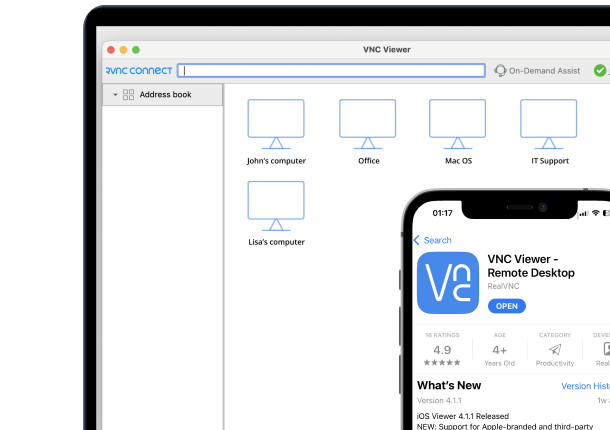
RealVNC Connect supports controlled remote-access workflows around those systems. It does not replace a data platform, catalog, warehouse, or governance framework. Instead, it provides an operational access layer that helps IT leaders apply identity assurance, least-privilege permissions, and reviewable session evidence when support work reaches sensitive analytics environments.
- Multi-factor authentication (MFA) and single sign-on (SSO): Microsoft Entra ID or Okta integration ties access to established identity controls.
- Role-based access controls (RBAC): Granular action-based permissions allow keyboard, mouse, and file transfer to be controlled separately.
- Session monitoring, recording, and detailed audit logs: Authorized administrators gain reviewable evidence of remote-control activity.
- Code Connect: Single-use 9-digit session codes provide time-bound access for third-party support without issuing standing credentials.
This approach keeps decision rights with the organization’s existing governance program. It gives support teams a more complete record when they work across production data systems and analytics infrastructure. Audit teams gain evidence that access was controlled, attributable, and available for review. That creates a more defensible operating record for analytics-adjacent work.
Final Words
A data and analytics strategy earns confidence when Business Outcomes, Trusted Data, Decision Architecture, Operating Model, and Value Realization guide each decision. MFA and single sign-on, role-based access controls, and session recording with detailed audit logs extend that discipline to remote support.
Arrange a meeting to discuss how RealVNC Connect can support audit-ready remote access across your governed IT operations.
FAQs
What is the executive framework for enterprise insight?
A data and analytics strategy aligns Business Outcomes, Trusted Data, Decision Architecture, Operating Model, and Value Realization. Maturity means repeatedly turning business questions into trusted decisions and measurable results, rather than counting dashboards or models.
What should a data strategy example include?
A useful example connects a business priority to data ownership, quality expectations, access rules, analytics use cases, and outcome measures. It names decision owners and shows how the work will progress from current state to target capability.
What belongs in a data and analytics strategy roadmap?
A roadmap sequences decisions across governance, architecture, talent, priority use cases, and measurement. Each stage needs an accountable owner, evidence of readiness, and a specific reason for moving to the next stage.
Which standards support governed data operations?
Relevant references may include ISO/IEC 27001, NIST guidance, GDPR, HIPAA, and PCI DSS, depending on sector, geography, and data type. No standard replaces business-owned decisions about stewardship, lineage, access, retention, and escalation.
How does RealVNC support governed analytics operations?
RealVNC Connect supports controlled remote access through multi-factor authentication, single sign-on, role-based access controls, and granular permissions. Session monitoring, recording, detailed audit logs, and Code Connect time-bound sessions provide reviewable evidence for support and remediation work. These controls complement data governance and analytics platforms; they don’t replace them.