


A key system misses a patch, a supplier’s access changes, and the board asks whether the business is prepared. Your team feels the pressure first, but the disruption reaches operations, revenue, and compliance fast.
Cyber risk management for IT leaders is the ongoing practice of finding, ranking, treating, and reporting cyber risks across company systems, cloud services, remote access, and third parties. Think of it as a live map of where the business could be disrupted, who owns each response, and whether the controls still work.
This article explains how to build that map through asset visibility, continuous control checks, incident planning, supplier oversight, and key risk indicators. It shows how to turn technical findings into decisions executives and directors can act on.
Why Is Cyber Risk Management Now a Governance Issue?
A board does not need another control inventory. It needs a clear view of which business services face disruption, who owns the response, and which decisions require funding or acceptance. Cyber risk management for IT leaders turns technical findings into that decision process by connecting exposure to business impact, assigned treatment, and evidence that controls operate as intended.
Fragmented ownership breaks that chain. A cloud service may sit with one team, supplier access with another, and recovery obligations with a business leader who sees neither report until an incident interrupts a customer-facing service. Revenue continuity, regulatory duties, and stakeholder confidence then depend on decisions nobody formally owns.
The pressure is growing. The World Economic Forum’s Global Cybersecurity Outlook 2025 found that 72% of respondents reported increased organizational cyber risks in 2025. That change calls for a living operating model, where leadership reviews material scenarios as business services, suppliers, technology, or obligations change.
The financial consequence gives those reviews weight: IBM’s 2024 report put the global average data-breach cost at $4.88 million. A periodic compliance exercise cannot show whether the organization is ready to make and carry out a risk decision. Governance can.
Which Framework Fits Enterprise Cyber Risk Governance?
No single framework answers every executive question. NIST Cybersecurity Framework (CSF) 2.0 provides the structure for governance and control mapping. ISO/IEC 27001:2022 and ISO/IEC 27005:2022 guide the management system and risk assessment. FAIR, or Factor Analysis of Information Risk, helps compare scenarios in financial terms. MITRE ATT&CK adds a threat-informed lens for validating assumptions.
Together, these methods create a board-ready risk operating model. Think of it like capital planning for a physical site: leadership identifies weak points, estimates the likely business consequence, funds a response, and checks whether the investment delivered the intended result. The National Institute of Standards and Technology (NIST) states: “The NIST Cybersecurity Framework (CSF) 2.0 provides guidance to industry, government agencies, and other organizations to manage cybersecurity risks.”
NIST CSF 2.0 adds the Govern function, linking oversight, policy, risk expectations, and cybersecurity strategy (NIST, 2024). That link matters. A control inventory records what exists. A governance model records who decides whether the remaining risk is acceptable.
The five decisions a risk framework must support
Use the same five dimensions in risk reviews, investment cases, and board reporting. Consistent labels stop teams from describing the same scenario in incompatible ways.
- Governance: Set decision rights, risk appetite, escalation routes, and accountable executives.
- Exposure: Identify the business service, assets, identities, suppliers, and access paths involved.
- Impact: Estimate operational, financial, regulatory, and customer consequences if the scenario occurs.
- Treatment: Select mitigation, transfer, acceptance, or retirement and assign the work.
- Assurance: Review control evidence, key risk indicators, and residual-risk movement over time.
The FAIR Institute’s 2025 State of Cyber Risk Management Report notes that mature programs use financial analysis alongside control frameworks when leaders must compare cyber scenarios with other enterprise investments. A framework is a decision architecture, not a certification checklist.
| Framework Dimension | Executive Decision It Supports | Evidence to Review |
|---|---|---|
| NIST CSF 2.0 | How policy and oversight connect to security objectives | Govern-function roles, risk appetite, control ownership |
| ISO 27001/27005 | How the management system assesses and treats risk | Scope, assessment method, treatment records |
| FAIR methodology | Whether competing scenarios justify different investment levels | Loss estimates, assumptions, confidence ranges |
| MITRE ATT&CK | Whether controls address relevant adversary techniques | Detection and response validation results |
| Risk register | Which scenarios need leadership action now | Owner, service impact, treatment status, residual risk |
The 5 Criteria for Quantifying Cyber Exposure
)
Quantification gives leaders a consistent way to compare scenarios without pretending that future loss is certain. A useful estimate combines likelihood, business impact, control strength, exposure duration, and recovery consequence, then makes its assumptions visible. That is more useful than a heatmap color with no explanation behind it.
The method must fit the decision. A qualitative rating may be enough for a local operational issue with a clear owner. A FAIR-style analysis earns its effort when leaders need to compare major investments, risk transfers, or acceptance decisions across business units. Sean Joyce, US Cyber, Risk & Regulatory Leader at PwC, writes: “Cyber risk quantification gives you the tools to clarify what matters most – and the credibility to make your case in the boardroom.”
- Likelihood: Define the scenario and the conditions that make it plausible, rather than assigning a probability to a broad threat category.
- Business service impact: Identify the revenue process, regulated data, customer commitment, or operational dependency at stake.
- Control strength: Test whether preventive, detective, and recovery controls work for the stated scenario.
- Exposure duration: Record how long a weakness, supplier dependency, or access path remains open before treatment takes effect.
- Recovery consequence: Estimate the effort and business disruption required to restore the affected service.
| Criterion | Leadership Signal | Decision Supported | Common Misread |
|---|---|---|---|
| Likelihood | Scenario plausibility | Prioritization | Treating probability as certainty |
| Service impact | Business consequence | Investment level | Counting technical assets alone |
| Control strength | Remaining protection | Treatment choice | Assuming a documented control operates |
| Exposure duration | Time at risk | Escalation timing | Measuring closure without context |
| Recovery consequence | Resilience requirement | Recovery funding | Viewing prevention as the whole response |
The FAIR Institute’s 2025 report found that nearly 45% of organizations use or plan to use FAIR. Its value is comparability, not mathematical theater. Board reports should show trend direction, assumptions, and confidence ranges so leaders understand what changed and what decision follows.
How Do IT Leaders Turn Assessment Into Treatment?
Assessment becomes management only when a named executive chooses a response, funds it, and reviews evidence that it happened. The risk register must connect each material scenario to a business service, an owner, a target date, a residual-risk threshold, and an escalation trigger. Otherwise, it becomes a list of concerns with no decision path.
Recovery belongs in the same discussion. ransomware was present in 44% of breaches, compared with 32% in the prior year, per Verizon’s 2025 Data Breach Investigations Report. That trend makes recovery capacity, restoration priorities, and tabletop exercises part of treatment evidence rather than a separate continuity document.
What belongs in a defensible treatment plan?
A defensible plan shows how leadership will know whether exposure has fallen, not simply whether a task was closed. Verizon reported that about 54% of perimeter-device vulnerabilities were fully remediated in its 2025 report (Verizon, 2025). Closure progress alone does not establish that the business service is protected.
- Executive owner: The leader accountable for the risk decision and escalation.
- Affected service: The business capability, customer process, or regulated activity at stake.
- Selected response: The chosen mitigation, transfer, acceptance, or retirement decision.
- Control milestones: Evidence dates that show when the response becomes operational.
- Residual-risk target: The remaining exposure leadership has agreed to carry.
- Review trigger: A key risk indicator or exercise result that forces reassessment.
- Mitigate: Fund controls or process changes when the residual risk exceeds appetite and the organization can reduce it.
- Transfer: Use contractual, insurance, or supplier arrangements where they meaningfully change the retained consequence.
- Accept: Record leadership approval when further treatment costs more than the reduction achieved.
- Avoid or Retire: Remove a service, dependency, or activity when no acceptable treatment path exists.
| Treatment Decision | When It Fits | Required Governance Evidence |
|---|---|---|
| Mitigate | Controls can reduce the scenario | Owner, milestones, test results, residual-risk target |
| Transfer | Another party can carry defined consequences | Contract terms, retained-risk assessment, review date |
| Accept | Remaining exposure fits approved appetite | Executive approval, rationale, monitoring trigger |
| Avoid or Retire | Exposure exceeds acceptable limits | Service decision, transition plan, closure evidence |
Hypothetical: A ransomware scenario affects a business-essential application. The register identifies the service owner, the recovery requirement, and the access paths used for remediation; leaders then test those assumptions in a tabletop exercise and decide whether to fund stronger recovery controls or retire the dependency. As the Gartner Evanta CISO Community editorial team wrote in 2025, “In 2025, CISOs made Cyber Resilience their top priority, which speaks to the need for organizations to not only withstand and respond to cyber attacks, but also to resume operations in a timely manner.”
Where Do Cyber Risk Governance Gaps Break Down?
Governance gaps usually appear where the organization changes faster than its evidence. A quarterly assessment may look complete. A new supplier, cloud workload, or remote support route can change the actual risk picture. Reassessment must follow material changes in business services, threat conditions, suppliers, and regulatory obligations rather than a calendar-only rule.
Third-party dependency deserves the same scrutiny as internally managed technology. Verizon’s 2025 DBIR reported that third-party involvement in breaches rose from 15% to 30% in the past year. A supplier review that records a questionnaire response but ignores service concentration, privileged access, and recovery dependence gives leadership an incomplete decision basis.
Reported loss trends reinforce the point without creating a universal benchmark: Resilience’s 2025 Cyber Risk Report found vendor-related failures accounted for nearly 19% of losses, with average severity of $1.36 million per incident. The board needs to see how supplier failure would affect its own services and commitments.
- Static evidence: Assessments age as systems, identities, and supplier relationships change.
- Unseen dependencies: Shadow IT and indirect suppliers leave service owners without a full map.
- Unclear decision rights: Teams identify risk but cannot obtain a treatment or acceptance decision.
- Metric theater: Dashboards count activity but can hide residual exposure and recovery readiness.
| Governance Failure | Executive Consequence |
|---|---|
| Static evidence | Funding decisions rely on an outdated view of exposure |
| Unseen dependencies | Service disruption arrives through an unplanned route |
| Unclear decision rights | Material scenarios remain open without accountable acceptance |
| Metric theater | Leadership sees completed tasks rather than changing business risk |
A useful board metric shows movement: aging material scenarios, overdue treatment milestones, supplier concentration against priority services, or repeated recovery-test findings. Those measures give leadership a reason to intervene before an operational event makes the gap visible.
How RealVNC Closes the Cyber Risk Evidence Gap
)
Remote access often sits inside the treatment workflows described above. During incident response, vulnerability remediation, third-party support, and evidence collection, teams need to show who reached a device, what access they received, and whether the session followed the approved route. Without that record, the risk register may show a treatment decision. The operational evidence may remain scattered across teams.
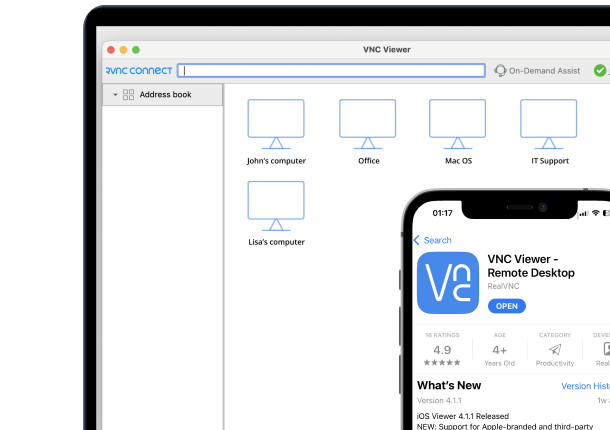
RealVNC Connect provides controls for that defined access surface. Role-based access controls (RBAC) assign permissions by role, and granular action-based permissions separately govern keyboard, mouse, and file-transfer activity. Multi-factor authentication (MFA) and single sign-on (SSO) with Microsoft Entra ID or Okta connect remote access to established identity controls. Session monitoring, recording, and detailed audit logs give authorized administrators evidence of who connected, when, from where, and with which permissions. Code Connect uses single-use 9-digit session codes for time-bound third-party access rather than standing credentials.
These controls do not replace the NIST CSF 2.0, FAIR analysis, supplier oversight, or board decisions described in this framework. They give the executive security-risk program a clearer record for remote support and remediation activity, where access governance must be visible to service owners and auditors. That makes remote-session evidence easier to review alongside treatment milestones, residual-risk targets, and incident findings.
Final Words
Cyber risk management for IT leaders works when frameworks, quantified scenarios, owned treatments, and board reporting stay connected as conditions change. That discipline turns control evidence into decisions.
RealVNC Connect adds MFA, single sign-on (SSO), role-based access controls, and detailed audit logs for governed remediation access. Arrange a meeting to review controlled, auditable access for your treatment workflows.
FAQs
What is the framework for cyber-risk governance?
Cyber risk management for IT leaders starts with five linked decisions: governance, exposure, impact, treatment, and assurance. NIST Cybersecurity Framework 2.0 provides the governance and control structure. FAIR adds financial comparison when leaders assess investment or risk-acceptance choices (NIST, 2024; FAIR Institute, 2025).
What is the difference between risk assessment and treatment?
Risk assessment estimates a scenario’s likelihood, business consequence, and remaining exposure. Treatment chooses and funds a response, assigns an owner, sets a review trigger, and validates whether the response reduced the stated risk.
How should cyber risk be reported to the board?
Board reporting should connect changing exposure to affected business services, treatment progress, residual risk, and the decision leadership needs to make. Scenario trends and material indicators provide more useful direction than counts of completed controls.
How can leaders build a practical cyber-risk process?
A practical process links each material scenario to an accountable owner, treatment choice, target date, residual-risk threshold, and review trigger. Reassess the register when business services, suppliers, threat conditions, or regulatory obligations change.
How does RealVNC support cyber-risk treatment workflows?
RealVNC Connect supports governed remediation and third-party access through multi-factor authentication (MFA), single sign-on (SSO), role-based access controls, and detailed audit logs. Code Connect adds time-bound 9-digit session codes, helping teams record and review short-lived support access without treating RealVNC as a replacement for enterprise risk governance.