


A storage limit is reached, a department buys its own application, and the service desk is asked to respond. Without agreed priorities, urgent work keeps displacing the technology changes the business needs.
Creating an IT strategic plan means setting a three-to-five-year direction for technology investment, capabilities, and governance that directly supports business goals. It defines what IT needs to achieve and when; tactical plans determine how individual teams deliver the work.
This article explains how to understand business priorities and competitors, assess the current IT environment, define the target strategy, prioritize gaps, and build a governed roadmap with measures tied to business outcomes.
Why does creating an IT strategic plan matter now?
A board can approve more technology funding and still lack a direct view of what that funding changes for the business. Creating an IT strategic plan turns enterprise priorities into governed capabilities, initiatives, investment choices, and outcome measures. It gives leaders a traceable reason to fund one change, defer another, and hold an owner accountable for the result.
The tension is visible in Grant Thornton’s Shift your tech strategy: 93% of business leaders reported increasing technology investment, yet 27% said technology was fully aligned with business goals (Grant Thornton, 2025). More spend does not settle the alignment question. Your plan must connect each material investment to a business capability, service criticality, risk tolerance, and named executive decision.
Project-led funding often starts with a system request, then searches for a strategic rationale. Business-capability planning starts with the outcome the organization needs to deliver, such as faster customer onboarding or reliable regional service, then decides which technology changes deserve funding. That distinction gives the CIO a defensible position when priorities compete.
The investment pressures behind strategic planning
Investment scrutiny: Finance needs a direct link between spend and expected business value. Legacy debt: Older platforms consume capacity that growth initiatives need. Cyber resilience: Security work must sit inside portfolio choices rather than operate as an isolated queue. Cross-functional demand: Departments need a visible route for needs that otherwise become shadow IT.
Spiceworks and Aberdeen Strategy & Research’s State of IT Report 2026 found that 64% of companies planned to increase IT budgets in 2025 (Spiceworks and Aberdeen Strategy & Research, 2024). That pressure makes decision rights visible: leaders need to know who recommends an investment, who funds it, and who owns the business result.
| Project-Led Planning | Business-Capability Planning | Executive Consequence |
|---|---|---|
| Funds a requested application | Funds an agreed business need | Spend has a stated rationale |
| Measures delivery dates | Measures outcome change | Reviews focus on value, not activity |
| Handles dependencies late | Maps dependencies before approval | Fewer portfolio surprises |
| Assigns ownership to IT alone | Names business and IT owners | Accountability reaches beyond delivery |
A plan earns boardroom credibility when every major initiative has a reason that leadership can explain without opening a project schedule.
What belongs in an enterprise technology planning framework?
A complete enterprise technology planning framework links Business Outcomes, Current State, Future State, Capability Gaps, Investment Portfolio, and Governance Cadence in one traceable chain. The chain prevents a project inventory from becoming the strategy as every initiative must show which outcome it advances, what constraint it addresses, and how leaders will review progress.
Think of the framework as a rail network map. Business outcomes are the destinations, capabilities are the routes, investments are the trains, and governance is the timetable that prevents every team from choosing its own track. The map does not decide every trip. It makes the choices and dependencies visible before money is committed.
Enterprise architecture and governance answer different questions. The Open Group Architecture Framework (TOGAF) helps leaders test whether architecture choices fit together over time. Control Objectives for Information and Related Technologies (COBIT) helps define decision rights, controls, and accountability. Neither framework supplies your strategy; each gives structure to decisions that remain specific to your operating model.
Business outcomes through capability gaps
Start with the business result, then describe the capability required to achieve it. A growth objective may require a customer-service capability that handles greater demand across channels; it does not automatically require a particular application. The Current State records what teams, data, architecture, and operating practices can deliver today. The Future State describes the needed capability; Capability Gaps identify what prevents the move.
Security belongs in that same chain. CyberEdge Group’s 2023 Cyberthreat Defense Report found that 87.7% of respondents expected their IT security budget to increase in 2023, with average growth of 5.3% (CyberEdge Group, 2023). Treat cyber resilience as a portfolio constraint with an owner and value case, rather than a separate technical workstream.
Artificial intelligence spending needs the same discipline. ISG’s Market Lens™ 2026 Cybersecurity Report reported that AI-related cybersecurity budgets represented more than 11% of total cybersecurity spending among surveyed enterprises (ISG, 2026). Leaders need a stated business benefit, risk owner, and review criteria before funding it.
Portfolio choices and governance cadence
The Investment Portfolio converts prioritized gaps into funding choices, resource commitments, and sequencing. Governance Cadence defines when leaders revisit those choices, test assumptions, and handle exceptions. KPMG’s Strategic IT & Business Alignment: The CIOs Guide argues that enterprise objectives must translate into measurable technology outcomes (KPMG, 2025).
Use the six elements consistently:
- Business Outcomes: State the enterprise result technology must advance.
- Current State: Establish evidence about present capabilities and constraints.
- Future State: Describe the capability required at the target horizon.
- Capability Gaps: Identify the difference between present and required performance.
- Investment Portfolio: Decide what to fund, defer, retire, or investigate.
- Governance Cadence: Set owners, review points, and exception routes.
| Framework Element | Key Executive Question | Evidence Input | Decision Output |
|---|---|---|---|
| Business Outcomes | What result must change? | Corporate strategy | Sponsored outcome |
| Current State | What limits delivery now? | Architecture and operating evidence | Agreed baseline |
| Future State | What capability is required? | Growth and service needs | Target boundary |
| Capability Gaps | What prevents progress? | Gap analysis | Ranked constraints |
| Investment Portfolio | What receives resources? | Value, cost, and dependency evidence | Funding choice |
| Governance Cadence | When do assumptions change? | KPI and event signals | Review decision |
The result is a plan leaders can revise without losing the logic behind its investment choices.
Which five steps turn strategy into a funded roadmap?
)
The sequence for creating an IT strategic plan moves from enterprise outcomes to evidence, capability gaps, portfolio choices, and governance. It does not start with a preferred technology and build a justification around it. That order keeps strategic intent ahead of vendor selection and delivery pressure.
Strategy states the capability direction, priority logic, and investment rationale. A roadmap sequences the approved initiatives that deliver it, including dependencies, decision gates, and ownership. Alan Thorogood, Research Leader at MIT Center for Information Systems Research, told CIO.com: “The top priority for 2025 is to change your IT operating model to fit your organization’s needs, which have surely changed recently.”
- Step 1: Define enterprise outcomes and planning guardrails – Set a strategic charter using corporate strategy, customer commitments, regulatory obligations, and financial constraints. Select a limited set of business outcomes with an executive sponsor. Do not turn every departmental request into a strategic objective.
- Step 2: Assess the current state – Build an evidence-based view of architecture, applications, data, cybersecurity, suppliers, talent, operating model, and shadow IT. A strengths, weaknesses, opportunities, and threats (SWOT) analysis helps expose constraints, but an asset inventory alone does not explain delivery capacity.
- Step 3: Define the future-state capability vision – Describe the capabilities and guiding principles the business needs. Use the growth model, customer expectations, resilience requirements, and enterprise architecture as inputs. A product list is not a capability vision.
- Step 4: Execute a gap analysis and prioritize initiatives – Compare present capability with the required state, then rank gaps by outcome impact, risk effect, dependency, cost, and delivery feasibility. Each selected initiative needs a measurable hypothesis and a direct outcome link.
- Step 5: Draft the roadmap and strategic charter – Sequence work around dependencies, resource limits, funding assumptions, and decision gates. Each initiative needs an accountable owner, time horizon, funding path, and measure before portfolio approval.
| Step | Primary Output | Executive Decision | Success Check |
|---|---|---|---|
| Define outcomes | Strategic charter | Approve outcome set | Each outcome has a sponsor |
| Assess current state | Evidence baseline | Confirm constraints | Leaders accept the baseline |
| Define future state | Capability vision | Set target boundaries | Business and IT use shared terms |
| Prioritize gaps | Ranked initiative set | Fund or defer choices | Each choice maps to an outcome |
| Draft roadmap | Governed sequence | Approve portfolio | Owners and measures are named |
The U.S. Office of Personnel Management’s 2023–2026 Information Technology Strategic Plan illustrates the principle by pairing objectives with timelines and performance measures monitored by its Office of the Chief Information Officer (OPM, 2023). Use directional evidence and defined ownership rather than artificial scoring precision.
How should leaders prioritize technology trade-offs?
Prioritization is a portfolio decision, not a contest between the loudest requests. Compare initiatives by their contribution to business outcomes, risk and resilience effect, strategic dependencies, total cost of ownership, and organizational capacity to absorb change. A credible matrix makes the trade-off visible to finance, security, and business leaders.
Which criteria belong in the prioritization matrix?
Business-outcome contribution asks what material result changes if the initiative succeeds. Risk and resilience effect considers service continuity, regulatory obligations, and control gaps. Dependency removal tests whether work supports other investments. Total cost of ownership covers ongoing operating and supplier costs. Change capacity asks whether teams can adopt the change without putting critical services under strain.
Resilience deserves explicit treatment: it changes the viable investment set. Industrial Cyber’s report on PwC’s 2026 Global Digital Trust Insights states that 60% of organizations are increasing cyber-risk management investment in response to geopolitical volatility (Industrial Cyber, 2025). That does not dictate your allocation, but it does show why resilience cannot sit outside portfolio governance.
Wendy Collins, Chief AI Officer at NTT DATA, told CIO.com: “The best AI strategies are anchored to a business’ core strategic objectives and are focused on driving business benefit beyond operational efficiency.” Apply that test before creating a separate funding lane for AI work.
Where do portfolio trade-offs differ by context?
Regulated enterprises may place greater weight on control evidence and mandated resilience. Organizations carrying substantial legacy infrastructure debt may prioritize dependency removal before customer-facing improvements. Growth-oriented firms may accept more delivery uncertainty where a capability directly supports market expansion. The same matrix works across those contexts, but the weight assigned to each criterion must reflect the organization’s strategy and risk tolerance.
The National Institute of Standards and Technology’s Cybersecurity Framework 2.0 places governance within enterprise risk management through its Govern function, including roles, policies, and strategy alignment (NIST, 2024). A quick-win lens often misses architecture dependencies and vendor lock-in exposure that later restrict choice.
| Prioritization Criterion | Question for the Investment Committee | Common Misread |
|---|---|---|
| Business outcome | Which result changes? | Activity equals value |
| Risk and resilience | What exposure changes? | Security is separate from strategy |
| Dependency removal | What work does this enable? | Enabling work has no value |
| Total cost of ownership | What continues after delivery? | Initial price is total cost |
| Change capacity | Who must adopt this? | Approval equals readiness |
Before board review, confirm:
- Outcome link: Each proposal states the business result it advances.
- Cost and risk assumptions: Financial and control assumptions are explicit.
- Dependency visibility: Prerequisite work and supplier constraints are visible.
- Named decision owner: One executive owns the funding recommendation.
That preparation turns a funding meeting into a decision about choices, rather than a debate over disconnected requests.
When should an IT strategic plan be reviewed?
A plan stays useful when governance distinguishes stated alignment from actual decision rights. Teams may agree that business and IT priorities align, yet still lack influence over where the technology budget goes. Cisco’s How Aligned Are Business and IT Priorities? found that 70% of business leaders reported alignment, yet 67% said IT would influence less than half of the following year’s business technology budget (Cisco, 2023).
Use an annual strategic refresh as the formal point to test direction; periodic portfolio reviews examine delivery evidence, funding changes, and dependencies. Event-triggered reassessment is appropriate after an acquisition, regulatory change, material cyber event, major market shift, or change in business strategy. The review rhythm must protect strategic choices without allowing every urgent request to rewrite them.
- Decision rights: Identify who recommends, approves, funds, and owns outcomes.
- Review cadence: Separate periodic delivery and portfolio reviews from the annual strategy refresh.
- Exception path: Define how regulatory, incident, acquisition, or market changes trigger reassessment.
- Communication model: Publish a practical plan for teams and restricting sensitive architecture, risk, and commercial details.
| Outcome Area | Leading Indicator | Lagging Indicator | Accountable Executive |
|---|---|---|---|
| Service reliability | Priority remediation progress | Service availability | CIO |
| Cyber resilience | Control review completion | Material control findings | Security leader |
| Modernization | Dependency retirement progress | Operating cost change | Technology leader |
| Customer value | Capability adoption | Customer retention trend | Business sponsor |
Gartner’s IT Strategy Toolkit: Build a Successful Strategic Plan frames review around four questions: whether the strategy remains valid, execution plans remain valid, the strategy is working, and plans are being executed correctly. Oregon Department of State Lands and the U.S. Consumer Product Safety Commission offer useful public examples of measurable governance targets and outcome-linked scorecards. The board needs evidence that the plan guides decisions between formal refreshes.
How RealVNC Closes the IT Strategic Planning Execution Gap
)
A roadmap may set modernization objectives, risk guardrails, service outcomes, and ownership, but those commitments still depend on controlled work on the systems where change occurs. Distributed teams and external specialists need access during support, remediation, and operational events. Without traceable access, a technology governance charter has a gap between approved intent and daily execution.
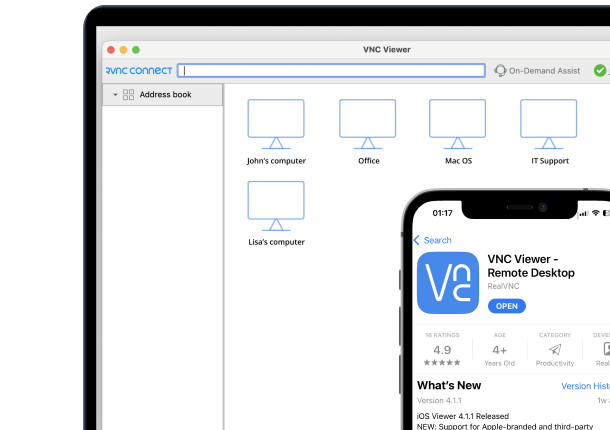
RealVNC Connect supports accountable remote-access workflows adjacent to that execution. It does not replace portfolio governance or strategic ownership. It gives IT leaders controls that make support activity easier to authorize, oversee, and evidence:
- Multi-factor authentication and single sign-on (SSO) with Microsoft Entra ID or Okta: Align remote-access authorization with enterprise identity controls.
- Role-based access controls and granular action-based permissions: Separate keyboard, mouse, and file-transfer permissions according to the person’s role and task.
- Session monitoring, recording, and detailed audit logs: Create traceable evidence for remote support, operational change, and incident-response review.
- Code Connect with 9-digit time-bound session codes: Provide controlled temporary access for external support participants without issuing standing credentials.
Those controls matter when a portfolio initiative depends on hybrid operations or third-party participation. An approved change may need a specialist to inspect a remote device, yet the organization still needs to show who connected, under which permissions, and for what approved purpose. Access governance keeps that evidence connected to the owner and decision path already defined in the plan.
The Oregon Department of State Lands set a published target for all IT changes and investments to follow its governance process by July 1, 2026 in its Information Technology Strategic Plan 2023–27 (Oregon Department of State Lands, 2023). The U.S. Consumer Product Safety Commission’s Strategic Plan 2023–2026 uses scorecard measures for uptime, delivery, and vulnerability response (U.S. Consumer Product Safety Commission, 2025). RealVNC Connect helps make the support activity behind those measures accountable and reviewable.
Final Words
Creating an IT strategic plan gives leadership a disciplined way to move from business outcomes and current-state evidence to capability gaps, funding choices, and a roadmap with named owners. The work holds when portfolio decisions test value, resilience, dependencies, and change capacity together, then return to those assumptions through planned reviews.
That discipline matters in daily operations, where approved modernization and resilience commitments depend on controlled work across distributed teams and external specialists. RealVNC Connect brings multi-factor authentication, role-based access controls, and session monitoring with detailed audit logs to those remote-support workflows, so leaders can connect operational activity to the decision rights and evidence their governance model requires. Book a 30-minute demo to see how these controls map to your strategic execution needs.
FAQs
What framework supports creating an IT strategic plan?
Creating an IT strategic plan requires a traceable framework linking business outcomes to capabilities, investments, ownership, and measurable results. It should connect the current state, future state, capability gaps, investment portfolio, and governance cadence rather than treating a project list as the strategy.
What is the difference between IT strategy and a roadmap?
An IT strategy defines the required capabilities, priorities, risks, costs, and investment logic. A roadmap sequences approved initiatives, dependencies, decision gates, and delivery timeframes; it changes as delivery assumptions shift.
What should an IT strategic plan template include?
An IT strategic plan template should include business outcomes, a current-state assessment, future-state capabilities, gap analysis, portfolio priorities, decision rights, measures, and review triggers. Use it as a decision record, not as a substitute for executive judgment.
What are useful IT strategy examples?
Useful IT strategy examples show how technology choices advance a defined business result, such as resilient customer service or controlled modernization. Compare each example by its outcome, constraints, ownership, investment logic, and measures rather than copying its initiative list.
How often should technology strategy be refreshed?
Technology strategy should receive a formal annual refresh, supported by periodic portfolio reviews and event-triggered reassessment. Mergers, regulatory changes, material cyber events, major market shifts, or a changed business strategy warrant earlier review.
How does RealVNC support strategic-plan governance?
RealVNC supports governed remote-access workflows through multi-factor authentication, single sign-on, role-based access controls, granular permissions, session monitoring, recording, and detailed audit logs. Code Connect adds temporary third-party access through time-bound 9-digit session codes, helping leaders connect support activity with accountable evidence.