


A migration program can look orderly on a roadmap until one overlooked dependency delays a customer-facing service or leaves a critical team without access. The disruption reaches far beyond infrastructure.
Cloud migration planning is the deliberate process of deciding which applications, data, and services move to a cloud environment, in what order, and under which security, cost, and continuity controls. It connects business goals with workload dependencies, regulatory duties, risk tolerance, and a tested route for keeping core operations available.
This guide explains how to assess readiness, choose among the seven Rs, select a deployment model, set measurable baselines, and stage work safely. It covers cost governance, compliance accountability, disaster recovery, vendor dependence, and the operating practices that keep the new environment performing after cutover.
Why Is Cloud Migration Planning a Governance Issue?
A migration portfolio fails when workload decisions, security controls, and budget approvals move on separate tracks. Cloud migration planning gives executive sponsors one decision model for deciding what moves, who accepts exceptions, and what continuity evidence is required before each cutover.
A credible cloud migration blueprint assigns decision rights before delivery teams begin moving workloads. It sets a financial baseline, defines service interruption tolerances, and makes exceptions visible to the people accountable for customer commitments. Think of the portfolio as an airport departure board: every workload has a destination, dependency constraints, a departure sequence, and an explicit decision to delay when conditions are unsafe.
Which forces make migration governance urgent?
- Cost accountability: Executives need a named owner for forecast assumptions, resource demand, and post-cutover spend.
- Regulatory boundaries: Data residency and sovereignty obligations determine where a workload may run and where backups may reside.
- Interdependency risk: Workload owners must show which systems, identity services, and data flows need to move together.
- Operational continuity: Sponsors need agreed rollback conditions before customer-facing or business-critical services enter a wave.
| Planning Lens | Project-Centric Approach | Portfolio-Governed Approach |
|---|---|---|
| Workload choice | Teams nominate systems independently | Leaders classify systems against shared evidence |
| Financial control | Cost review follows migration | Budget ownership begins before wave approval |
| Exceptions | Decisions sit in delivery conversations | Sponsors record and accept material exceptions |
| Continuity | Cutover plans vary by team | Common gates define rollback and acceptance |
Centralize the guardrails: financial assumptions, risk acceptance, and continuity standards. Workload owners still own the evidence for their services. That division prevents a migration program from becoming a queue of technical moves with no shared accountability.
Which 7Rs Create a Defensible Migration Portfolio?
The 7Rs migration framework turns workload disposition into a repeatable executive choice. It classifies each application according to the evidence behind its value, condition, dependencies, and future role, rather than allowing organizational preference to decide its destination.
The seven options are rehost, replatform, refactor, repurchase, relocate, retain, and retire. A single approach across every application usually carries existing cost, technical constraints, or operating exposure into the target environment. Novas Arc wrote Novasarc in 2026: “The most cost-efficient cloud migration strategy in 2026 is a hybrid approach using the 7 Rs framework (Rehost, Replatform, Refactor, Repurchase, Retire, Retain, Relocate), combined with mature FinOps practices for real-time cost optimization.”
How should leaders classify each workload?
Start with evidence, then select the disposition. A migration discovery assessment must inventory applications, datasets, infrastructure, security controls, skills, dependencies, compliance needs, and business objectives. Rehosting moves a service with few code changes; replatforming makes targeted architectural changes; refactoring substantially redesigns code, data, or architecture.
- Business criticality: Identify customer, revenue, safety, or regulatory consequences if the service is unavailable.
- Technical fitness: Assess maintainability, support status, and whether the application can operate in its intended environment.
- Dependency density: Map identity, data, integration, and operational connections that constrain sequencing.
- Risk and compliance: Identify data classes, access requirements, and obligations that shape the target design.
- Economic case: Compare migration effort and ongoing operating cost with the value the service provides.
| Dimension | Evidence to Gather | Decision Signal | Likely 7R Outcomes | Common Misread |
|---|---|---|---|---|
| Business criticality | Service owner, outage effect, recovery need | Material business interruption | Retain, replatform, refactor | Critical means immediate migration |
| Technical fitness | Support status, code condition, architecture | Limited future viability | Retire, repurchase, refactor | Old always means retire |
| Dependency density | Interfaces, identity paths, data flows | Sequencing constraints | Retain, relocate, replatform | One application equals one move |
| Risk and compliance | Data class, jurisdiction, access evidence | Control requirements | Retain, replatform, refactor | Provider controls settle every duty |
| Economic case | Effort, run cost, contract terms | Clear value or duplication | Rehost, repurchase, retire | Lowest initial cost wins |
A lightly integrated service with little business differentiation may suit repurchase or retirement. A revenue-critical system with many dependencies needs a deliberate disposition, even when its eventual destination is clear. Retaining a workload is disciplined when the evidence shows that its migration conditions are not yet acceptable.
When does modernization justify refactoring?
Refactoring earns its investment when measurable product delivery, resilience, regulatory, or maintainability outcomes depend on a redesigned service. Modernization potential and modernization urgency are different decisions; a system may benefit from redesign without belonging in the next wave.
For cloud-native services, the National Institute of Standards and Technology’s SP 800-228 guidance identifies API protection as a formal design concern. Leaders need to assess API exposure, authentication, authorization, and control requirements before approving a refactor. That keeps architecture ambition tied to an operating outcome.
How Do You Sequence Migration Waves Without Disruption?
)
Migration waves should prove readiness in smaller, repeatable groups before the program moves business-critical services. A workload enters a pilot, standard wave, or exception track only after its dependencies, landing zone, continuity plan, and operating ownership meet the required gate.
Cloud spending makes that discipline material. Flexera’s State of the Cloud Report reports that 76% of large enterprises spend more than $5 million monthly on public-cloud services. The point is not that every enterprise needs the same threshold; it is that migration sequencing and financial accountability cannot be separated.
- Dependency and data-flow validation: Confirm upstream, downstream, identity, data-transfer, and operational dependencies before assigning a workload to a wave.
- Landing-zone readiness: Verify identity controls, network segmentation, logging, backups, environment standards, and policy ownership.
- Pilot and continuity proof: Define performance baselines, failover expectations, rollback conditions, and business-owner acceptance criteria.
- Financial and operating acceptance: Confirm tags, budgets, forecast ownership, support coverage, and post-cutover accountability.
| Wave Gate | Required Inputs | Executive Decision | Failure Signal |
|---|---|---|---|
| Dependency validation | Data flows and integration map | Approve sequencing | An upstream service remains untested |
| Landing-zone readiness | Control ownership and environment evidence | Approve target environment | Required controls lack an owner |
| Continuity proof | Baselines, rollback plan, acceptance criteria | Approve pilot or cutover | Recovery conditions are undefined |
| Operating acceptance | Budget, tags, support model | Accept post-cutover ownership | Spend or service ownership is unclear |
Benjamin Thomas, Chief Technology Officer at Sedai, put the financial gate plainly in 2026: “Build cost guardrails before migrating: budgets, tagging policies, resource lifecycle rules, & automated rightsizing.” Wave confidence matters more than an aggressive count of completed moves, as each proven wave supplies evidence for the next decision.
What Makes a Cloud Migration Project Plan Executable?
An executable cloud migration project plan is an executive control document that records who decides, what evidence is required, and who owns the service after cutover. A timeline alone cannot resolve a disputed security exception, an untested rollback, or a budget assumption that fails after a workload begins consuming cloud resources.
The FinOps Framework defines cloud financial management as collaboration among engineering, finance, and business stakeholders, with teams taking ownership of cloud usage and unit cost. That principle gives central teams a defined role: set common guardrails. The teams creating demand remain accountable for its cost and value.
The operating controls behind predictable waves
- Decision rights: Name the executive sponsor, workload owner, security authority, and cutover approver.
- Cost ownership: Record forecast assumptions, resource tags, budget variance review, and the owner of unit-cost decisions.
- Security exception handling: Document the control gap, compensating measure, expiry date, and acceptance authority.
- Business continuity authority: Define who may pause, reverse, or accept a cutover when service conditions change.
- Value-realization review: Compare the original case with performance, spend, and service outcomes after migration.
- Define the workload scope and its business outcome.
- Record dependency evidence and the selected 7R disposition.
- Set security, continuity, and acceptance criteria.
- Assign budget assumptions and post-cutover service ownership.
- Schedule steering reviews around evidence gates, not calendar milestones.
| Control Area | Accountable Owner | Evidence for Steering Review |
|---|---|---|
| Workload disposition | Service owner | Classification rationale and dependency map |
| Financial control | Finance and product owner | Forecast, tags, variance ownership |
| Security controls | Security authority | Required controls and approved exceptions |
| Continuity | Business sponsor | Rollback conditions and acceptance criteria |
| Post-cutover operations | Operations owner | Support model and performance review |
Ravi Shankar, Cloud Strategy Lead at Tarento, wrote in 2026: “FinOps embedded from day one, with cost ownership in the product teams that consume the cloud.” Amazon Web Services’ Fanatics Commerce case describes plans to move 1,800 servers across five data centers, with a case-specific projection of 48% infrastructure-cost savings. Scale does not remove the need for accountable owners; it makes their evidence more important.
Where Do Cloud Migration Risks Concentrate?
Migration risk belongs in workload selection and wave design, where leaders still have choices about sequence, target environment, and acceptance conditions. Treating risk as a late approval step leaves sponsors choosing between delay and unmanaged exposure after technical commitments are already in place.
- Identity and access: Define privileged access, least privilege, separation of duties, and the evidence required before sensitive workloads move.
- Data residency and sovereignty: Map data classes, processing locations, backup locations, and jurisdictional obligations.
- Continuity and recovery: Specify cutover, rollback, recovery sequence, business communications, and test ownership.
- Portability and lock-in: Record proprietary dependencies, data-export options, contract implications, and alternate designs.
- Legacy compatibility: Identify unsupported integrations, protocols, licensing assumptions, and operating dependencies early.
A hybrid, private, public, or multicloud model is a context decision, not a default answer. Compare the models using data residency, latency or legacy dependencies, control requirements, operating capability, and portability needs. The National Institute of Standards and Technology’s SP 800-207 guidance states that cloud-native, multicloud access governance must use a Zero Trust model rather than implicit network trust. That requirement affects sequencing; identity architecture and access evidence need to exist before sensitive services enter a target environment.
Keep a migration risk register as a living steering artifact. For each material issue, record the affected workload, accountable owner, decision deadline, mitigation, residual exposure, and acceptance authority. A register that changes with the waves gives executives a usable view of what the program is asking them to accept.
How RealVNC Closes the Cloud Migration Execution Gap
)
Migration-wave governance can break down when remote access during validation, cutover, and remediation sits outside the identity and evidence model. Support teams, infrastructure specialists, application owners, and approved third parties often need access to both legacy and target systems during testing of landing-zone readiness and continuity gates. That activity needs the same decision rights and review trail as the rest of the program.
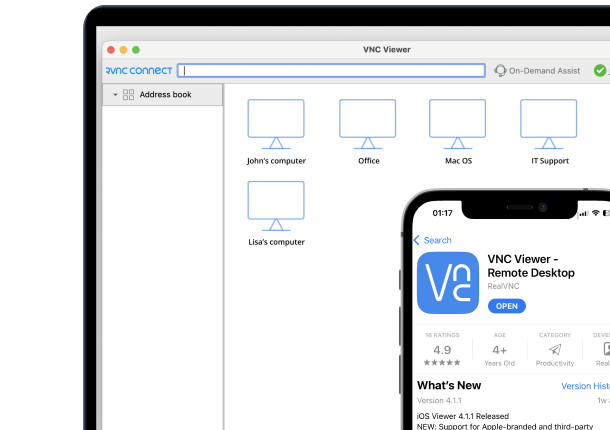
RealVNC Connect provides a controlled remote-access option for teams carrying out that work. It maps practical access controls to migration operations:
- Multi-factor authentication and single sign-on (SSO) with Microsoft Entra ID or Okta: Align approved access with enterprise identity policies.
- Role-based access controls and granular action-based permissions: Limit keyboard, mouse, and file-transfer privileges by migration role.
- Session monitoring, recording, and detailed audit logs: Create reviewable evidence for cutover, remediation, and security-compliance workflows.
- Cloud and Direct deployment options: Accommodate cloud-connected and internally controlled environments.
The need extends beyond the migration event. Russell Moore, Chief Information Officer at VC3, wrote in 2026: “Treat the financial management of your cloud resources as an ongoing discipline and not just as a one-time estimate.” The same operating discipline applies to access: teams need remote support and remediation activity to remain attributable, constrained, and reviewable as post-cutover ownership takes hold.
Final Words
Cloud migration planning works when leaders classify workloads, prove readiness, govern each wave, and retain accountability after cutover. Leaving those decisions disconnected turns delivery pressure into continuity and cost exposure.
RealVNC Connect supports controlled migration work with single sign-on, multi-factor authentication, role-based access controls, and session evidence. Arrange a meeting to map auditable remote access to your migration operations.
FAQs
How should executives assess migration-program maturity?
Cloud migration planning is mature when portfolio decisions, wave gates, and post-migration ownership operate as one repeatable governance system. Executives should review workload decisions, dependencies, budget assumptions, security controls, rollback procedures, and post-cutover outcomes together.
What is the 7Rs framework for workload migration?
The 7Rs classify workloads as rehost, replatform, refactor, repurchase, relocate, retain, or retire. Leaders use business value, technical condition, migration effort, risk, and future requirements to select a defensible disposition for each workload.
What is the difference between rehosting and refactoring?
Rehosting moves an application with few code changes. Refactoring substantially changes its code, data, or architecture. Rehosting usually prioritizes speed and continuity; refactoring suits cases where long-term maintainability or cloud-native capabilities justify greater investment.
Which governance frameworks apply to cloud transitions?
Relevant references include NIST SP 800-207A for Zero Trust access control and the FinOps Framework for shared ownership of cloud usage and unit-cost decisions. ISO 27001, SOC 2, GDPR, HIPAA, and PCI DSS apply according to the organization’s obligations and data, so they require context-specific controls rather than a universal checklist.
How does RealVNC Connect support controlled migration work?
RealVNC Connect supports approved migration personnel with multi-factor authentication, single sign-on with Microsoft Entra ID and Okta, and role-based access controls. Session monitoring, recording, detailed audit logs, and Cloud and Direct deployment options provide controlled access and reviewable evidence during validation, cutover, and remediation.