


A stalled rollout rarely starts with a technology failure. It starts when ownership is unclear, a key specialist holds critical knowledge, or a hybrid team lacks a shared way to resolve competing priorities.
Building a high-performing IT team means creating clear outcomes, trusted working patterns, and continuous learning so people can make sound decisions without constant supervision.
This article explains how CIOs can set that direction as they balance generative AI adoption, stakeholder alignment, employee development, and operational stability.
Why Is Building a High-Performing IT Team Urgent?
A technology strategy can look sound on paper, yet delivery slows in the places executives feel last: missed commitments, unresolved service issues, and business teams waiting for decisions. A high-performing IT team repeatedly delivers secure, reliable business outcomes. It preserves the learning capacity and sustainable workloads needed to keep doing so. That requires leaders to design the conditions for good judgment, rather than relying on constant supervision.
Engagement puts that design challenge in view. Gallup reported in 2025 that 32% of U.S. employees were engaged at work, a signal that clear direction and meaningful work cannot be assumed. When people do not understand priorities or escalation routes, hybrid delivery turns ordinary dependencies into delays.
The pressure reaches beyond the IT function. Business leaders expect reliable services, responsible generative AI adoption, and informed technology partnership at the same time. Your operating model needs to make ownership, decision rights, and capability gaps visible before they interrupt delivery.
That starts with a more useful question than whether individuals are busy: does the team have the structure and shared context to deliver the outcomes the business needs?
What Defines a High-Performing IT Team Today?
A strong technology team combines reliable delivery with the ability to learn, adapt, and make decisions close to the work. It measures success through service quality, secure change, customer adoption, and business results – not ticket closure or project activity alone. The standard must reflect your service criticality, regulatory duties, and workforce model.
Think of the team as an operating system in a company. Individual applications matter, but performance depends on how roles, decision rights, feedback loops, and dependencies work together. A skilled specialist cannot compensate for unclear ownership between product, platform, security, and service teams.
Capability scarcity makes that distinction practical. The UK Department for Science, Innovation and Technology reported in 2025 that 49% of UK businesses identified a basic technical cyber-security skills gap. Leaders need to know where critical capability sits, who can cover it, and when work requires an escalation.
- Business alignment: Define outcomes in terms business stakeholders can recognize, such as adoption, service reliability, or risk reduction.
- Operational resilience: Build coverage for critical systems so absence or turnover does not leave one person carrying a service.
- Learning capacity: Reserve time to build skills, review incidents, and absorb changing technology demands.
- Decision clarity: Place routine choices with the team and name the decisions that require executive involvement.
| Legacy Team Assumption | Outcome-Led Team Design | Executive Consequence |
|---|---|---|
| Project completion proves success | Adoption and service results define success | Leaders review value after release |
| Specialists own knowledge alone | Teams document and share critical knowledge | Dependency risk becomes visible |
| Activity metrics show productivity | Flow, quality, and stakeholder outcomes are reviewed together | Performance discussions gain context |
| Managers resolve most decisions | Boundaries guide local decisions and escalation | Delivery moves without informal approval chains |
This definition shifts the conversation from individual effort to the conditions that let capable people work well together.
How Should Leaders Design Roles and Decision Rights?
)
Roles and decision rights need to show who owns an outcome, who provides supporting expertise, and who settles trade-offs when priorities collide. A workable design gives delivery teams room to act and retains executive control over service criticality, investment choices, and material operational exposure. The goal is fewer ambiguous handoffs, not a more elaborate organization chart.
The Team Topologies framework described by Matthew Skelton and Manuel Pais offers a useful lens: stream-aligned, platform, enabling, and complicated-subsystem teams serve different purposes. It is not a universal blueprint. Use it to examine cognitive load – the amount of knowledge and coordination a team must carry to complete its work – before adding another dependency.
A capability map belongs beside the organization chart. Pluralsight’s 2025 Tech Skills Report found that 48% of IT professionals had abandoned projects due to insufficient technology skills. That figure does not prescribe a hiring plan, but it does show why leaders need evidence of coverage for critical services and emerging work.
- Outcome ownership: Assign one accountable leader for each service or business outcome, with clear measures and stakeholder relationships.
- Team boundaries: Define where a team begins and ends so platform requests, security reviews, and product decisions do not circulate without an owner.
- Capability coverage: Identify skills that are critical to service continuity, then document knowledge and cross-train staff where dependency is concentrated.
- Decision rights: State which choices teams make locally, which require consultation, and which must move to senior IT leadership.
| Framework Dimension | Leadership Question | Evidence to Review | Failure Signal |
|---|---|---|---|
| Outcome ownership | Who is accountable for the service result? | Service objectives and stakeholder feedback | Several teams assume another group owns the decision |
| Team boundaries | Which work belongs inside this team? | Handoffs, queues, and dependency patterns | Work waits for repeated approvals |
| Capability coverage | Where does knowledge sit today? | Skills map, documentation, and succession plans | One specialist is needed for routine recovery work |
| Decision rights | Who resolves priority conflicts? | Role charters and escalation records | Teams negotiate the same dispute repeatedly |
Specialization earns its place when it reduces complexity for the rest of the organization. It becomes a liability when it creates a permanent queue around one expert or one platform team.
Which KPIs Reveal IT Team Performance?
Useful IT performance metrics show whether work creates value without exhausting the people delivering it. Leaders need a balanced view of outcome attainment, flow, service stability, capability resilience, and team health. One measure cannot explain sustainable performance, especially when teams support different services and customers.
Aggregate engineering data is available, but it needs local interpretation. Worklytics’ review of 2025 benchmarks draws on LinearB’s benchmark data covering more than 2.6 million pull requests from 3,000+ teams in 50+ countries. That scale is useful for understanding what can be measured; it does not create a universal target for your organization.
- Outcome attainment: Track whether priority work improved the agreed business or service result. Use it to decide what to fund next. Do not treat a completed delivery plan as proof of value.
- Flow and throughput: Review how work moves from commitment to use. Use it to find queues and repeated handoffs. Do not reward volume when teams are splitting work into smaller units merely to raise counts.
- Service stability: Review incidents, recovery patterns, and change quality. Use it to decide where reliability work needs investment. Do not read a quiet period as evidence that underlying service debt has disappeared.
- Capability resilience: Review critical-skill coverage, documentation quality, and succession exposure. Use it to target development or redesign. Do not confuse a skills inventory with demonstrated ability to support a live service.
- Team health and retention risk: Review workload signals, friction, and employee feedback. Use it to intervene before sustained pressure becomes attrition. Do not turn pulse data into individual surveillance.
RedMonk’s account of DORA 2025 recommends considering throughput and stability alongside friction, burnout, individual effectiveness, and time spent on valuable work. Segment the results by service, team mandate, and change type before setting expectations.
| KPI Category | What It Signals | Data Source | Common Misread |
|---|---|---|---|
| Outcome attainment | Whether work changed a business or service result | Product, service, and stakeholder reviews | Assuming release equals value |
| Flow and throughput | Where work waits or moves smoothly | Delivery-system data | Treating volume as productivity |
| Service stability | Reliability under normal operations and change | Service-management records | Ignoring recurring patterns |
| Capability resilience | Depth of support for critical work | Skills maps and coverage reviews | Counting courses instead of readiness |
| Team health and retention risk | Whether the operating pace is sustainable | Feedback and workload reviews | Using aggregate signals to judge individuals |
The executive test is straightforward: every metric must lead to a decision about priorities, staffing, service design, or operating practice.
How Do Leaders Build Skills, Trust, and Retention?
Skills development and trust are operating requirements. Teams cannot raise concerns, challenge a weak assumption, or share incomplete knowledge if speaking up carries a personal cost. Psychological safety means people can contribute concerns and ideas without fear of social penalty; it does not remove accountability for results. It makes early escalation possible.
Amy C. Edmondson, Novartis Professor of Leadership and Management, told Harvard Business School Working Knowledge in 2023: “In a nutshell, it’s about making honest statements that make clear that you value others’ voices.” That standard is visible in how leaders respond when a team surfaces a missed assumption, a capacity limit, or a disagreement about priorities.
- Write role charters and outcome expectations: Set the goal, authority, dependencies, and escalation route for each role. Review them when services or priorities change. A vague title is not a role charter.
- Hire for learning agility and collaboration: Assess how candidates reason through unfamiliar problems and work across specialties. Technical depth matters, but isolated expertise creates avoidable dependency.
- Map critical skills and cross-train for resilience: Identify skills tied to important services, then pair documentation with practice. The success check is whether another qualified person can take the work when needed.
- Run feedback and incident-learning rituals: Hold structured reviews that examine decisions, signals, and process gaps. The CIPD’s 2024 evidence review recommends mastery goals alongside performance targets, so development remains part of the work.
- Set sustainable hybrid-work norms: Agree on response expectations, meeting purpose, documentation habits, and protected focus time. Flexibility without shared norms leaves employees to negotiate availability one message at a time.
These practices give leaders a practical basis for deciding whether to hire, develop talent, automate routine work, or redesign the work itself.
Where Do High-Performing IT Teams Break Down?
)
Capable teams lose momentum when operating habits leave important work to informal negotiation. Hero dependency, unprioritized demand, distorted metrics, and weak hybrid norms are design conditions that leaders can correct. They become persistent when nobody owns the intervention.
Learning reviews offer an early route back to control. Edmondson, writing for Harvard Business School Working Knowledge, describes the first step plainly: “It might be as simple as organizing a team meeting to understand why something went wrong and gleaning lessons for next time.” Use that review to identify the decision, handoff, or missing information that made the issue likely.
- Hero dependency: Critical knowledge sits with one person. The consequence is fragile service coverage; leaders need documentation, paired work, and planned skill transfer.
- Conflicting priorities: Stakeholders submit competing work without a shared ranking method. The consequence is hidden delay; leaders need a visible forum that resolves trade-offs.
- Metric distortion: Teams optimize the count. Reporting it is easier than reporting the outcome. The consequence is activity without improvement; leaders need balanced measures and narrative review.
- Unmanaged hybrid friction: Decisions remain in meetings or private messages. The consequence is uneven context; leaders need documented decisions and predictable escalation routes.
| Anti-Pattern | Operational Risk | Governance Response |
|---|---|---|
| Hero dependency | Service knowledge becomes concentrated | Set coverage expectations and review them |
| Conflicting priorities | Teams work on the loudest request | Use an agreed prioritization forum |
| Metric distortion | Activity replaces outcome focus | Pair measures with service and stakeholder evidence |
| Unmanaged hybrid friction | Context fragments across channels | Record decisions, owners, and escalation paths |
CIPD’s 2023 evidence review identifies team-building, teamwork training, debriefs, and goal-setting as interventions associated with stronger team effectiveness. The point is to correct the operating condition, not assign blame.
How RealVNC Closes the High-Performing Team Gap
Autonomous teams still need controlled ways to reach production, operational, and user systems during support and remediation work. Without agreed access routes, a remote session can become an undocumented intervention, and a useful handoff can depend on private knowledge rather than a repeatable process. That weakens the decision clarity and knowledge sharing described throughout this framework.
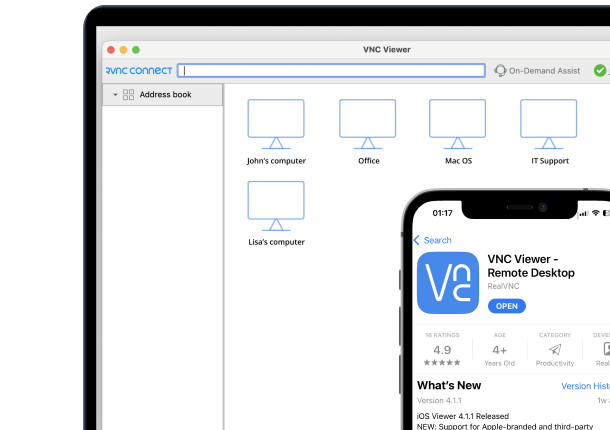
RealVNC Connect supports governed remote-support workflows without replacing your IT operating model. Role-based access controls (RBAC) and granular action-based permissions let leaders separate keyboard, mouse, and file-transfer access, so authorization reflects the task rather than a broad standing entitlement. Multi-factor authentication (MFA) and single sign-on (SSO) with Microsoft Entra ID or Okta align remote access with established identity practices. Session monitoring, session recording, and detailed audit logs make support activity visible to authorized administrators, creating evidence of who connected, when, and with which permissions.
Those controls support a practical management outcome: teams can collaborate on remote work and preserve accountable access and usable operational records. Cloud-brokered and Direct deployment options let organizations select an architecture that fits their environment. RealVNC Connect does not create trust, role clarity, or sound prioritization on its own; it gives distributed IT teams a controlled channel for the support work that depends on them.
Final Words
Building a high-performing IT team starts with the work your people need to own: clear outcomes, defined decision rights, capability coverage, and measures that connect delivery to service results. When those conditions are in place, teams can surface concerns early, share knowledge, and resolve competing priorities without waiting for informal approval.
The same discipline needs to extend into remote support and remediation. RealVNC Connect combines role-based access controls (RBAC), granular permissions, and session recording with detailed audit logs, so authorized staff can work together and leaders retain evidence of access decisions. Arrange a meeting to assess how RealVNC Connect fits your governed remote-support workflows and helps your distributed teams keep operational work accountable.
FAQs
What is a high-performing team?
Building a high-performing IT team requires clear outcomes, shared accountability, learning capacity, and sustainable workloads. The team measures service and business results alongside delivery activity, so leaders can see whether work creates value.
What are five characteristics of a high-performing team?
Five common characteristics are clear goals, defined roles, open communication, constructive feedback, and continuous learning. These qualities work together; individual expertise cannot compensate for unclear ownership or weak coordination.
What are the 4 C’s of high-performing teams?
One commonly used 4 C’s lens is clarity, communication, collaboration, and commitment. Treat it as a discussion tool rather than a universal standard, then test each area against service outcomes and decision rights.
What are examples of high-performing teams?
Examples include a service team that restores critical systems through shared procedures and a platform team that reduces repeated work for delivery teams. The defining evidence is consistent business value, knowledge sharing, and dependable operating practice.
Which governance practices matter for hybrid IT teams?
Hybrid IT teams need explicit decision rights, shared working agreements, and outcome-based measures so issues surface early regardless of where people sit. Anchor reviews in regular debriefs and clear ownership rather than presence-based supervision, and keep escalation paths identical for on-site and remote members.
How does RealVNC support high-performing IT teams?
When an escalation reaches a distributed team, RealVNC Connect supports controlled remote access through multi-factor authentication, single sign-on with Microsoft Entra ID and Okta, role-based access controls, and granular permissions. During post-incident review, session monitoring and recording, plus detailed audit logs, give authorized leaders evidence for accountable handoffs and remediation workflows.