



When a plant network issue stops a production line, the consequences spread fast. Operators lose visibility, engineers pause changes, and leadership must protect continuity while preserving the safe operation of connected equipment.
Industrial cybersecurity compliance standards are the laws, sector rules, and technical frameworks that define how an organization protects operational technology (OT). They guide controlled access, network separation, incident readiness, and audit evidence, while recognizing that a routine IT action may interrupt industrial control systems, programmable logic controllers, or supervisory control and data acquisition (SCADA) environments.
That distinction changes how assurance work gets done. An aggressive scan, an untested patch, or a broad remote-access permission may disrupt a legacy asset that operations depend on. Cloud services, Industrial Internet of Things devices, and external support connections also mean plant networks need clear boundaries, accountable owners, and records that show why access occurred.
This guide explains how ISA/IEC 62443, NIST SP 800-82 Revision 3, NERC CIP, NIS2, NIST Cybersecurity Framework 2.0, and ISO/IEC 27001 serve different purposes. It then sets out a practical route for inventorying assets, mapping IT-to-OT connections, defining trust zones, governing supplier access, and retaining evidence that auditors can inspect without disrupting production.
What makes OT compliance different from IT compliance?
Industrial controls must protect cyber resilience while preserving safe, continuous physical operations. In operational technology (OT), a control that looks routine in corporate IT can disrupt a production process when it reaches a legacy controller, an engineering workstation, or a safety-related dependency. Industrial cybersecurity compliance standards therefore need evidence that safeguards work without interrupting plant operations.
The connection between IT events and plant operations makes this a leadership concern. TxOne Networks’ 2024 Annual ICS-OT Cybersecurity Report found that 94% of surveyed organizations reported OT incident risk, while 98% of those organizations experienced IT incidents affecting OT. The European Commission recorded 12,762 cybersecurity incidents reported by EU Member States for 2024, compared with 1,077 in the preceding year (European Commission / NIS Cooperation Group, 2025).
The pressures reshaping plant-floor assurance
Consider a shift handover: an engineer would not alter a running process without checking the permit, current conditions, and responsible owner. Active scanning needs similar review in OT. A scan that queries an older controller too aggressively may interrupt communications that production staff depend on.
- Convergence: Corporate networks, cloud services, and connected equipment create paths between business systems and plant assets.
- Availability: Process continuity and safety constraints shape when controls can be tested, changed, or patched.
- Third-party access: Original equipment manufacturers, integrators, and support providers need narrowly governed access.
- Reporting accountability: Leaders need evidence that access and response controls operated as approved.
| Dimension | Enterprise IT default | Industrial/OT decision context |
|---|---|---|
| Primary consequence | Data or service interruption | Process interruption, safety exposure, and production loss |
| Change approach | Frequent automated updates | Engineering review, maintenance windows, and compensating controls |
| Asset ownership | Central IT administration | Shared ownership across operations, engineering, suppliers, and IT |
| Audit evidence | Policy and system records | Records tied to assets, process consequence, approvals, and access activity |
A policy-led program is not enough. Leaders need an operating model that joins engineering judgment with repeatable control evidence.
Which standards belong in an OT compliance model?
No single standard covers every industrial requirement. Effective programs layer binding obligations, OT-specific engineering practices, and enterprise governance around shared controls, then test applicability by jurisdiction, sector, contract, and asset criticality.
That distinction prevents a common planning error: treating every framework as if it creates the same duty. The ISA/IEC 62443 Series of Standards describes requirements and processes for implementing and maintaining electronically secure industrial automation and control systems. NIS2, NERC CIP, CMMC, and Transportation Security Administration directives may impose duties for in-scope entities, while NIST Cybersecurity Framework (CSF) 2.0 and ISO/IEC 27001 give leaders a common way to govern controls.
Four layers of industrial assurance
Your control model needs four labels that remain consistent across sites and audits. The six NIST CSF 2.0 functions – Govern, Identify, Protect, Detect, Respond, and Recover – help connect these labels to business decisions (National Institute of Standards and Technology, 2024).
- Legal obligation: A law or nationally implemented requirement that applies to the organization or facility.
- Sector rule: An industry-specific duty, such as NERC CIP for cyber assets essential to the North American Bulk Electric System.
- OT engineering baseline: Architecture and lifecycle practices, including IEC 62443 and NIST SP 800-82 Revision 3.
- Enterprise governance overlay: Risk ownership, assurance reporting, internal audit, and cross-framework control mapping.
ENISA’s perspective is useful here. Juhan Lepassaar, Executive Director of the European Union Agency for Cybersecurity, said: “The ENISA NIS360 gives valuable insight into the overall maturity of NIS sectors and the challenges of individual sectors. It explains where we stand, and how to move forward.”
Use the framework as a crosswalk, not a replacement
A crosswalk connects one control to several relevant requirements. Think of it as one maintenance record filed against several inspection obligations, rather than separate maintenance work for each form. NIST’s CSF 2.0 Informative References support relating CSF Categories to other standards and guidelines.
The OWASP OT Project mapping table shows how OT risk items relate to CSF 2.0 Categories. That mapping reduces duplicated evidence collection, but it does not confirm legal compliance. Legal, safety, and engineering owners must still validate local requirements and control operation.
| Framework or rule | Primary purpose | Typical scope | Executive owner | Evidence to retain |
|---|---|---|---|---|
| NIS2 | Legal cyber-risk duties | In-scope EU entities under national law | Executive management and legal | Risk decisions, incident procedures, supplier records |
| NERC CIP | Electricity-sector reliability requirements | Bulk Electric System assets | Compliance and operations leadership | Access records, perimeter evidence, incident reports |
| CMMC | Contractual assurance for U.S. defense work | Covered contractor information and systems | Security and contract leadership | Assessment records and control evidence |
| IEC 62443 | Industrial security engineering | Automation systems and components | OT engineering leadership | Zone design, requirements, and test records |
| NIST SP 800-82 Rev. 3 | OT security guidance | Industrial control environments | Security and OT leadership | Architecture decisions and compensating controls |
| NIST CSF 2.0 / ISO/IEC 27001 | Risk governance and management system | Enterprise and site governance | CIO, CISO, and internal audit | Risk register, policies, reviews, and audit findings |
How do leaders map controls to audit evidence?
)
Audit-ready controls link each obligation to an owner, a technical or procedural safeguard, and time-stamped evidence that the safeguard operated. This approach shifts the discussion from whether a policy exists to whether leaders can reconstruct decisions, exceptions, and performance at a particular site.
Accurate asset knowledge comes first because evidence has little value when it cannot be tied to a controller, workstation, application, or connection. Nozomi Networks’ OT & IoT Security Report reported that CISA issued 196 industrial control system advisories from July 1 through December 21, 2023, covering 885 new and existing vulnerabilities affecting industrial products.
- Asset and dependency inventory: Record plant assets, software, owners, network relationships, and process dependencies before setting control priorities.
- Identity, access, and remote-session control: Tie access to named identities, approval rationale, permitted assets, and a defined end point.
- Zones, conduits, and segmentation: Document trust boundaries and the justified communication paths between them.
- Vulnerability and change-risk management: Use maintenance windows, engineering approval, and compensating controls where a direct update is unsafe.
- Monitoring, incident response, and recovery evidence: Retain records that show detection, escalation, response decisions, and restoration activity.
| Control domain | Leadership decision supported | Evidence artifact | Common interpretation error |
|---|---|---|---|
| Asset inventory | Investment and ownership priority | Asset register and dependency map | Counting devices without recording process consequence |
| Access governance | Approval and exception authority | Identity, authorization, and session records | Treating shared accounts as accountable access |
| Segmentation | Trust-boundary funding | Zone design and approved communication paths | Assuming a firewall rule proves isolation works |
| Change governance | Legacy-system risk acceptance | Change review and compensating-control record | Applying enterprise patch cycles without engineering review |
| Response and recovery | Resilience readiness | Exercise records, event logs, and recovery decisions | Measuring plans rather than tested performance |
The Federal Energy Regulatory Commission’s CIP audit lessons state that entities need to account for inbound and outbound access permissions, document the reason for access, and deny other access by default. The Valmet example in this 2023 SSRN research also illustrates why engineering evidence needs to accompany standards-aligned work.
Maturity scores have value when they show direction and decision priorities. They fail when they replace site-specific review of exceptions, process consequence, and accountable ownership.
Build an industrial compliance roadmap around risk
A roadmap works when decision rights come before technology selection. Start by identifying which sites, processes, and connections create the greatest operational consequence, then assign the people who can accept exceptions or fund corrective work.
The case for sequencing is clear: Fortinet’s 2024 State of Operational Technology and Cybersecurity Report found that 73% of organizations reported intrusions affecting OT systems only or both IT and OT. The same report found that 31% reported six or more intrusions during the previous year. A global manufacturer, regulated utility, and specialist operator will begin from different baselines, but each needs one accountable process for prioritization.
- Set applicability and risk boundaries: Identify relevant legal duties, contracts, critical assets, and site-specific safety constraints.
- Assign accountable owners and escalation rights: Define where IT, OT engineering, legal, safety, procurement, and executive authority meet.
- Create one obligations-to-controls register: Map each requirement to a control owner, evidence record, review cadence, and exception route.
- Validate critical workflows under realistic conditions: Test incident response, vendor support, and recovery activities without placing active operations at risk.
- Review changes, exceptions, and supplier exposure: Reassess material changes to assets, connectivity, suppliers, and regulatory scope.
For in-scope entities, NIS2 implementation requires careful review of the applicable national law. Juhan Lepassaar, Executive Director of ENISA, said: “The implementation of NIS2 is a top priority for ENISA. The Agency is pushing for more alignment and simplification.”
The register becomes useful when it shapes investment choices. If leadership cannot name the owner, critical asset, approved connection, and evidence record for a control, that control is not ready for assurance.
Audit trails fail at the vendor-access boundary
Remote access often becomes the weak point between a written policy and verifiable practice. Auditors need to reconstruct who entered an industrial environment, why access was approved, which assets were reachable, what permissions applied, and how the session ended.
This is not an argument against external support. Original equipment manufacturers, integrators, managed service providers, and emergency specialists often hold essential knowledge. NERC’s CIP-008-6 Annual Report recorded three reports from Responsible Entities in 2023, all attempts to compromise, with no Reportable Cyber Security Incidents submitted. That reporting context does not represent the entire industrial sector, but it reinforces the need for accurate records.
- Unowned permissions: Access remains available after the business reason or supplier engagement ends.
- Shared credentials: A record shows that an account connected, but not the individual who used it.
- Evidence gaps after emergency access: Teams restore service yet cannot document approval, asset reach, or session closure.
| Audit failure | Governance response | Evidence to retain |
|---|---|---|
| Supplier receives broad standing access | Use named, approved, time-limited access routes | Authorization record and expiry decision |
| Emergency support bypasses normal review | Define an emergency approval route with later review | Incident reference, approver, and session record |
| Asset reach is unclear | Limit access to approved systems and roles | Asset scope and permission record |
Component scope matters as well. A 2024 Alias Robotics case study assessed a UR3e collaborative robot against IEC 62443-4-2 Security Level 1, covering authentication, secure communication, and system hardening. The example is scoped, yet it shows that access assurance extends beyond traditional controllers and remote terminal units.
What RealVNC Adds to Industrial Compliance Evidence
)
A policy that limits remote access still leaves a difficult question: can you prove who supported an industrial asset, under which authorization, and with which permitted actions? That gap sits between identity governance, third-party access oversight, and the audit trail needed after a support event.
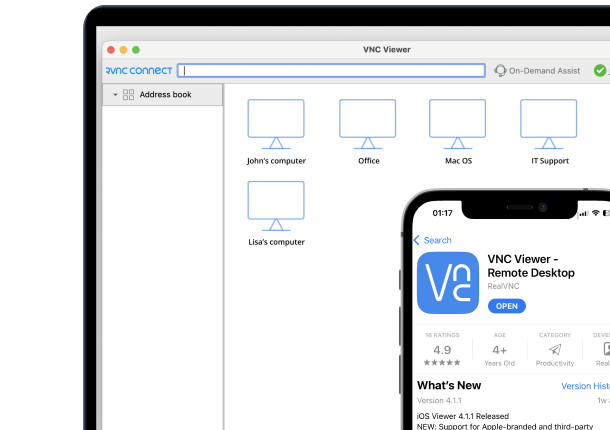
RealVNC Connect supports controlled industrial support workflows with multi-factor authentication (MFA) and single sign-on (SSO) through Microsoft Entra ID or Okta on Enterprise plans, strengthening identity assurance before a session begins. Role-based access controls (RBAC) and granular action-based permissions let administrators separately control keyboard, mouse, and file-transfer activity according to approved support roles. Session monitoring, session recording, and detailed audit logs provide reviewable records of remote-support activity. Code Connect supplies single-use nine-digit session codes for attended third-party access, without creating standing credentials for every supplier engagement.
Those records map to the access principles in the Federal Energy Regulatory Commission’s CIP audit lessons: document access rationale and deny unapproved permissions by default. They also fit the crosswalk approach described by NIST CSF 2.0 Informative References, where one evidence record may relate to several control outcomes.
RealVNC Connect strengthens access-control evidence; it does not replace OT segmentation, engineering safeguards, or regulatory interpretation. Your organization remains responsible for connecting each remote-support record to the applicable control owner, asset scope, and assurance requirement.
Final Words
Industrial cybersecurity compliance standards work when leaders turn overlapping obligations into a control model that plant teams can operate and auditors can inspect. Start with applicability, then use IEC 62443 and NIST SP 800-82 Revision 3 to ground engineering decisions, while NIS2, NERC CIP, and contractual duties define the obligations that apply to your organization. NIST Cybersecurity Framework 2.0 gives those efforts a shared governance language, so one control record can serve several relevant requirements without pretending every framework is interchangeable.
The payoff is clearer decision rights when an asset changes, a supplier needs urgent support, or an exception reaches a legacy system. Your teams need to connect each control to an accountable owner, approved asset scope, and evidence that it operated in practice. RealVNC Connect contributes to that evidence through role-based access controls, session monitoring and recording, detailed audit logs, and Code Connect time-bound session codes for attended third-party access. These records strengthen remote-support oversight, while segmentation, engineering safeguards, and regulatory interpretation remain your responsibility. Arrange a meeting to assess how RealVNC Connect can strengthen controlled remote-access evidence across your industrial support workflows.
FAQs
What framework connects OT requirements to business risk?
Industrial cybersecurity compliance standards are best managed through a layered control model rather than a single framework. NIST Cybersecurity Framework (CSF) 2.0 gives executives a shared language across Govern, Identify, Protect, Detect, Respond, and Recover, while ISA/IEC 62443 provides requirements and processes for secure industrial automation and control systems. Together, they connect business risk, governance decisions, and plant-level safeguards without treating the frameworks as interchangeable.
What is the difference between NIS2 and IEC 62443?
NIS2 establishes cybersecurity and management-accountability duties for entities within its scope, while IEC 62443 addresses secure industrial automation and control systems. The European Commission’s NIS2 Directive covers sectors including energy, transport, manufacturing, and water, subject to national transposition and entity classification; ISA/IEC 62443 provides an industrial security baseline. An organization may use IEC 62443 practices within its risk program, but it must assess NIS2 applicability separately.
Which industrial obligations apply to remote vendor access?
Remote vendor access requires named users, documented approval, limited permissions, revocation, monitoring, and retained evidence, although the exact obligation depends on sector and jurisdiction. FERC’s CIP audit lessons emphasize recording inbound and outbound permissions, documenting the reason for access, and denying other access by default. NIST SP 800-82 Revision 3 addresses remote access within the operational requirements of industrial control systems.
What are the typical compliance standards for cybersecurity?
Typical programs combine an OT engineering reference, a governance framework, and any binding sector or legal requirements that apply to the organization. Common examples include IEC 62443, NIST SP 800-82, NIST CSF 2.0, ISO/IEC 27001, NIS2, and NERC CIP; their roles and scope differ. NIST’s CSF 2.0 Informative References support crosswalks between control categories and other standards, but a crosswalk does not establish automatic legal compliance.
How does RealVNC evidence controlled OT support activity?
RealVNC Connect contributes remote-support evidence through role-based access controls (RBAC), session monitoring, session recording, and detailed audit logs. Code Connect provides single-use, time-bound session codes for attended third-party access, while granular action-based permissions separately control keyboard, mouse, and file-transfer activity. These records support access governance and control mapping, but they do not replace OT segmentation, engineering safeguards, or regulatory interpretation.