


A growth plan lands on the leadership agenda, but the technology choices behind it remain scattered across teams. Funding then follows the loudest request, so dependencies surface late and delivery slows.
Developing an enterprise architecture strategy means turning business objectives into a governed set of technology and change decisions. It defines the target state, the routes to reach it, the constraints that apply, and the trade-offs leaders accept when allocating scarce investment capacity.
This article explains how to assess the current operating model, define a credible target architecture, compare options by benefit, effort, and risk, and govern transition work through an adaptable roadmap.
What makes an EA strategy a business decision system?
An enterprise architecture (EA) strategy gives leaders a repeatable way to decide which technology changes deserve funding, which constraints apply, and who owns the trade-offs. It connects business outcomes to capability choices, architectural guardrails, investment sequencing, and accountable governance.
The shift matters: technology portfolios now shape how revenue is created and delivered. IDC’s 2023 FutureScape predictions projected that digital products, services, and experiences would generate 40% of G2000 revenue by 2026. Those investments lack shared decision rights, so teams fund local improvements and enterprise dependencies arrive late.
Think of EA as a city plan. It coordinates zoning, utilities, and staged development without dictating every building design. Stéphane Vanrechem, a Forrester senior analyst, and Charles Betz, Forrester’s VP and principal analyst for enterprise architecture (Forrester).
Which forces raise the stakes for architecture?
- Digital revenue dependence: Product, service, and customer-experience investments require shared data, application, and infrastructure decisions.
- AI and data governance: Teams need defined ownership for data use, model-related workloads, and the controls that govern them.
- Technology debt accumulation: Local workarounds become enterprise constraints when they affect integration, service continuity, or change cost.
- Funding conflicts: A common decision process lets leaders compare capability value against effort and uncertainty before budgets are committed.
| Legacy Architecture Role | Decision-System Role | Executive Consequence |
|---|---|---|
| Maintains technical diagrams | Links capabilities to investment choices | Funding follows business outcomes |
| Reviews solutions late | Sets decision rights before delivery | Fewer late-stage reversals |
| Records standards | Defines guardrails and exception paths | Teams know when escalation is required |
| Reports technology status | Tests transition outcomes against intent | Portfolio decisions stay accountable |
How do leaders frame an enterprise architecture strategy?
Developing an enterprise architecture strategy starts by defining the outcome leaders need, the capabilities required to achieve it, the guardrails that shape choices, and the transition states that make progress usable. Frameworks provide structure for this work, but they do not decide what your organization will fund, defer, or stop.
The four-part model keeps strategy grounded in decisions rather than documentation. It gives business and technology leaders a common way to discuss the target operating model: how work, information, systems, and infrastructure must work together to deliver the intended result.
- Outcome: State the measurable business result and the conditions that define success.
- Capabilities: Identify what the organization must be able to do end to end.
- Guardrails: Set principles, constraints, decision rights, and appetite for uncertainty.
- Transitions: Sequence complete increments that deliver usable value before the final target state.
Define outcome and capability boundaries
Start with the value at stake, then map the business capabilities that produce it. A capability is a durable ability, such as resolving customer issues across channels, rather than a project, application, or team structure. That distinction prevents leaders from treating a software replacement as the outcome when the real need is faster, more consistent service.
Business capability mapping makes dependencies visible before platform debates begin. McKinsey & Company advises leaders to prioritize modernization in domains where architecture decisions create the greatest competitive advantage and business impact. The practical test is simple: if a proposed investment cannot name the capability it improves and the outcome it changes, it is not ready for portfolio priority.
Set guardrails and transition states
Architecture principles turn broad intent into rules teams can use when making design choices. The Open Group defines principles as “the underlying general rules and guidelines for the use and deployment of all resources and assets across the enterprise” in the TOGAF Standard, 10th Edition. Principles need owners, a defined exception route, and a link to actual investment decisions.
Transition states stop a roadmap from becoming a distant end-state drawing. They define interim operating points where a capability is complete enough to use, measure, and govern. The TOGAF Standard, 10th Edition Downloads make implementation governance and architecture change management explicit parts of the Architecture Development Method (ADM), which helps teams revisit assumptions as delivery changes the available evidence.
| Framework Dimension | Executive Question | Primary Artifact | Evidence Source | Common Misread |
|---|---|---|---|---|
| Outcome | What business result must change? | Outcome statement | Performance baseline | A target is a strategy |
| Capabilities | What must the enterprise do well? | Capability map | Operating-model analysis | Applications equal capabilities |
| Guardrails | Which choices require consistency? | Principles and decision records | Constraints and decision rights | Standards alone govern behavior |
| Transitions | What usable value arrives first? | Roadmap and work packages | Dependencies and delivery confidence | The final target is the only value point |
TOGAF provides an iterative method for developing and governing architecture. Zachman helps organize descriptions across stakeholder perspectives. Use either framework only where it improves decision clarity; neither replaces the leadership work of choosing an outcome, setting boundaries, and accepting trade-offs.
Which decisions turn strategy into a roadmap?
)
An architecture roadmap becomes executable when leaders validate the current problem, compare options on consistent terms, and fund complete capability increments. The sequence must show where value arrives, what dependencies must be addressed first, and which assumptions need review before the next transition.
Begin with evidence rather than a preferred solution. A customer-service team may report slow resolution times, yet the root cause could sit in fragmented customer data, unclear handoffs, overlapping applications, or unmanaged remote support access. Treating the first visible symptom as the gap sends investment toward a local change that leaves the operating problem intact.
- Business capability contribution: Define the end-to-end outcome the work must deliver, rather than funding isolated technical components.
- Root-cause gap validity: Test assumed deficiencies across the operating model, value chain, data, applications, infrastructure, and relevant control requirements.
- Benefit, effort, and uncertainty: Compare options with consistent assumptions about expected value, delivery work, and confidence in the estimate.
- Transition-state completeness: Fund increments that produce usable outcomes, rather than partial changes that add dependencies without delivering value.
- Dependency and resilience exposure: Identify integrations, data flows, service criticality, regulatory constraints, and continuity implications before sequencing work.
| Decision Criterion | Leadership Signal | Decision Supported | Common Error |
|---|---|---|---|
| Capability contribution | Clear outcome owner | Whether to fund the change | Funding a component without a business result |
| Gap validity | Evidence across affected domains | Whether the problem is correctly framed | Treating a symptom as the root cause |
| Benefit and effort | Comparable assumptions | Which option takes priority | Comparing estimates built on different scopes |
| Transition completeness | Usable outcome at each stage | How to sequence the roadmap | Stopping at technical deployment |
| Dependencies | Named owners and constraints | When work can begin | Discovering critical links during delivery |
A vendor-published example shows why application rationalization needs that discipline: Ardoq’s 2023 guide reports that Serta Simmons Bedding identified $5 million in cost-saving opportunities across its application set. That figure is an illustration, not a planning benchmark. Your decision case still needs a baseline, a stated scope, and confidence levels that make uncertainty visible.
Roadmaps work best when leaders treat them as design artifacts. Each review should ask whether the expected benefit remains credible, whether new dependencies alter the sequence, and whether the next transition still fits the organization’s stated appetite for uncertainty.
Where does EA strategy lose stakeholder support?
Stakeholder support weakens when architecture appears after the investment decision, speaks only in technical artifacts, or cannot show how its guidance changes a business outcome. Leaders earn trust when architecture teams bring options early, record trade-offs plainly, and make decision ownership visible.
The capability gap is a people issue. By 2026, enterprises that did not effectively address the talent and digital skills gap would constrain revenue-growth opportunities by 20%, according to IDC’s 2023 IT Industry FutureScape. Scarce expertise raises the value of reusable decision records. Teams cannot afford to rediscover the same architecture rationale in every initiative.
Assign decision rights before solution reviews
Define who owns principles, exceptions, investment sequencing, and solution conformance before a delivery team reaches formal review. Architecture governance works when it monitors and directs architecture-related work against agreed principles, standards, and roadmaps, as described in the TOGAF Standard, 10th Edition.
A solution review must validate a decision that was made earlier, not become the place where strategy is improvised. Centralized models suit organizations that need consistent controls across shared services. Federated models suit businesses with distinct delivery domains, provided the enterprise retains defined guardrails and escalation routes.
| Governance Model | Best-Fit Context | Implication |
|---|---|---|
| Centralized | Shared platforms and tightly controlled services | Consistency improves, but review capacity needs active management |
| Federated | Autonomous business domains with local delivery ownership | Local speed improves when enterprise principles remain explicit |
| Hybrid | Shared foundations with varied product or regional needs | Decision rights must distinguish enterprise rules from local choices |
Build credibility through reusable evidence
Credibility comes from showing the evidence behind a recommendation. Capability maps, baseline measures, exception records, and transition outcomes give leaders a traceable account of what changed and why. Forrester’s 2026 EA Awards call asks entrants to demonstrate outcomes, quantified benefits, baselines and actuals, governance artifacts, and decision records.
Charles Betz, Principal Analyst at Forrester, wrote: “Pragmatic architecture beats perfect architecture every time. The best EAs I have worked with think like trusted advisors, they show up early, and they connect technology choices to measurable business outcomes.” That is the operating standard: bring usable evidence before choices harden, then retain it so the next team starts from a stronger position.
What governance keeps architecture strategy adaptive?
Adaptive governance reviews the assumptions behind architecture decisions without reopening every decision from scratch. It sets a regular portfolio cadence for examining transition outcomes, approved exceptions, accumulated technology debt, and changes in business or regulatory conditions.
The goal is disciplined adjustment. Zachman-FEAC argued in 2026: “As we move into 2026, the role of enterprise architecture is no longer centered on documenting the enterprise. It is about governing autonomy, shaping decisions, and sustaining trust at scale.” Leaders need a governance model that gives delivery teams room to act and preserve the evidence needed to explain their choices.
- Framework theater: Detailed artifacts exist, but they do not change investment or delivery decisions.
- Fixed-target planning: The target state remains unchanged after market, technology, or regulatory conditions shift.
- Exception accumulation: Temporary deviations lack owners, expiry dates, compensating controls, or portfolio visibility.
- Outcome-free maturity: Teams score repository completeness instead of decision quality and transition results.
| Governance Failure Mode | Corrective Control |
|---|---|
| Framework theater | Require a decision record for material portfolio and design choices |
| Fixed-target planning | Review target assumptions at defined portfolio checkpoints |
| Exception accumulation | Assign owners, expiry dates, and review criteria to every exception |
| Outcome-free maturity | Measure transition outcomes against the original capability case |
A mature EA practice does not promise certainty. It makes uncertainty explicit, assigns decision rights, and gives leaders a defined point at which to revisit the roadmap.
How RealVNC Closes the Architecture Strategy Gap
)
Capability maps, principles, and transition roadmaps set the intended operating model. The gap appears when remote support, third-party remediation, or distributed operational work reaches production systems without the same decision rights and evidence trail that architecture governance requires. An architecture plan loses credibility when the work needed to maintain transition-state systems happens outside its documented controls.
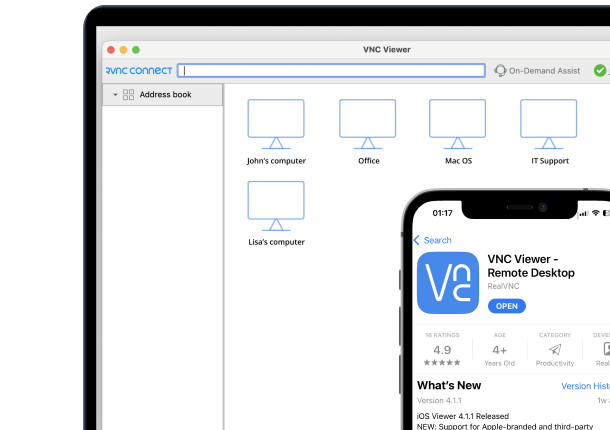
RealVNC Connect supports governed remote access as an adjacent operational control, rather than replacing enterprise architecture methods or portfolio governance. Its capabilities connect access activity to the decisions defined in architecture reviews:
- Role-based access controls and granular action-based permissions: Limit keyboard, mouse, and file-transfer actions according to operational roles and approved responsibilities.
- Multi-factor authentication (MFA) and single sign-on (SSO): Extend enterprise identity policy into remote-access workflows through Microsoft Entra ID or Okta on Enterprise plans.
- Session monitoring, recording, and detailed audit logs: Give authorized teams traceable evidence for solution reviews, exception management, incident follow-up, and audit preparation.
This matters during modernization work, when support teams often need access across old and new environments at the same time. RealVNC Connect gives architecture and operational leaders a practical way to connect remote-session permissions and records to the governance model already established for the transition. Controlled operations make it easier to show that remediation and privileged support follow the intended design rather than creating undocumented exceptions.
Final Words
Developing an enterprise architecture strategy connects outcomes, capabilities, decision rights, and transition states as delivery changes.
RealVNC Connect applies MFA, role-based access controls, and audit logs to governed remote operations. Arrange a meeting to explore how RealVNC Connect supports governed, audit-ready remote access across your architecture transition portfolio.
FAQs
What framework supports an enterprise architecture strategy?
Developing an enterprise architecture strategy usually combines TOGAF for iterative development and governance, the Business Motivation Model for linking goals to tactics, and capability maps for defining business priorities. These tools are complementary decision aids, not a mandatory single method.
How does TOGAF compare with Zachman for planning?
TOGAF provides a process for developing, governing, and evolving architecture. Zachman organizes architecture descriptions by stakeholder perspective. Organizations may combine them when the added structure improves decision clarity. (The Open Group; Zachman-FEAC)
What should an enterprise architecture strategy example include?
An example should connect a business outcome to required capabilities, decision guardrails, investment choices, and transition states. It should identify owners, dependencies, and the evidence used to review progress.
Which governance model fits a federated enterprise?
Federated governance fits organizations that need local delivery autonomy alongside enterprise guardrails. Decision rights, escalation routes, and exception records must remain explicit. (Forrester)
How does RealVNC Connect support architecture governance?
RealVNC Connect supports governed remote operations through multi-factor authentication, single sign-on, role-based access controls, and granular permissions. Session monitoring, recording, and detailed audit logs provide traceable evidence for support, remediation, and review workflows.