














RealVNC® ロゴマーク

RealVNC Viewer

生産性

アイコンクローズサークル

Still running RealVNC v5 or v6?
It hasn’t been patched in years.

Your RealVNC perpetual licenses still work, but they stopped getting security updates years ago, leaving your organization with unsupported, unpatched software. Here's how to fix that without starting over.

What a legacy install actually costs you

Security exposure

Versions 5 and 6 of RealVNC Connect stopped receiving security updates years ago. Vulnerabilities published since remain unpatched on any device still running them.

These flaws need local access to exploit rather than being reachable from the internet, but on a device that is already compromised they give an attacker a clear route to escalate.

Compliance and audit exposure

No single sign-on. No multi-factor authentication. No centralised or tamper-evident session audit. These are increasingly the exact controls that cyber insurers, SOC 2 and ISO audits, and sector regulators expect on any remote access tool. Without compensating controls, a legacy install is a common audit finding.

OS compatibility decay

Versions 5 and 6 pre-date Windows 11, Apple Silicon Macs and current Linux kernels. As you refresh endpoints, the old software works less reliably, and eventually not at all.

No support, no path forward

Without a maintenance contract there are no patches, no fixes and no one to call when something breaks. The estate only gets riskier the longer it runs.

Secure every device, control every connection

Current RealVNC Connect gives you the security updates, modern
authentication, and central management that versions 5 and 6 simply can't.

Ongoing security updates and active support

Single Sign-On and multi-factor authentication

Central management and policy control across every device

Cloud connectivity, so new sites need no per-device firewall or VPN work

Session audit logging for incident response and compliance

The path forward

Modernise what you already own

This is not rip-and-replace. You keep using RealVNC, on the devices you already run it on, with the same core capability your teams rely on. What changes is that it becomes supported, secure, centrally managed, and sized to what you actually use today rather than the licence count from a decade ago.

Our team can help you map your current estate and plan a phased move, starting with the highest-risk devices. You go at your own pace.

CASE STUDY

You're not the first to make this move

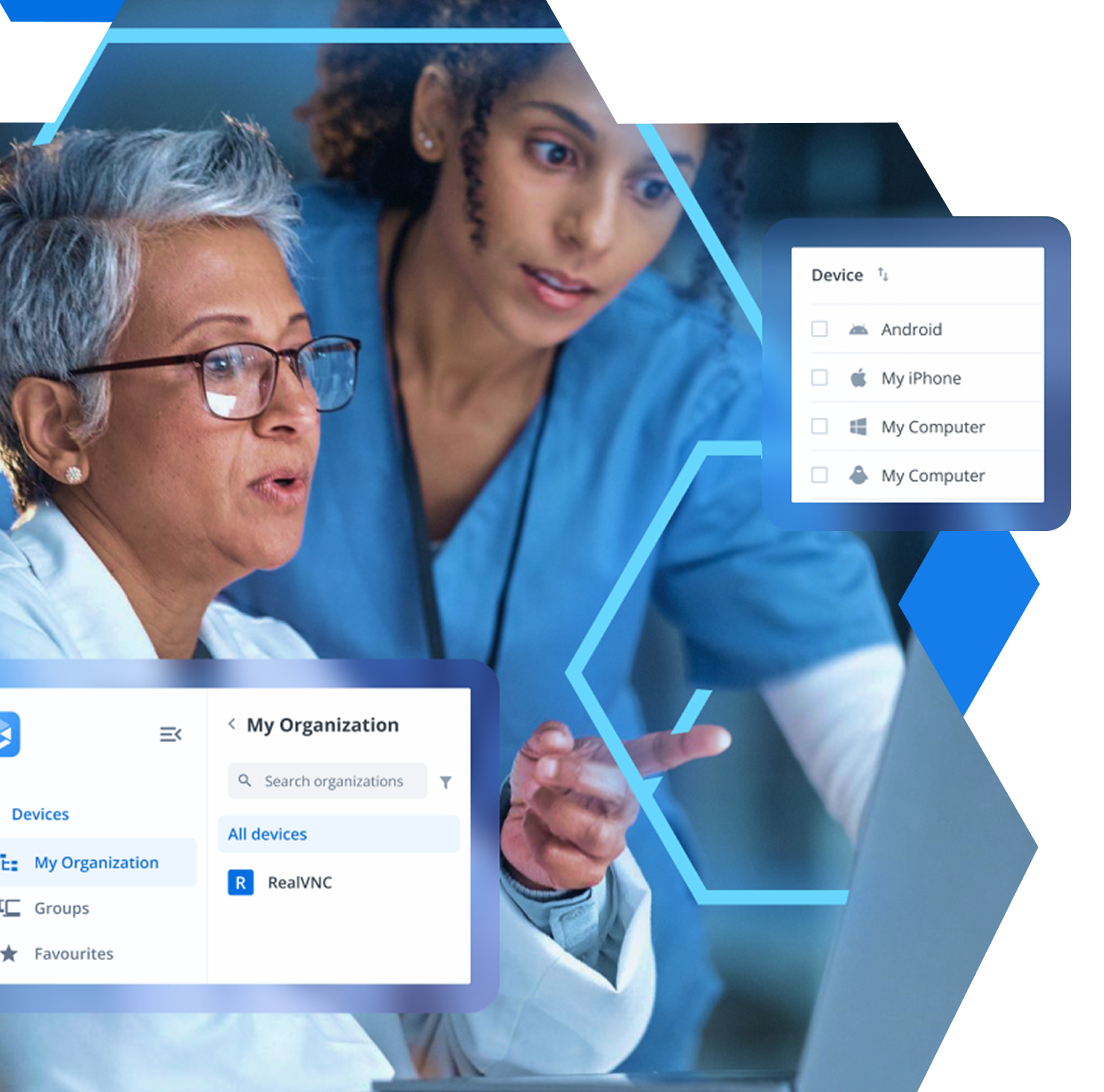
One healthcare group recently modernised a legacy perpetual estate of 8,000 devices. There was no rip-and-replace.

Their team rolled out the current Viewer and Server using standard deployment tools, pushing the installers and licence key through MSIs and Group Policy Objects, with command-line token deployment available where they needed it. The software they already relied on, brought up to date and supported, across thousands of machines.

CASE STUDY

You're not the first to make this move

One healthcare group recently modernised a legacy perpetual estate of 8,000 devices. There was no rip-and-replace.

Their team rolled out the current Viewer and Server using standard deployment tools, pushing the installers and licence key through MSIs and Group Policy Objects, with command-line token deployment available where they needed it. The software they already relied on, brought up to date and supported, across thousands of machines.

Frequently asked questions

If you can’t find an answer to your question, please visit our Help Center or get in touch with us.

Yes. Perpetual licences do not stop working. The issue is that versions 5 and 6 are no longer supported or updated, so any flaw found since your version shipped stays unpatched.

There are documented, published vulnerabilities affecting those versions that remain unpatched. They require local access rather than being remotely exploitable, but on a device that is already compromised they give an attacker a straightforward way to escalate. Combined with the lack of modern authentication and audit logging, it is a gap most security and audit teams want closed.

You get ongoing security updates, single sign-on and multi-factor authentication, central management, cloud connectivity that removes per-device firewall work, and session audit logging. Plus support when you need it.

It is sized to the devices nd number of active connections you actually use today, which is often far fewer than the original licence count. Talk to us and we will give you a clear quote based on your real estate.

No. Most organisations phase it, starting with the highest-risk devices such as those that are internet-facing or used by privileged accounts. You keep what works and move at your own pace.

Trusted by leading IT teams worldwide

philips
intel
animazione dreamworks
conchiglia
nasa
ibm
遠隔患者モニタリングからスマートピル、デジタルツインまで、医療におけるIoTアプリケーションは、医療の提供、追跡、改善の方法を再定義している。ここでは、接続デバイスが安全かつ効率的に医療の未来を再構築している様子をご紹介します。...

  TightVNCとRealVNCはどちらも2000年代初頭に誕生しました。それ以来、両者は全く異なる2つの道を歩んできました。どちらのVNCソリューションも、リモートデスクトップアクセスをシンプルにするとい … 続きを読む

...

Splashtopは、ユーザーが別のデバイスからコンピュータにアクセスできるようにする、一般的に使用されているリモートデスクトップソリューションです。PCネットワークへのリモートビジネスアクセスを求める企業や、信頼性の高 … 続きを読む

...
最適なVNC Server選定のためのガイドです。TightVNCからRealVNC Connectまで、主要なリモートデスクトップツールを比較し、TLS暗号化、中央管理制御、コンプライアンス対応などの機能を整理しています。レガシーシステム、最新デバイス、エンタープライズ規模の導入に適したソリューションを把握できます。...

リモート・セッションを台無しにする最も手っ取り早い方法は何だろう?フリーズしたり、もたついたり、見せるつもりのないものが点滅したりする、不便な画面共有体験だ。 Windowsを使うなら、画面共有はギャンブルではなく、シー … 続きを読む

...
G2 Reviews

4.7 stars, 400+ reviews

Top 50 IT Management Products 2020

Capterra Review

4.5 stars, 100+ reviews

Remote Access & Support Shortlist 2024